UNESCO World Heritage Sites in Armenia
Armenia has three UNESCO World Heritage sites: Haghpat and Sanahin, Geghard, Echmiatsin with Zvartnots. What is inscribed, what is not, how to visit.
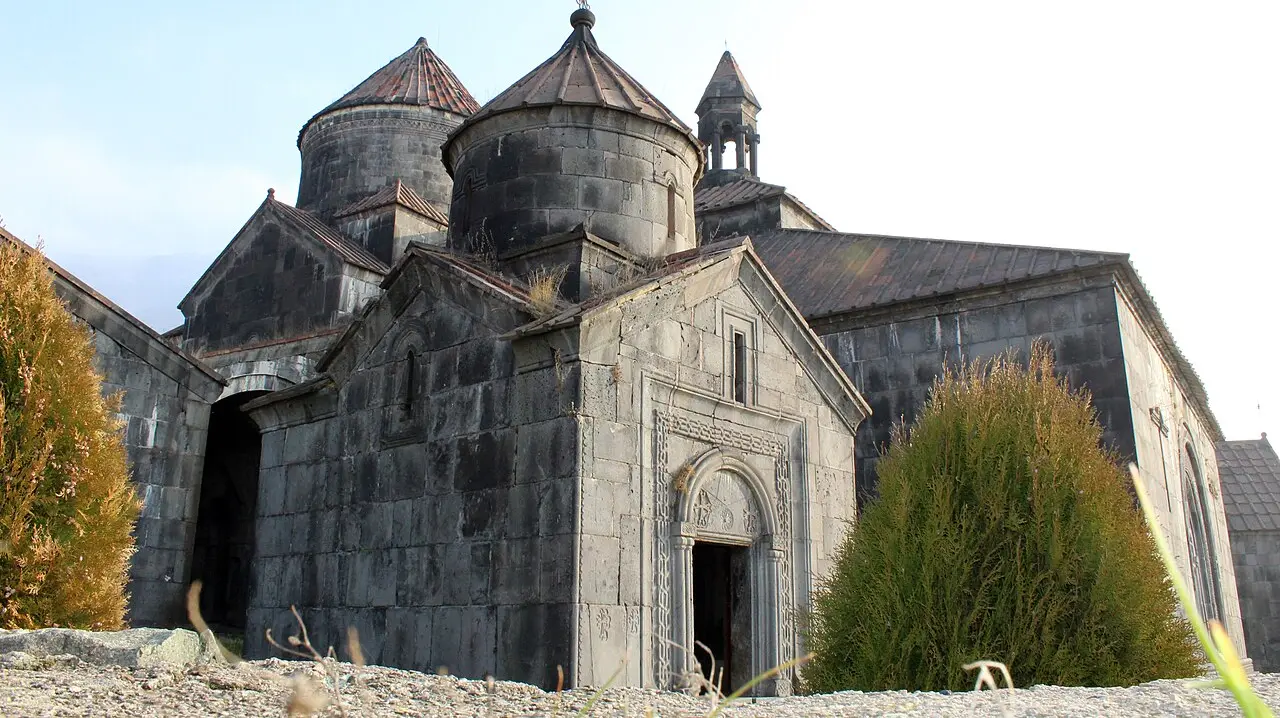
Armenia has three UNESCO World Heritage sites, all cultural, and between them they cover six separate places: the Monasteries of Haghpat and Sanahin in the north, the Monastery of Geghard and the Upper Azat Valley east of Yerevan, and the serial property of the Cathedral and Churches of Echmiatsin and the Archaeological Site of Zvartnots on the Armavir road. Two of the three are within an hour of the capital. The third is a long day north, or better, an overnight.
The more useful half of this page is what’s not on the list. Garni, Noravank, Tatev and the Areni-1 cave all appear in “UNESCO Armenia” search results and none of them is inscribed; they sit on the country’s tentative list, which is a queue, not a status. Knowing the difference stops you paying for a “UNESCO tour” that mostly isn’t one.
The three inscriptions, in the order they were listed
Armenia acceded to the World Heritage Convention by succession on 5 September 1993, and the country’s first inscription followed three years later. This is the UNESCO frame rather than a ranking; if you want the sites weighed against each other, our guide to the best monasteries in Armenia argues which ones repay the drive, and the register of 20 monasteries by region gives distances and entry costs across the whole country.
1. Monasteries of Haghpat and Sanahin (1996, extended 2000)
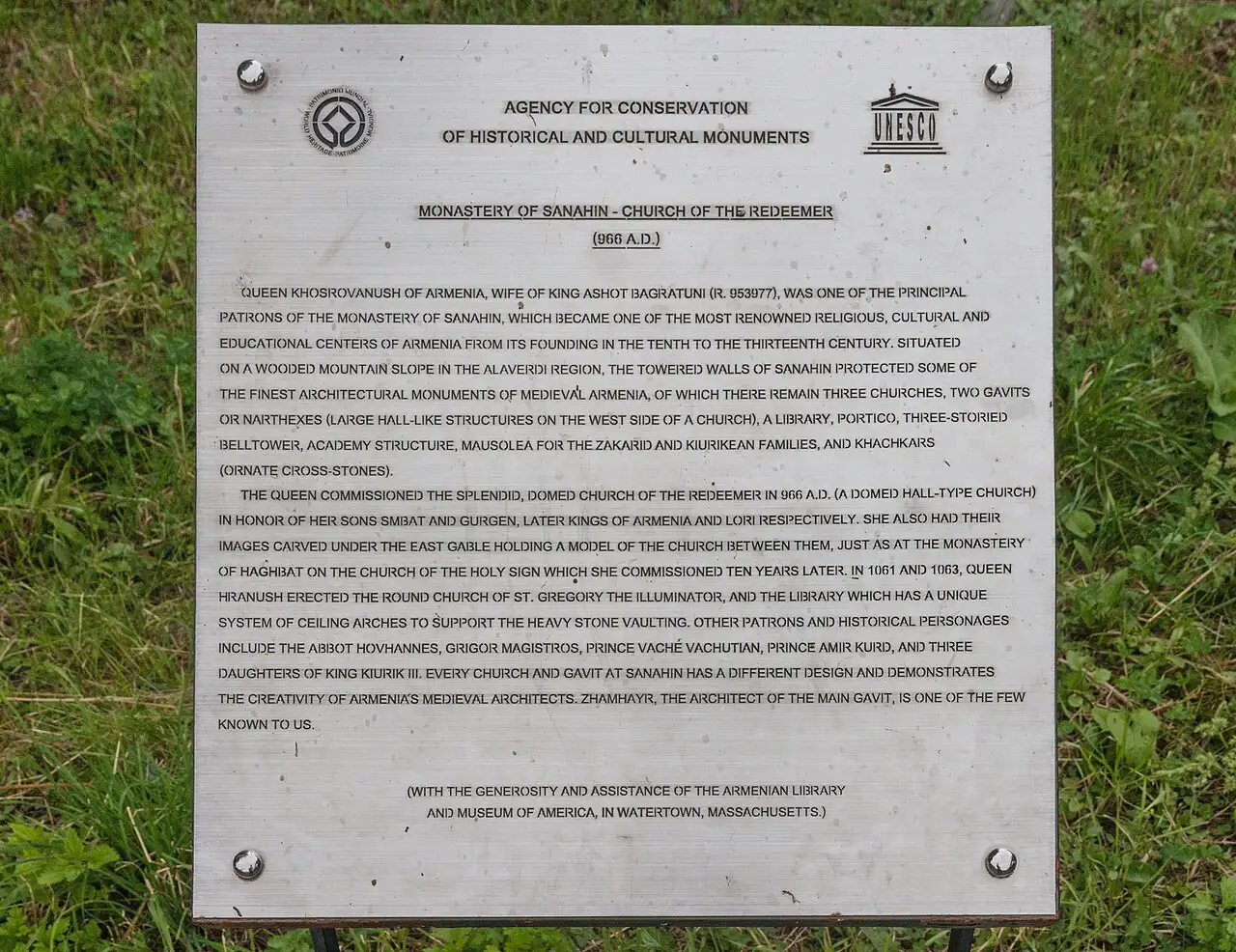
Inscribed in 1996 under criteria (ii) and (iv), with a significant boundary modification in 2000. It’s a serial property: two monasteries a few kilometres apart in the Lori region, both perched on the wooded slopes high above the Debed canyon, reached off the same gorge road.
UNESCO’s case for them is architectural. Both complexes date from the 10th to 13th centuries, the prosperous period of the Kiurikian dynasty, and they represent what the citation calls the highest flowering of Armenian religious architecture, a style formed by blending Byzantine church design with the vernacular building of the Caucasus.
The dates worth carrying in your head at Haghpat: the monastery was founded in AD 976 by Queen Khosrovanush, wife of King Ashot III the Merciful. The oldest building, St Nshan church, went up between 976 and 991 under the architect Trdat, the same man later called to rebuild the dome of Hagia Sophia after the earthquake of 989. Look on the upper part of the east facade for the bas-reliefs of kings Smbat and Gourgen holding a model of the church between them. The narthex was added in the second decade of the 13th century by Princess Mariam, and Abbot Hamazasp’s building of 1257 is the largest of its type in the complex, a square hall on four columns with a smoke hole in the roof. The approaches were watched from Kayanberd fortress, built in the 13th century for exactly that purpose.
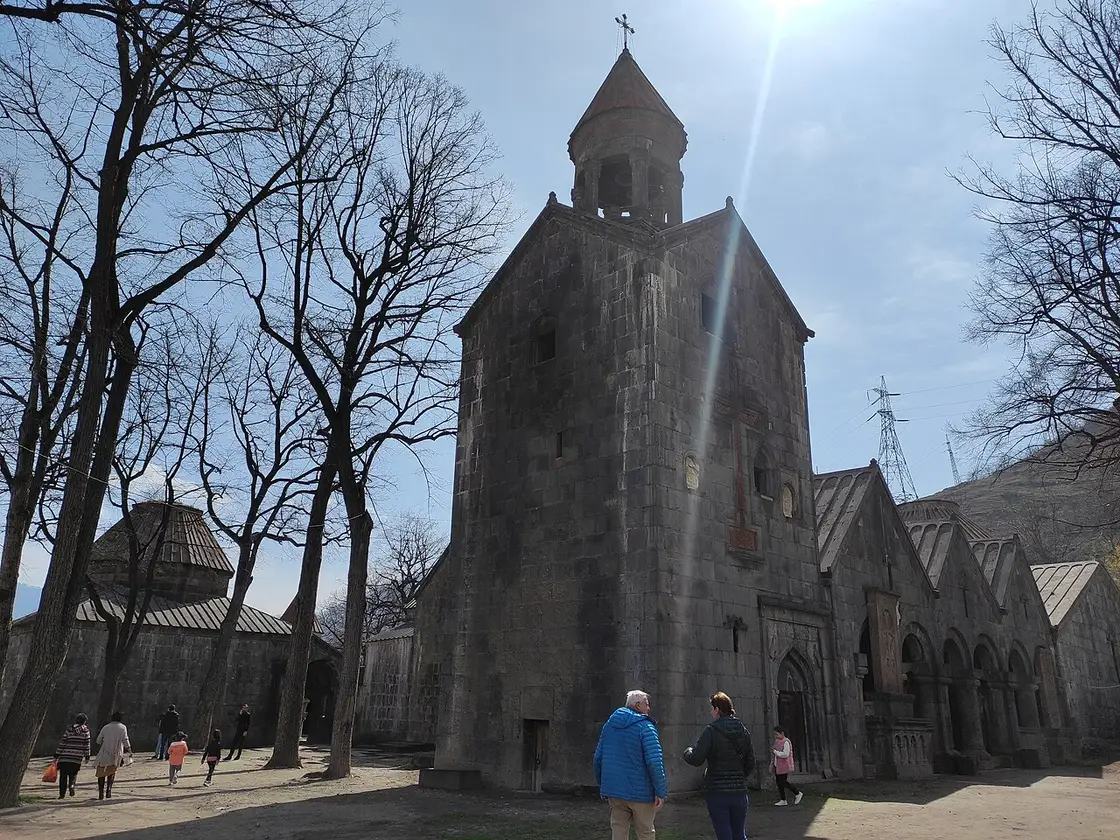
Sanahin, twenty minutes away by road, was the scholarly one: a famous school of illuminators and calligraphers, with an academy gallery whose stone arcade you can still walk. Practically, the two are a pair, and you won’t want to visit one without the other. Our guide to northern Armenia, Lori, Haghpat and Sanahin covers the drive, the canyon and what else is up there.
2. Monastery of Geghard and the Upper Azat Valley (2000)
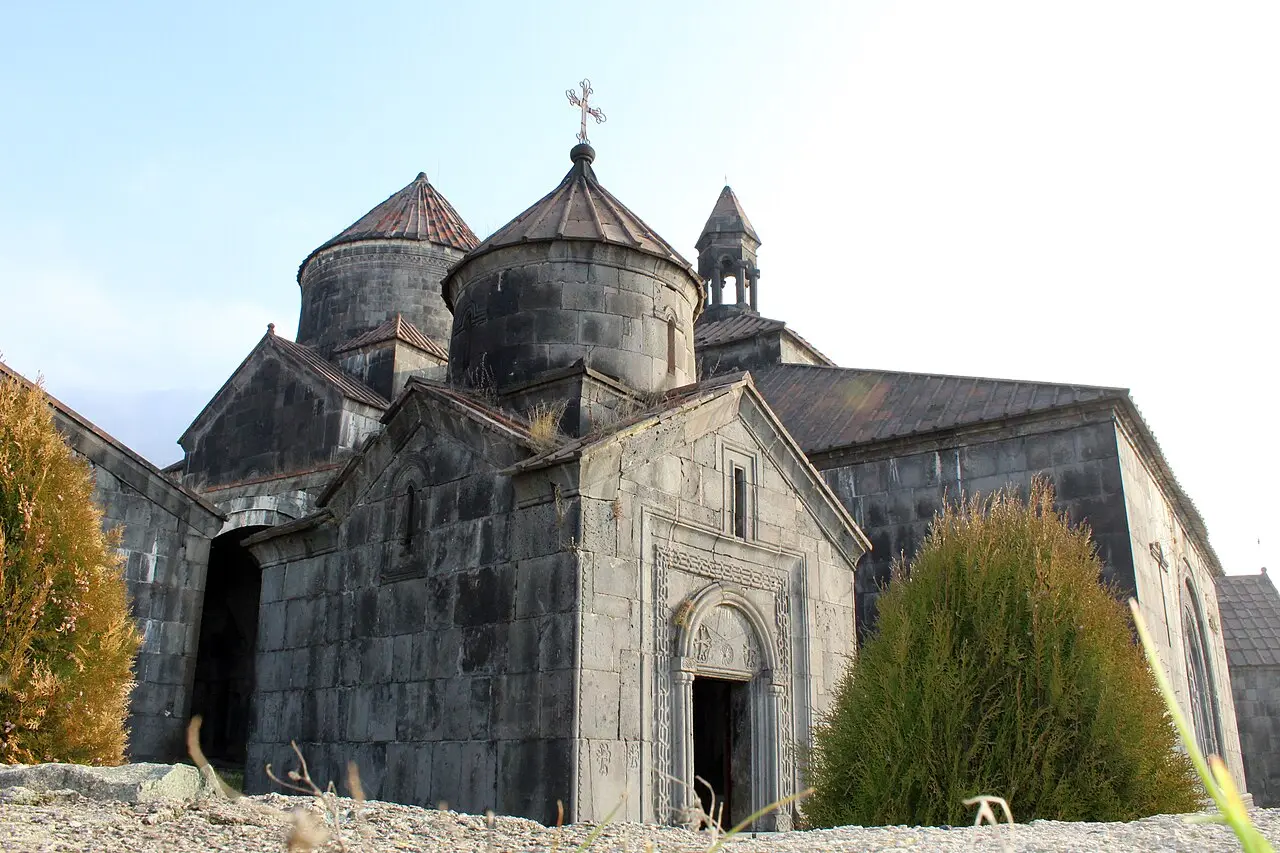
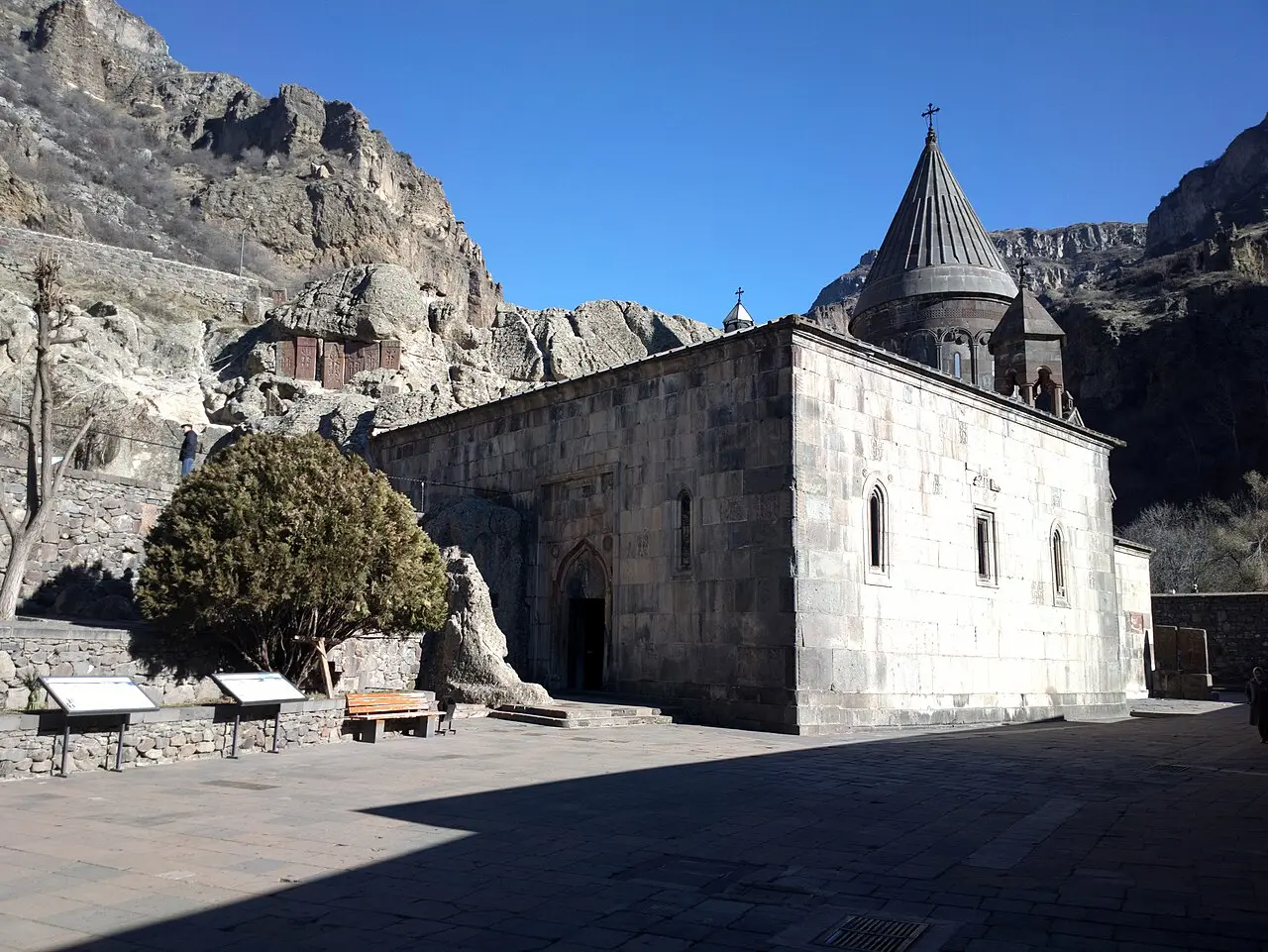
Inscribed in 2000 under criterion (ii) alone, in Kotayk near the village of Goght, at the head of a steep gorge where the Azat river comes down out of the mountains. The monuments span the 4th to the 13th century.
The thing that makes Geghard extraordinary is that much of it’s not built at all, it’s carved out of the cliff. Its early name was Ayrivank, “monastery in the cave”, and tradition credits its founding to St Gregory the Illuminator in the early 4th century, right after Christianity became the state religion. The main complex was finished in the 13th century: the Kathoghike, its gavit, two rock-cut churches, and the tomb of the Proshyan princes. The first rock-cut church was cut before 1250; the second in 1283. Outside the ramparts, the partly hewn chapel of St Astvatsatsin carries inscriptions dated 1177 and 1181, the oldest surviving on the site. Most of the monks lived in cells excavated straight into the rock face.
Go for the acoustics as much as the architecture. In the rock-cut chambers a single voice carries in a way no built church manages, and if a choir happens to be singing when you walk in, that’s the memory you’ll keep. Geghard pairs with the Greco-Roman temple at Garni half an hour down the same valley; see our guide to Garni temple and Geghard monastery for the half-day.
3. Cathedral and Churches of Echmiatsin and the Archaeological Site of Zvartnots (2000)
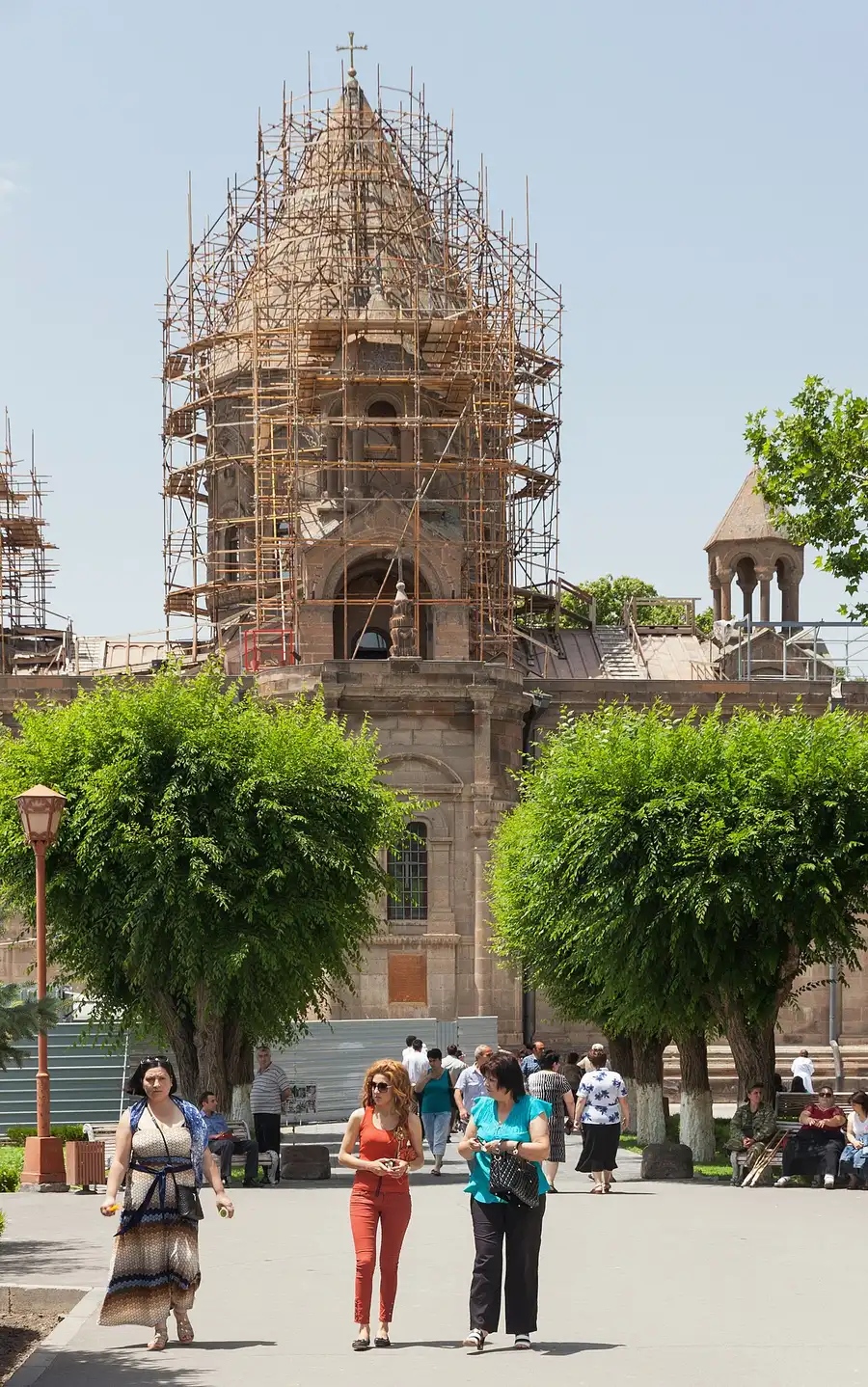
Also inscribed in 2000, under criteria (ii) and (iii), and the largest of the three at 74.3 hectares. It’s a serial property in three separate areas: the Mother Cathedral with St Gayane (about 30 ha), the churches of St Hripsime and St Shoghakat (about 25 ha), and the archaeological site of Zvartnots (about 19 ha) a few kilometres away towards Yerevan.
The headline fact is the age. The Cathedral of Echmiatsin was built in AD 301-303 by King Trdat III and St Gregory the Illuminator, immediately after Armenia adopted Christianity as a state religion, which makes it the earliest domed church anywhere and, by most reckonings, the oldest cathedral in the world. Its cruciform plan with four apses and a central dome on four pillars is what UNESCO singles out as Armenia’s structural contribution to Christian architecture generally, an idea that travelled to Byzantium and on into Europe. The painted interior frescoes came much later, from 1712 to 1721.
The town under it’s older still. The oldest written reference is an Urartian cuneiform inscription of King Rusa II (685-645 BC), where the settlement appears as Kuarlini; it was Vagharshapat under King Vagharsh I Arshakuni (AD 117-140), and the name Echmiatsin came into use only after AD 301.
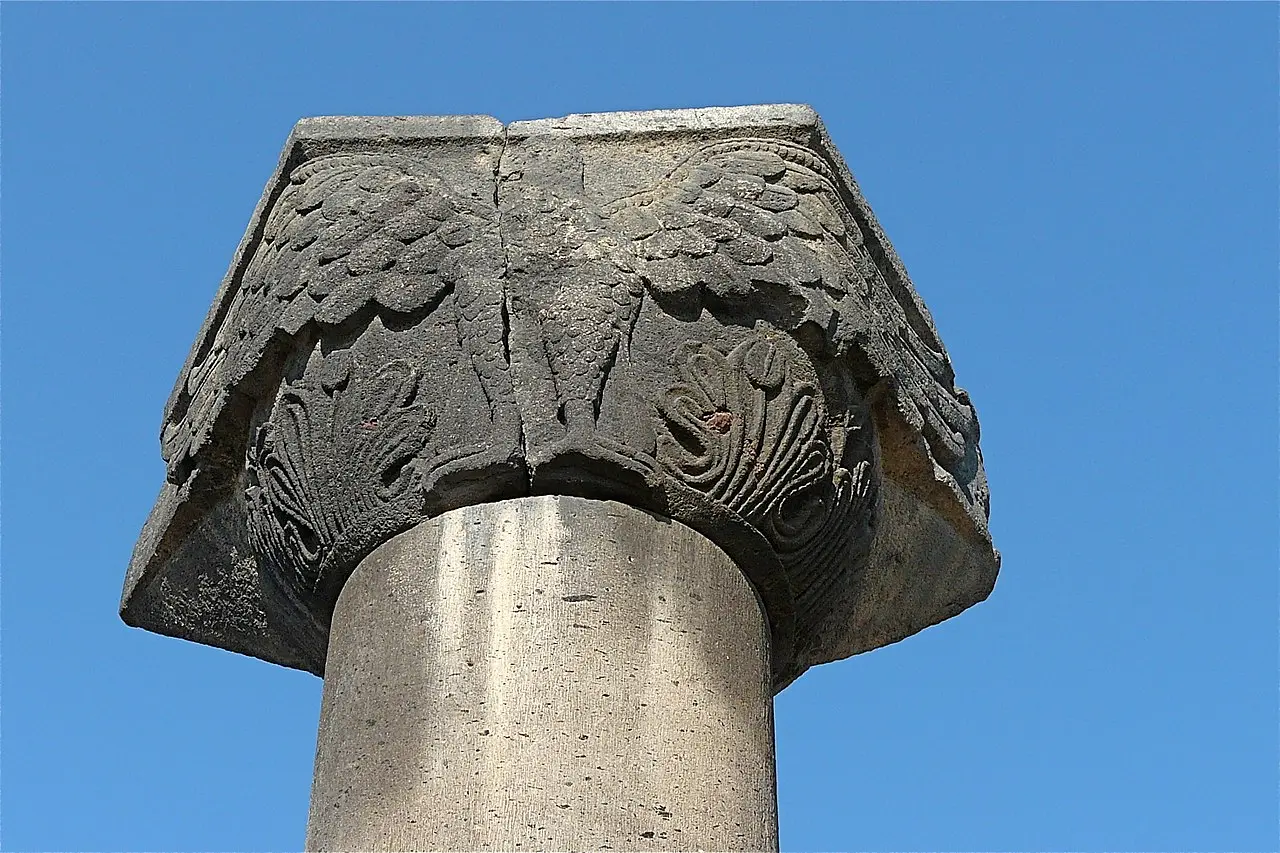
Zvartnots, the third area, is the ruin that repays the ticket: a vast round 7th-century cathedral that collapsed, leaving a circular footprint, one re-erected column and a field of carved capitals. It’s a strange, moving place precisely because so little of it is still standing. Our separate guides cover Echmiadzin Cathedral, the Zvartnots ruins and the town of Vagharshapat in detail.
What is not inscribed, and what is queuing
Armenia keeps eight sites on its tentative list, the inventory a country submits of places it may nominate later. Being on it confers no status at all, which is worth knowing when a tour is sold as “UNESCO” and isn’t inscribed anywhere yet. The current list, with the year each entry was submitted:
- The archaeological site of the city of Dvin (1995)
- The basilica and archaeological site of Yererouk (1995)
- The monastery of Noravank and the upper Amaghou Valley (1995)
- The monasteries of Tatev and Tatevi Anapat and the Vorotan Valley (1995)
- The Vishaps and the Cultural Landscape of Tirinkatar (2024)
- The Archaeological Complex of Garni and the “Basalt Organ” columnar joint (2025)
- The Urartian Heritage of Yerevan (2025)
- Areni-1 (Birds’) Cave: Prehistoric Life and Winemaking in the Arpa River Gorge (2026)
Two things stand out. First, Noravank and Tatev have been sitting on that list since 1995 without moving, which tells you something about how slow the process is, not about how good they are; both are among the finest things in the country and our guides to Noravank and Tatev and the Wings of Tatev cableway explain why. Second, Armenia has been busy lately: three new entries in 2024, 2025 and 2026, including Garni, the Greco-Roman temple most visitors assume is already inscribed, and the Areni-1 cave, where the world’s oldest known winery was excavated. Our page on the Areni-1 cave covers that find.
The other UNESCO list, where Armenia stands out
World Heritage is only half of it. Armenia has eight elements on UNESCO’s Representative List of the Intangible Cultural Heritage of Humanity, and for a country of under three million that’s a striking tally. In order of inscription:
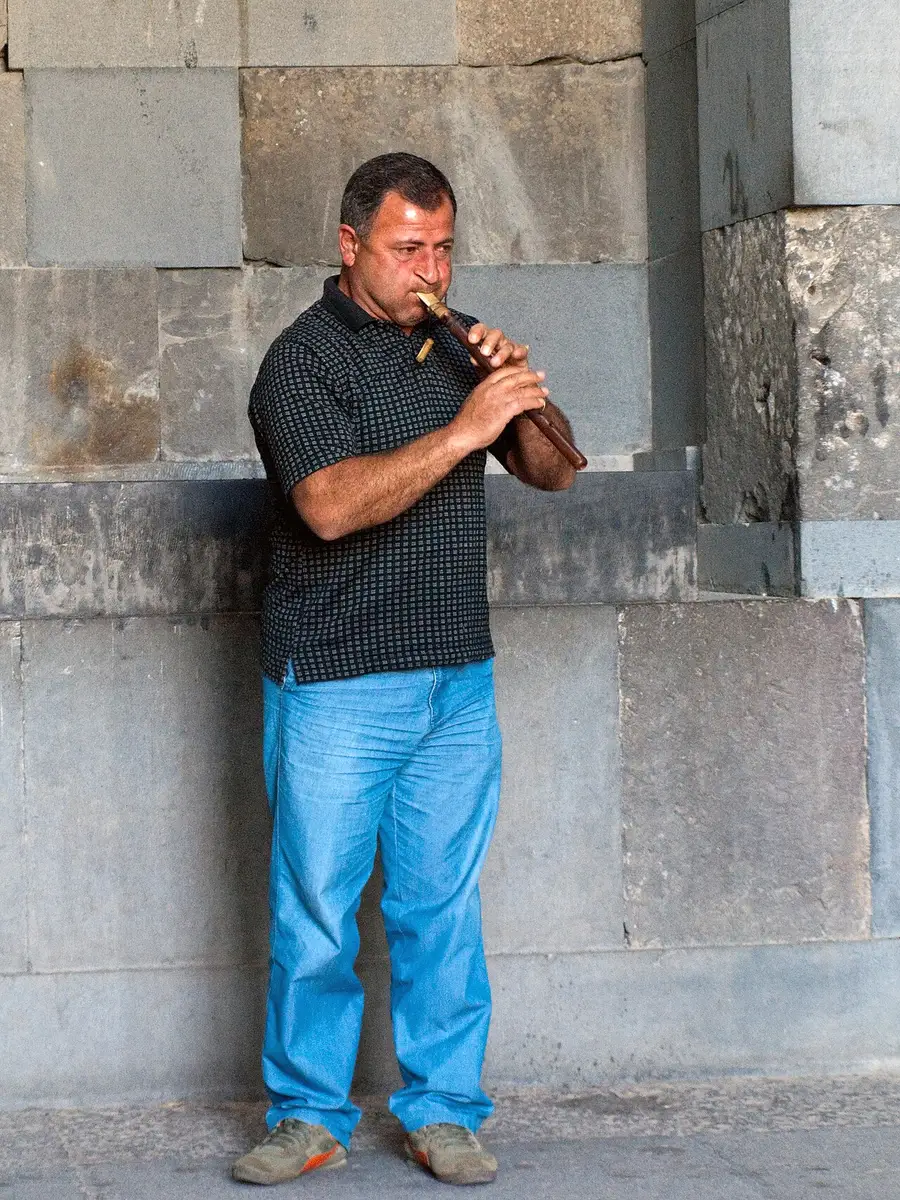
- Duduk and its music (2008) - the apricot-wood double-reed pipe, and the sound most people associate with Armenia
- Armenian cross-stones art: symbolism and craftsmanship of khachkars (2010)
- Performance of the Armenian epic of “Daredevils of Sassoun” (2012)
- Lavash: the preparation, meaning and appearance of traditional bread (2014)
- Kochari, traditional group dance (2017)
- Armenian letter art and its cultural expressions (2019)
- Pilgrimage to the St Thaddeus Apostle Monastery (2020)
- Tradition of blacksmithing in Gyumri (2023)
The practical version of that list: you can hear a duduk played live in half the restaurants in Yerevan, watch lavash slapped onto the wall of a tonir at Garni, and see hundreds of khachkars standing in the grounds of every monastery on this page, including the finest sets at Haghpat and Sanahin. It’s heritage you eat, hear and touch rather than queue for; our guide to Armenian dishes covers what to order, lavash included.
How to see all three
The geography is kind on two of them and unkind on the third.
One morning covers half the property list. Echmiatsin is about 20 km from Yerevan, Zvartnots about 15 km, and they’re on the same road; St Hripsime, St Gayane and St Shoghakat sit a few minutes apart in the same town. That takes in all three areas of the Echmiatsin and Zvartnots property, half the six inscribed places, in an unhurried half-day with lunch in Vagharshapat.
One afternoon covers Geghard, roughly 40 km east and an hour each way, ideally combined with Garni on the same run.
Lori is the commitment. Haghpat and Sanahin sit near the Georgian border, several hours north on the Debed canyon road, and doing them as a Yerevan day trip means most of the day in a car. Stay a night in the canyon instead, or fold them into an overland trip to or from Tbilisi, which is what they’re naturally on the way to - our Debed Canyon road trip lays out that two-day version stop by stop.
On tickets: the working churches, including Haghpat, Sanahin, Geghard and Echmiatsin, are free to enter, with a candle box rather than a booth. Zvartnots is the ticketed one, in the region of 1,300 to 1,500 dram when we last checked, and prices drift, so confirm at the gate. Dress as you would for any working church, shoulders and knees covered, and go early or late at Geghard, which fills with tour coaches in the middle of the day.
Photos
Read also

What to see · 10 min read
Soviet Modernist Yerevan: An Architecture Walk
Verified · September 5, 2026Walk Yerevan's Soviet modernism: Rossiya Cinema, Komitas Hall, Cascade, Hrazdan Stadium and Demirchyan Complex - dates, route order, and what still stands.

What to see · 9 min read
Kond: Walking Yerevan's Oldest Neighborhood
Verified · September 3, 2026Walk Kond, Yerevan's oldest living quarter: Surp Hovhannes, Tepebashi mosque walls, Leo Street alleys, and how to visit without treating it like a set.
What to see · 8 min read
Sardarapat Memorial: Armenia's 1918 Battle Site
Verified · August 31, 2026Sardarapat Memorial near Armavir: 1918 battle site, Israelyan's red-tufa complex, ethnography museum tickets, hours and how to reach it from Yerevan.
What to see · 12 min read
Goshavank Monastery & the Village of Gosh
Verified · August 29, 2026Visiting Goshavank: Mkhitar Gosh's law code that reached Poland, the 1291 embroidered khachkar, his statue and hillside tomb, and the drive from Dilijan.