Wings of Tatev & Tatev Monastery: Complete Guide
How to ride the Wings of Tatev, the world's longest reversible cableway, visit the clifftop Tatev monastery, and reach it from Yerevan or Goris.
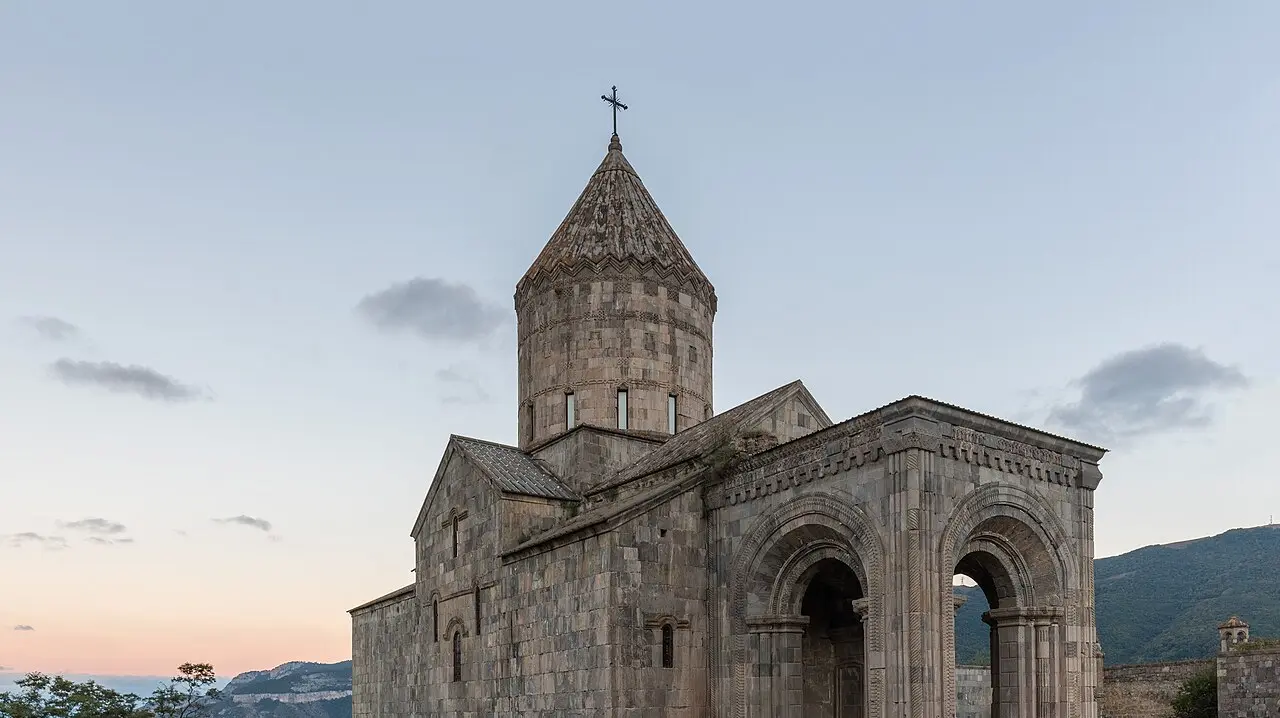
The Wings of Tatev is a cable car with a world record and a genuine reason to go: at 5,752 metres it’s the longest reversible aerial tramway ever built without a mid-way change, and it swings you from the village of Halidzor across the Vorotan gorge to the medieval Tatev monastery in about twelve minutes - a ride that replaces a white-knuckle forty-minute crawl down the serpentine road. The catch is distance: Tatev sits some 255 km south of Yerevan, a good four hours each way, so this is a full-day expedition rather than a lazy afternoon, and a night in Goris makes it far easier.
The essentials
- The cableway is closed on Mondays, in every season - it runs Tuesday to Sunday plus public holidays all year. Hours: 10:00-19:00 from May to September (last cabin 18:45), 10:00-18:00 in October and November and again in March and April (last cabin 17:45), and 10:00-18:00 in December, February and from 2 January (first cabin 10:30, last 17:30). Departures are every 15 minutes except in deep winter, when they stretch to every 30. Confirm the current timetable on tatever.am before committing to the drive.
- Tickets, from the operator’s tariff: a round trip is 9,000 AMD (about $24.50) from March to November and 5,500 AMD from December to February; one-way is 6,500 or 4,000 AMD; children up to 140 cm ride for 1,000 AMD. Buy at the Halidzor or Tatev office, or online.
- The ride takes about twelve minutes each way and climbs as high as 320 m above the floor of the gorge.
- Getting there: it’s 255 km and about four hours from Yerevan. A day trip is possible but a 10-to-15-hour slog, so sleeping in Goris (15 km from the Halidzor station) is the far better plan.
The Wings of Tatev: what the record actually means
Plenty of places call their cable car “the longest.” Tatev has the paperwork. On 23 October 2010 the Wings of Tatev entered the Guinness World Records as the longest non-stop double-track reversible aerial tramway, and sixteen years on it still holds the title. “Reversible” is the key word: two cabins run on a fixed pair of cables, one going up as the other comes down, shuttling back and forth rather than looping continuously. Spanning over five and a half kilometres in one unbroken run, with no mid-station where you swap cabins, is what makes it unusual.
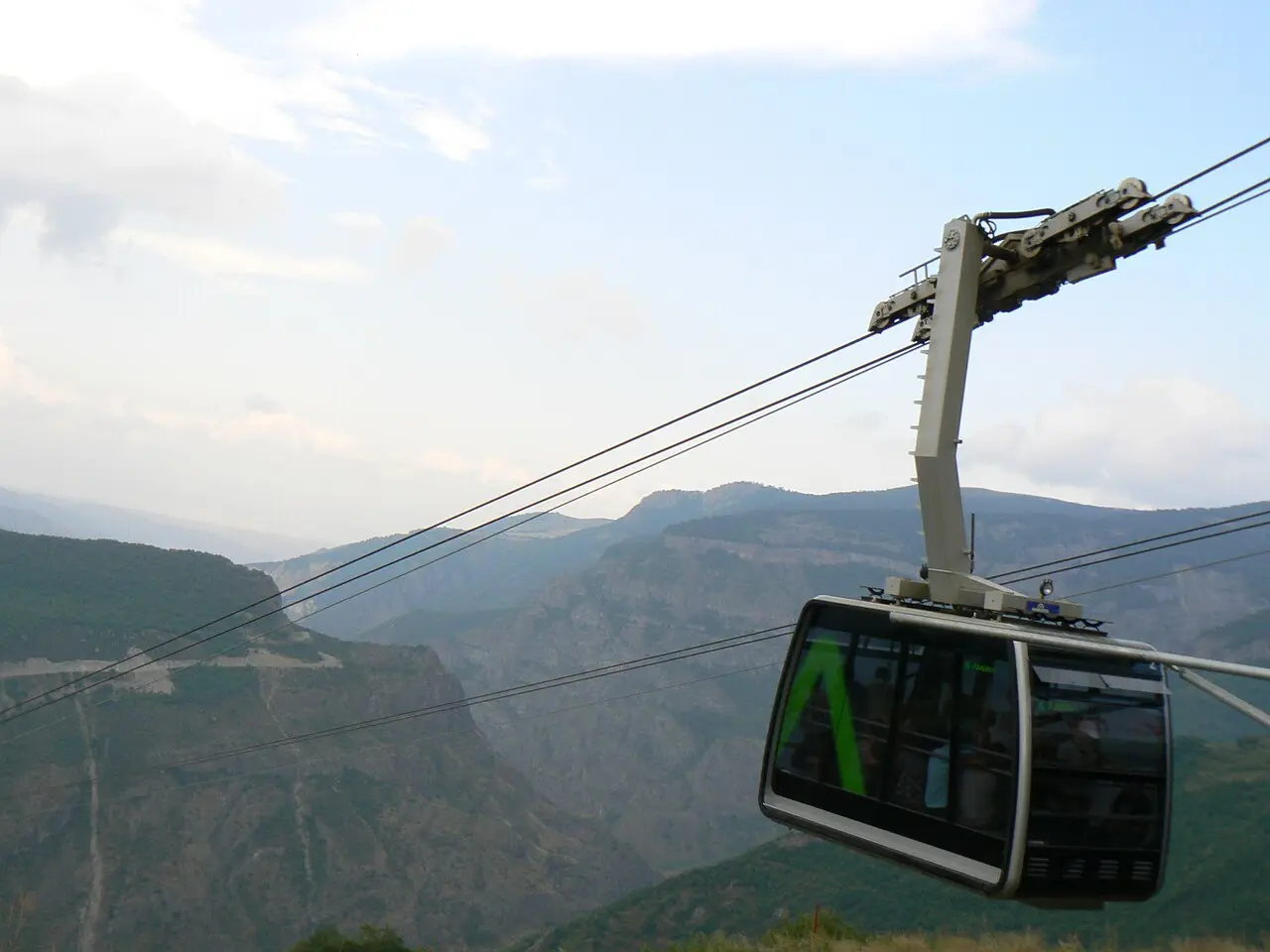
The numbers hold up in the cabin. Suspended from towers that split the route into four sections, you climb as high as 320 metres above the floor of the gorge, moving at roughly 37 km/h, with the Vorotan River a thread of water below and the monastery growing on its plateau ahead. Each cabin takes 25 passengers and an attendant, and the crossing runs eleven to fifteen minutes depending on the wind. It was built by the Austrian-Swiss Doppelmayr/Garaventa group as the centrepiece of the Tatev Revival Project - a non-commercial effort, started by Ruben Vardanyan and Veronika Zonabend, that funnels proceeds back into restoring the monastery and supporting the villages around it. So the ticket is also a small donation to the place you’ve come to see.
One honest word on nerves: the cabins are enclosed and steady, but if serious heights unsettle you, the middle of that gorge is a long way down and there’s nowhere to look but out. Most people find it exhilarating rather than frightening - but you can always take the road one way and the cable the other.
Tickets and opening hours
The cableway runs all year round, but it’s shut every Monday, summer included - the operator’s timetable reads Tuesday to Sunday and public holidays in every season. That single line catches more people than anything else on this page, so plan the long drive around it: arriving to a shut station after four hours on the road is a special kind of heartbreak, and it’s one a ten-second check before you leave avoids entirely. The hours then shift with the calendar, per the operator’s published schedule (read on 28 July 2026): May to September 10:00-19:00, with the last cabin at 18:45; October and November, and again March and April, 10:00-18:00, last cabin 17:45; December, February and from 2 January 10:00-18:00, first cabin 10:30 and last 17:30. Departures run every 15 minutes, stretching to every 30 in deep winter. Weather can add extra non-working days, so glance at the timetable on tatever.am before you commit to the drive.
Prices are seasonal too, straight from the operator’s tariff table: from March to November a round trip costs 9,000 AMD (roughly $24.50 at the Central Bank rate of late July 2026) and a one-way ride 6,500 AMD; from December to February it drops to 5,500 AMD return and 4,000 AMD one-way. Children up to 140 cm tall ride for 1,000 AMD in any season. Buy at the Halidzor or Tatev ticket office, or online at tatever.am - online booking is worth using on a busy summer weekend when queues build at the Halidzor base. One caveat: tickets are non-refundable, though unused ones can be exchanged for another date.
Tatev Monastery: a thousand years on the cliff
Step out of the cabin and there’s the monastery, spread across a basalt plateau on the lip of the Vorotan gorge. A monastery has stood here since the ninth century - the church of St Gregory the Illuminator went up in 848 under Prince Pilipos of Syunik - and for centuries this was the seat of the Bishop of Syunik and one of the most powerful religious centres in the whole of medieval Armenia, at its height overseeing hundreds of villages.
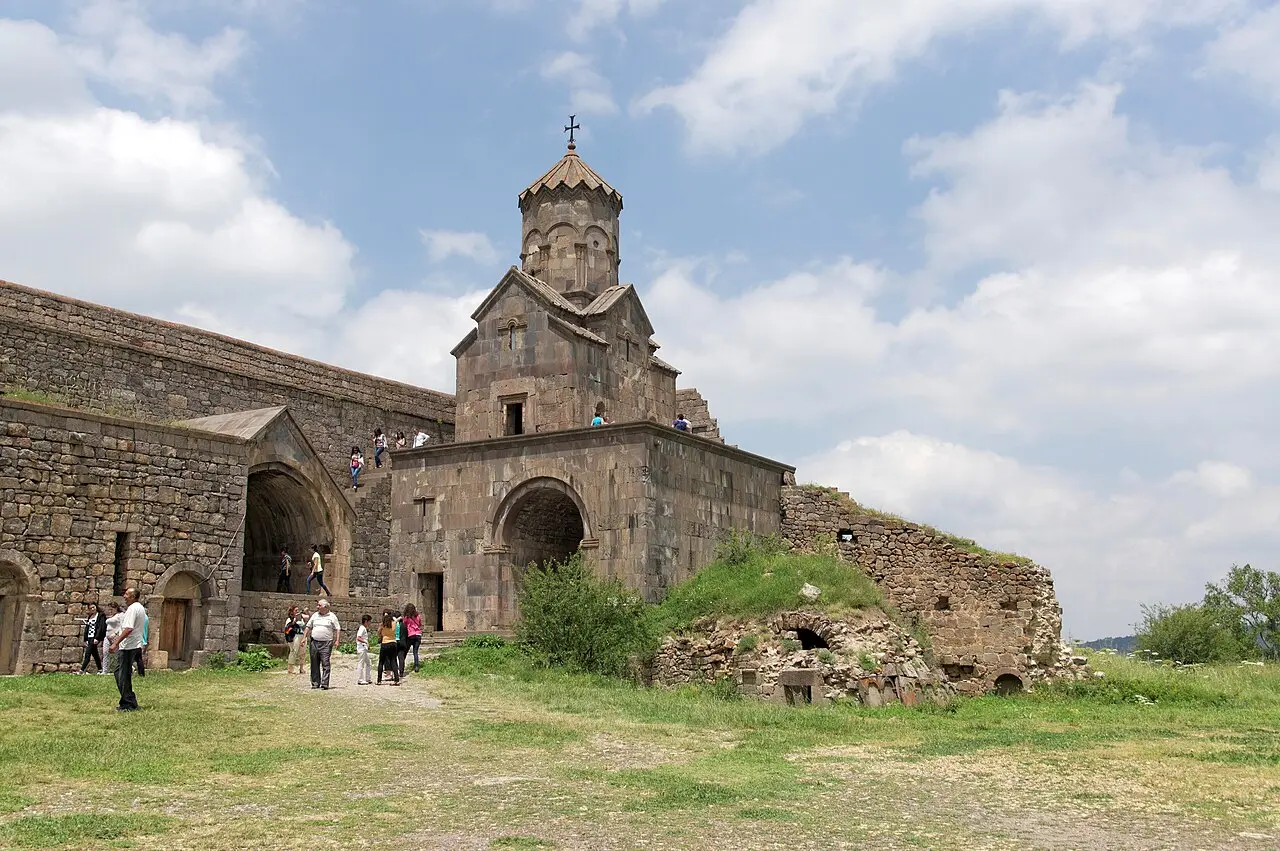
The building that dominates the compound is the church of Saints Paul and Peter (Surb Poghos-Petros), raised at the turn of the tenth century, its high dome carved on the outside with human faces and coiling serpents. Earthquakes have shaped Tatev as much as masons did - a violent one in 1138 brought down that dome and wrecked St Gregory’s church, and both were rebuilt, which tells you this place hasn’t had an easy thousand years. In the fourteenth and fifteenth centuries the monastery reached its intellectual peak as the home of the University of Tatev, a medieval school of theology, philosophy, science and manuscript painting whose scholars and illuminators were among the finest in the Armenian world. Along with Noravank to the north, it’s one of the two most celebrated monasteries in the country - and standing on its plateau, with the gorge falling away on three sides, it’s easy to see why the medieval church chose a spot this remote and this defensible.
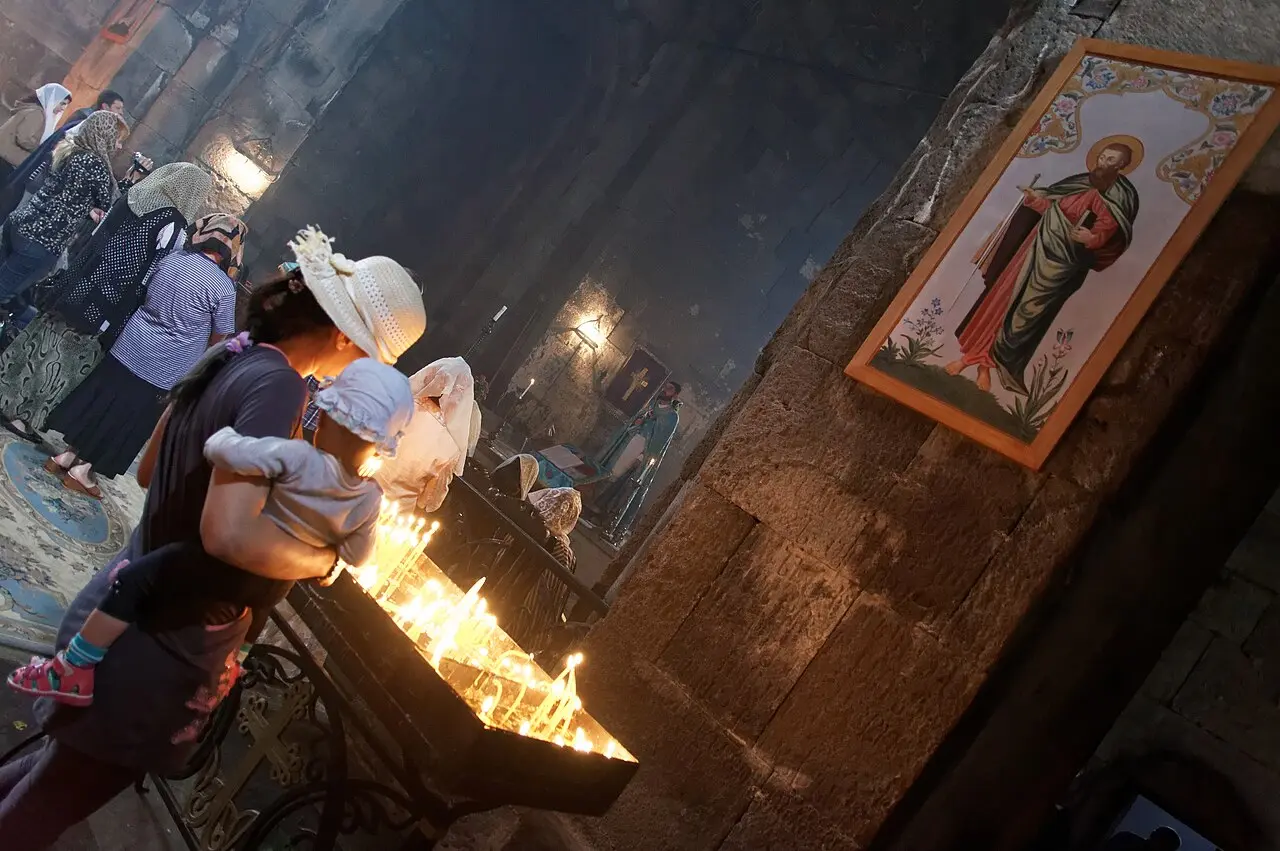
This is a working monastery again, restored and reconsecrated, with services held under those old vaults. Treat it accordingly: cover shoulders and knees, keep your voice down inside the churches, and don’t turn a monk’s morning into a photo shoot. It costs nothing to enter the grounds - the ticket you pay is for the cable car, not the monastery.
The Gavazan: a medieval earthquake alarm
Don’t leave without finding the Gavazan, the cleverest thing at Tatev and the kind of detail a rushed tour skips. It’s an octagonal stone column about eight metres tall, erected around 900 and dedicated to the Holy Trinity, standing in the courtyard and topped with a carved khachkar (cross-stone). What makes it remarkable is hidden at the base: the column is set on a hinged, pivoting foot, so that under a light push - or the tremor of an earthquake - it leans, sways, and then rights itself.
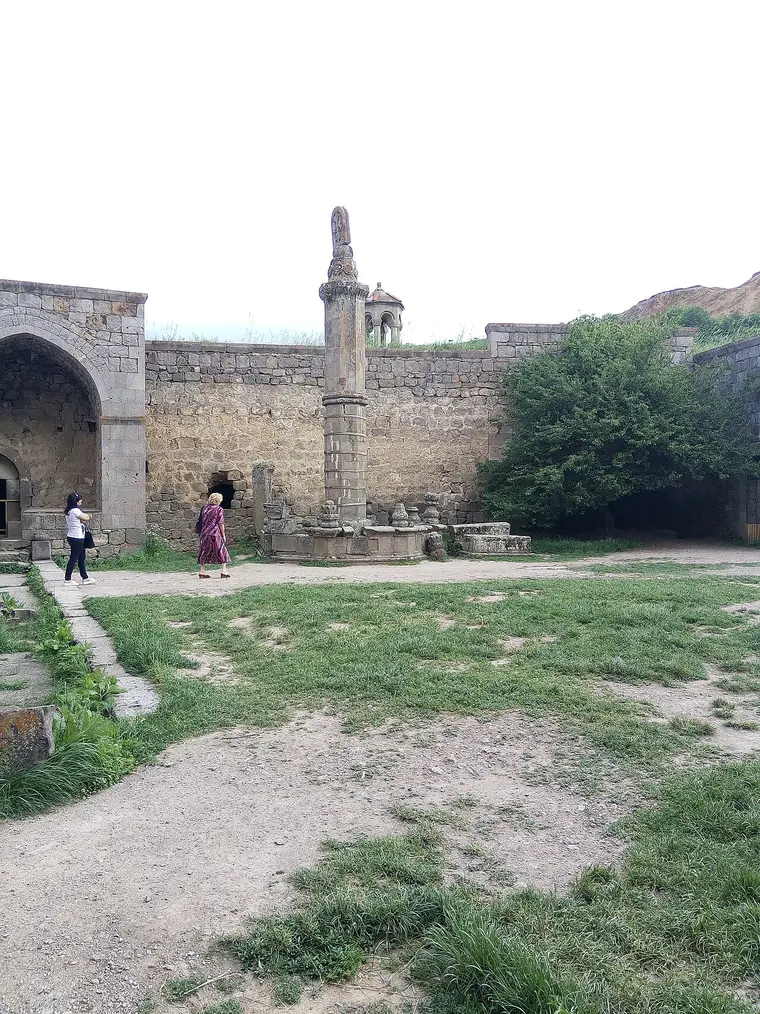
In effect the monks built a seismograph in stone more than a thousand years before the instrument was invented in the nineteenth century: a wobble of the Gavazan warned of coming tremors - no small thing in a region this seismic - and it’s said to have shivered at the approach of hostile armies too. A sundial gnomon on its southern face doubled its use. It’s a small grey pillar and it would be easy to walk past; don’t. Stand at it, picture a ninth-century monk watching it tilt, and Tatev stops being a pretty ruin and becomes a working mind.
The Devil’s Bridge in the gorge below
Most visitors ride up, see the monastery and ride back - and miss the other half of Tatev, down on the floor of the gorge. Where the road crosses the Vorotan on its way up sits the Devil’s Bridge (Satani Kamurj), a natural bridge, not a built one: over millennia the river and its warm mineral springs laid down a span of travertine rock, roughly thirty metres long, that the road now runs across. Underneath, at the water’s edge, are warm mineral pools ringed with coloured stalactites and rock stained orange and green by the minerals - you can bathe in the shallow warm water, and few people do.
You need your own wheels or a driver to get down there - it’s on the gorge road, not at the cable-car station - and getting to the pools themselves is a short, rough scramble on foot, so wear proper shoes and skip it in the wet. If you’re driving the serpentine one way for the scenery, the Devil’s Bridge is the reason to; if you’re doing the cable car both ways, you’ll need to detour for it.
Getting to Tatev from Yerevan - the honest version
Here’s where expectations need managing. Tatev is about 255 km south of Yerevan, and the drive is roughly four hours each way on a good day. That adds up fast: eight hours in a car plus two or three at the monastery is a ten- to eleven-hour day at the very least, and many bus tours stretch to thirteen or fifteen. It can be done in a day - but it’s a long, tiring one, and you’ll see the far south through a windscreen.
The far better plan, if your schedule allows, is to sleep in Goris. The town of Goris is the natural base - a pleasant place in its own right, about four hours from Yerevan, and only 15 km on a paved road from the Halidzor cable-car station. A night there halves the driving stress, lets you ride the Wings of Tatev at a civilised hour before the coaches arrive, and opens up the gorge and the cave-town of Khndzoresk nearby without a stopwatch running. From Goris a taxi to the cable car runs a few thousand dram. Hotel and guesthouse options are in where to stay in Goris. From the same base you can also push on inland toward Kapan and Meghri - our deep-south Goris to Meghri road trip is that continuation.
For actually getting there, weigh three options:
- An organised day tour is the simplest and often the best value, since Tatev is usually sold in the big southern loop with Khor Virap and Noravank - a driver-guide handles the brutal distance while you doze between stops. Just know what you’re signing up for: it’s the 13-15-hour version.
- A private transfer or taxi buys you a fixed price and your own timing, and makes sense if you’re basing in Goris or want to control the schedule rather than share a minibus.
- A rental car is the move if you’d rather split the trip over two days, chase the Devil’s Bridge, and carry on to the cave-town of Khndzoresk or the prehistoric standing stones of Karahunj near Sisian. Our guide to car rental in Armenia covers the paperwork and the mountain-road driving, and note that the eastern border areas beyond here are under a “do not travel” advisory - keep well clear of them.
Public transport gets you to Goris (bus No. 602 leaves Yerevan’s Southern Bus Station at 08:30 and 15:00 and is timetabled at 5 h 50 min), and from Goris a local bus carries on: No. 08-006 leaves at 10:10, stops in Halidzor, the cable-car village, at about 10:54 and reaches Tatev village itself at 11:22, and on the way back it passes Halidzor at 17:16 and reaches Goris at 18:00. It runs daily on the ministry timetable, which prints no fare, and travellers report other times, so check in Goris the day before; a taxi is the flexible alternative. Our guide to getting from Yerevan to Goris and Tatev breaks down the minibus, the shared taxi and that last hop to the cable car. Late spring through early autumn is the season to come: the cabins run year-round but never on a Monday, in any season - and winter brings shorter hours, half-hourly departures and the real chance of a gorge socked in with cloud.
Fitting Tatev into a bigger trip
Because it’s so far south, Tatev works best either as a deliberate two-day excursion or bundled into the classic southern tour. If you’re weighing the drive, our guide to Khor Virap monastery - the postcard monastery under Mount Ararat - covers the sight most often paired with Tatev on that long loop, and it’s a far shorter run from the capital. Tatev is the biggest of the day trips flagged in our roundup of things to do in Yerevan, which will help you decide how many nights the capital is worth before you head south. For more monasteries, gorges and caves to string a southern route around, browse the full attractions section - Tatev is the grand finale, but it’s a long way to drive for one plateau, however spectacular. Our roundup of the best monasteries in Armenia shows how to slot Tatev in with the rest without a punishing day, and our map of Armenia’s monasteries and UNESCO sites by region puts it in context against the other 19.
Photos
On the map
The map loads on click - to keep the page lightweight.
The map didn’t load. Check your connection and refresh the page.
Read also

What to see · 10 min read
Soviet Modernist Yerevan: An Architecture Walk
Verified · September 5, 2026Walk Yerevan's Soviet modernism: Rossiya Cinema, Komitas Hall, Cascade, Hrazdan Stadium and Demirchyan Complex - dates, route order, and what still stands.

What to see · 9 min read
Kond: Walking Yerevan's Oldest Neighborhood
Verified · September 3, 2026Walk Kond, Yerevan's oldest living quarter: Surp Hovhannes, Tepebashi mosque walls, Leo Street alleys, and how to visit without treating it like a set.
What to see · 8 min read
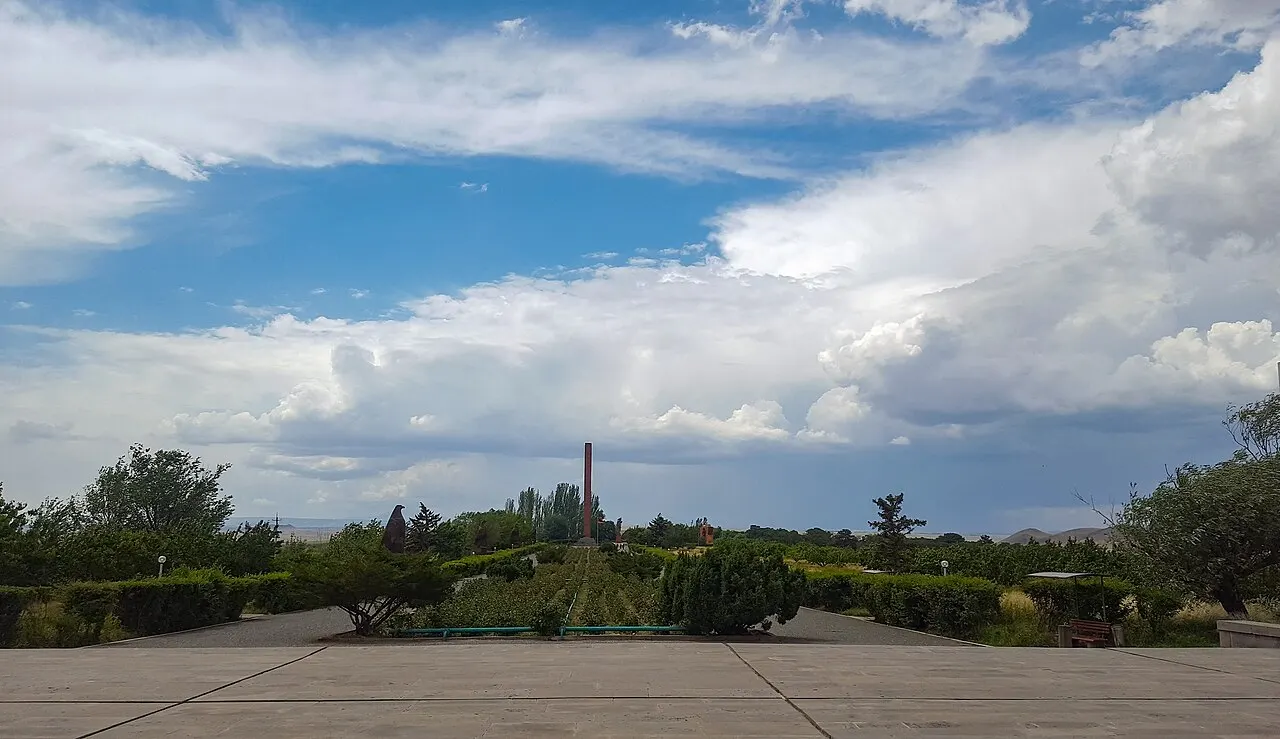
Sardarapat Memorial: Armenia's 1918 Battle Site
Verified · August 31, 2026Sardarapat Memorial near Armavir: 1918 battle site, Israelyan's red-tufa complex, ethnography museum tickets, hours and how to reach it from Yerevan.
What to see · 12 min read
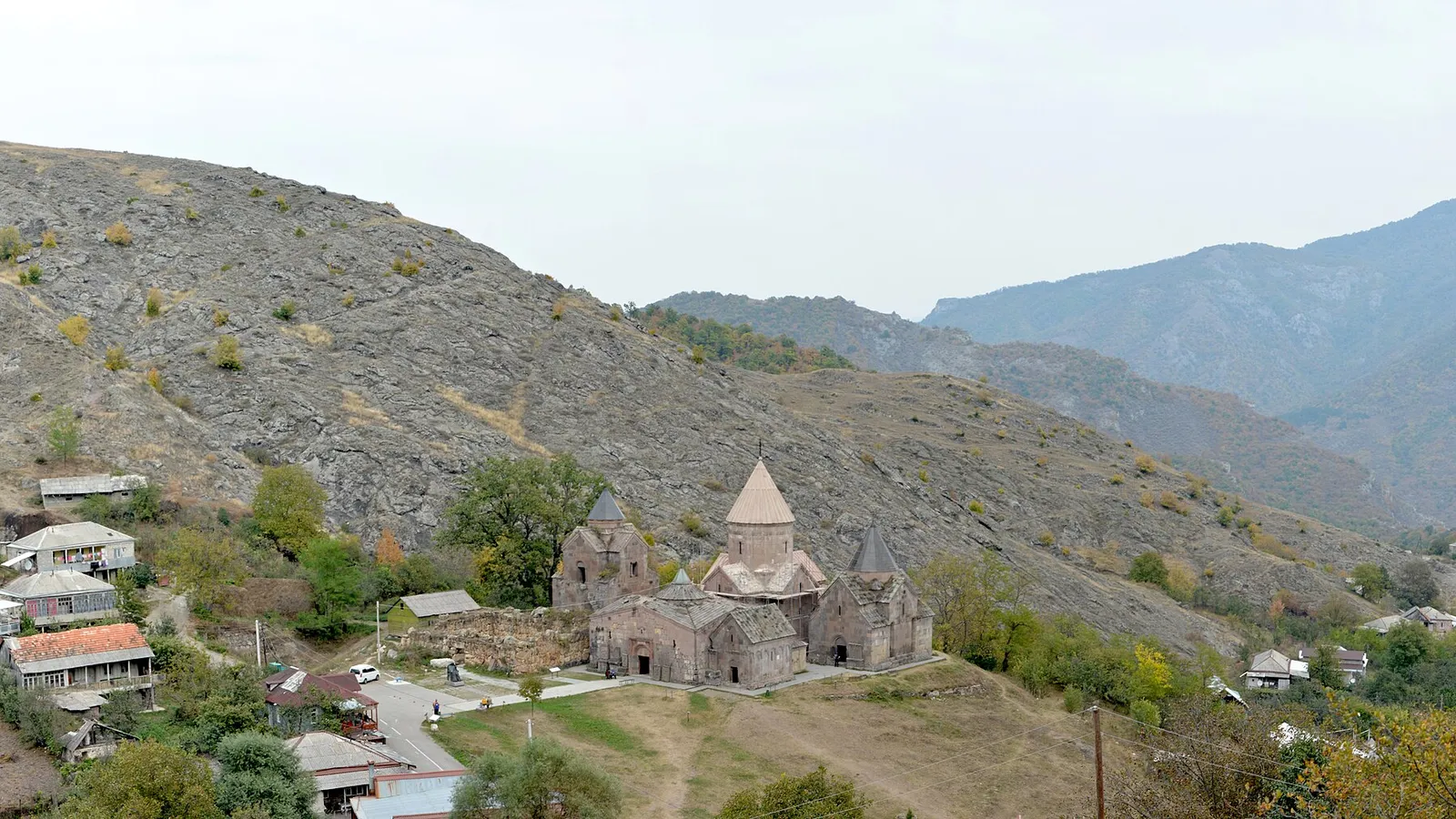
Goshavank Monastery & the Village of Gosh
Verified · August 29, 2026Visiting Goshavank: Mkhitar Gosh's law code that reached Poland, the 1291 embroidered khachkar, his statue and hillside tomb, and the drive from Dilijan.