Haghartsin Monastery: Dilijan's Forest Abbey
Visiting Haghartsin monastery near Dilijan: the three medieval churches, the Zakarid rebuild, the debated royal tomb, and the 2008-2013 restoration.
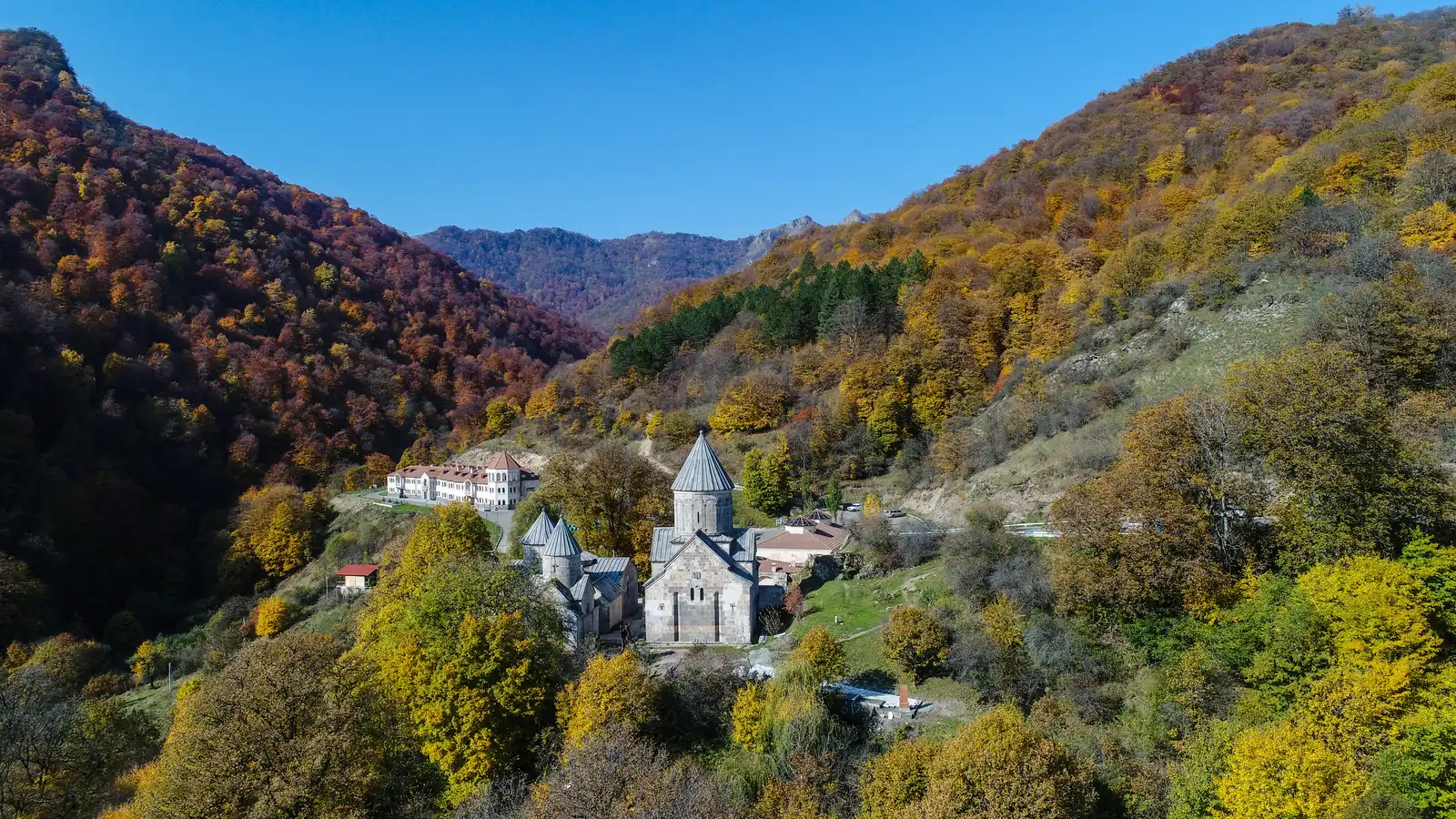
Haghartsin is the monastery Dilijan sends you to once the town itself runs out of things to do: a cluster of grey-stone churches tucked into a forest clearing about 13 km up a side valley. There’s no single knockout view here the way there is at Sevanavank’s lake or Noravank’s canyon, two of the sites rounded up in our guide to the best monasteries in Armenia. You come for the setting: the buildings genuinely look like they grew out of the woods around them. And you would be surprised how much of what gets repeated about this place turns out to be slightly off, starting with the bird carved on its biggest church (probably not the eagle everyone assumes) and the year everyone quotes for its restoration (off by two years, and we can now show you exactly why).
Eagles, a river, or neither: what the name might mean
Armenians read “Haghartsin” as a compound of “khaghal”, to play or move, and “artsiv”, eagle, and the story attached to it is that an eagle circled playfully over the dome during the church’s consecration, which is where the “play of eagles” translation comes from. It’s worth saying plainly that this is a popular etymology, not a documented fact: nobody recorded a bird’s flight path in the 10th century, and folk stories attach themselves to unusual place names everywhere. There’s a duller, and maybe truer, rival explanation sitting right next to the monastery: a stream called the Haghartsin still runs past it on its way to join the Aghstev river, and Armenian place names, like most others, come from water and land at least as often as they come from a story about birds.
What’s actually carved in stone doesn’t fully settle it either way. A relief on the east facade of the largest church shows two monks pointing at a model of the building with a bird between them, most often described as a dove rather than an eagle - but the monastery’s own materials don’t identify the bird at all, and plenty of tour guides will tell you confidently that it’s an eagle. If you go looking for one correct answer in the stonework, you’ll find disagreement instead.
Destroyed once, and rebuilt by a warlord family
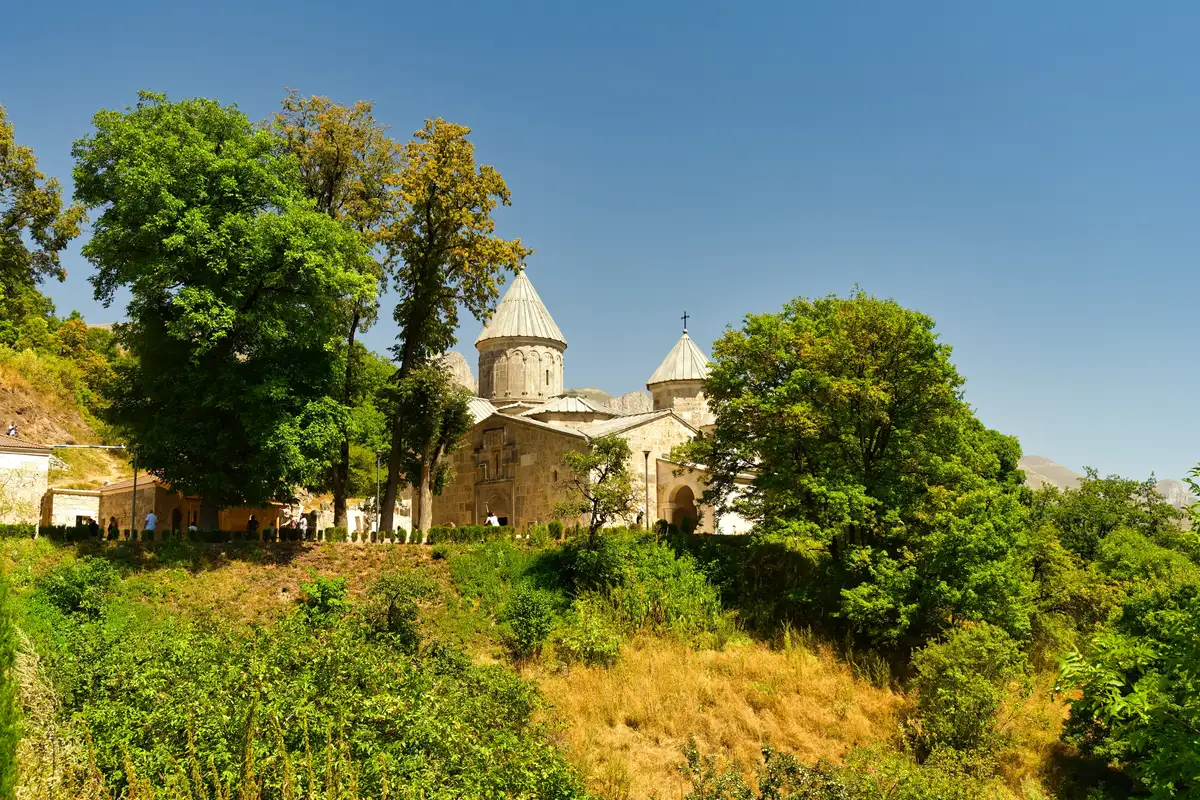
The tidy version of Haghartsin’s history, three peaceful centuries of steady building, isn’t quite what happened. The Seljuks destroyed most of the original complex in the late 11th century, and what stands of St. Gregory’s church today owes most of its fabric to a rebuild that began in 1184, paid for by the Zakarid princes Zakare and Ivane, who went on to make Haghartsin their family’s burial ground. Ivane’s own dedication, carved after his brother Zakare’s death in 1213, is still legible on the gavit he added to the church: a rare case of a medieval Armenian donor’s actual words surviving in place rather than only in a chronicle. Through all of this the monastery kept functioning as more than a set of chapels. The 13th-century historian Kirakos Gandzaketsi credits its abbot, the musician Khachatur Taronetsi, with both rebuilding parts of the complex and developing a new system of musical notation here for Armenian church chant, work that outlasted him by centuries. For where Haghartsin sits alongside the rest of the country’s medieval sites, our map of Armenia’s monasteries and UNESCO sites covers the other twenty or so by region.
The three churches, up close
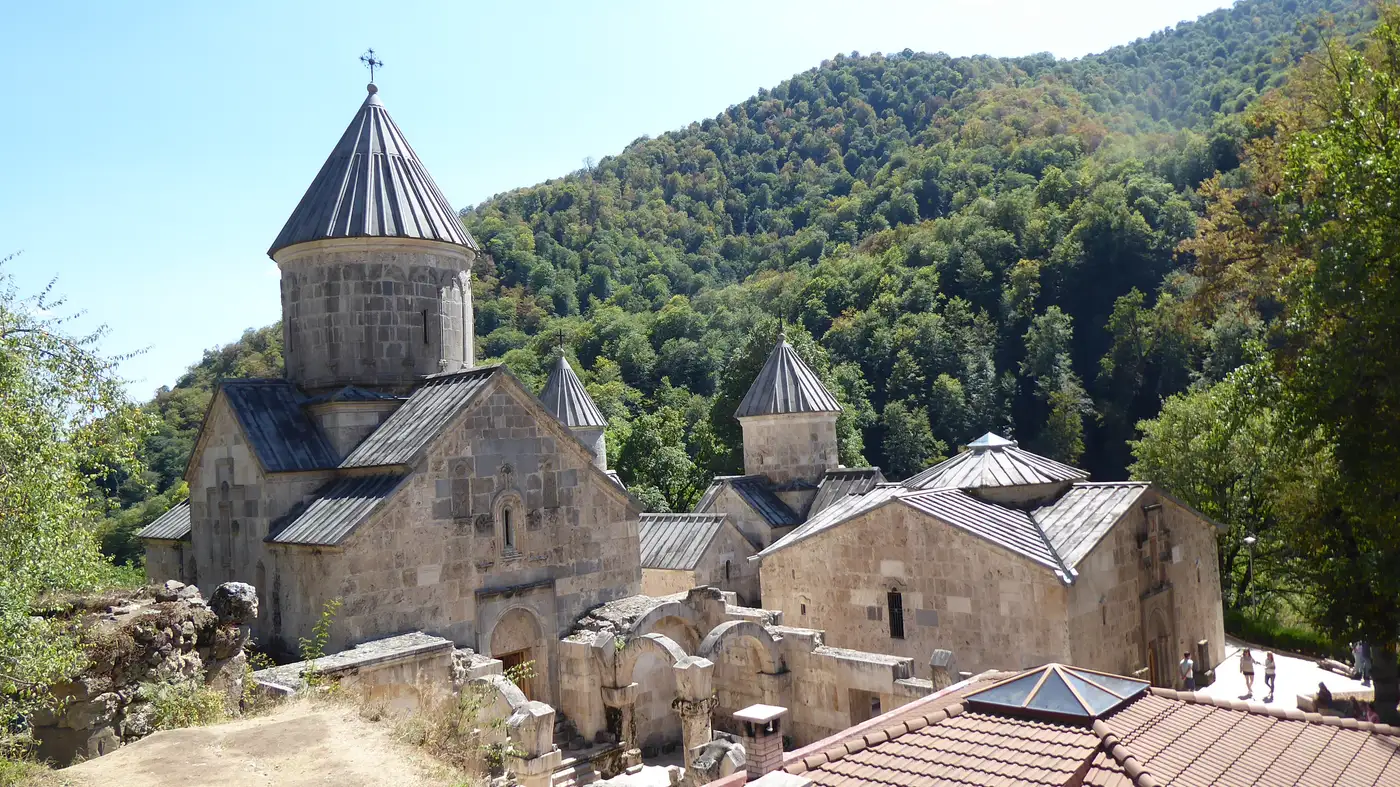
St. Gregory (Surb Grigor), the oldest of the three, is traditionally dated to the 10th century, though as the rebuild above suggests, most of what you are looking at is 12th-century work: a modest dome on an octagonal drum, entered through a gavit noticeably wider than the church itself. St. Stephen (Surb Stepanos), finished in 1244, is smaller again, with carved exterior decoration and, oddly for a church, a sundial cut into one wall. The largest, St. Astvatsatsin, the Church of the Holy Mother of God, was completed in 1281: a sixteen-faced dome sits over the crossing, and the columns that support it are linked by small triangular ledges and stone spheres, a detail that reads better in person than it does on paper.
None of the three buildings is huge on its own. What makes Haghartsin feel substantial is standing between them and picturing the whole cluster, churches, gavit, refectory and the ruined footprint of cells and outbuildings, as a working monastic town rather than three isolated chapels: press coverage of the restoration put the community at some 250 monks in its day. That’s a lot of people for a clearing that today can feel almost too quiet for a single tour coach.
The refectory, and a tomb nobody can quite name
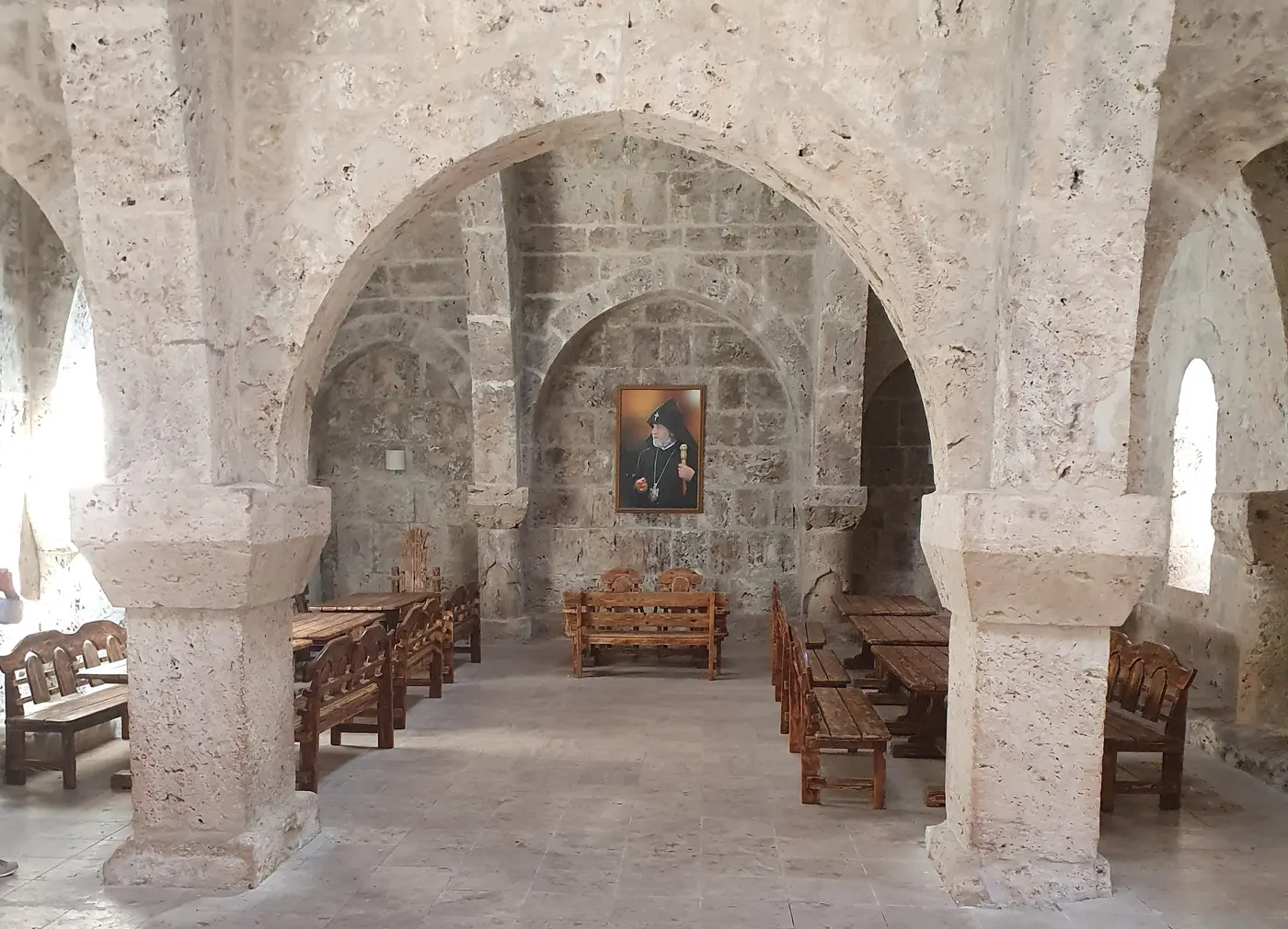
Off to one side of the churches stands a building most visitors walk straight past: a great vaulted refectory, raised in 1248 by the architect Minas. It survives essentially whole, which is unusual in itself. Armenian monasteries put their money and their upkeep into churches; the practical buildings around them, kitchens, dormitories, dining halls, mostly crumbled or vanished over the centuries, so a refectory this size and this complete counts as one of the best-preserved pieces of secular medieval architecture anywhere in the country. Two square halls, roofed with intersecting stone arches on thick round pillars, are lined with stone benches. Feeding a community that size in an orderly, silent hall was as much a piece of monastic discipline as anything happening next door in the churches.
Next to the south wall of St. Gregory’s gavit lies a royal sepulchre: partly dismantled in the 19th century by an abbot who reused the stone, but two gravestones survive, and one carries a legible inscription naming a “King Smbat.” The likelier reading, and the one both Wikipedia and the Armenian scholar Tamara Minasyan treat as the leading theory, is that these are kings of the Kiurikid branch of the Bagratuni dynasty. An older, now largely superseded theory named the earlier Bagratuni kings Smbat II, who ruled from 977 to 990, and Gagik I, who reigned from 990 into the early 11th century, but the historian Stepanos Asoghik, writing not long after, says Smbat was buried in Ani, not here, which is the strongest reason that reading has fallen out of favour. Nobody has closed the case for good, so treat any source, including this one, that hands you a single confident name as simplifying more than the evidence allows.
A restoration two years longer than you’ll read elsewhere
Haghartsin spent much of the 20th century falling apart. By the 2000s, cracks ran through the walls and plants had rooted themselves in the stonework, the ordinary fate of an unmaintained medieval building in a wet climate. The rescue came from an unlikely direction. Sheikh Dr. Sultan bin Muhammad Al Qasimi, the ruler of Sharjah in the UAE, visited Armenia in 2005 at President Robert Kocharian’s invitation, saw the monastery’s condition and offered to fund its repair through the Armenia Fund. Work ran from 2008 to 2013: reinforcing foundations, rebuilding walls and floors, redoing the drainage and electrical systems, and resurfacing the approach road you drive in on today. The fully restored complex was inaugurated on 19 October 2013 in a ceremony led by Catholicos Karekin II, with officials from both Armenia and Sharjah attending.
You will sometimes see the restoration dated simply to 2011, and there’s now a fairly clear paper trail for why. The citation usually attached to that date points to an Armenia Fund announcement page; the underlying press release itself is dated 19 March 2008, right at the start of the project, but the only date visibly stamped on the archived copy of that page is an October 2011 crawl by the Wayback Machine. It looks like later writers picked up the archive’s own snapshot date rather than the announcement’s date and mistook it for the finish line. The real finish line, backed by three separate press accounts, came more than two years after that.
Not everyone loves the result. The specific complaint you’ll hear from people who knew the site before 2008 is about the repointing, the mortar work run between the stones, which came out crisp and even in a way the original masons never built for; up close, a few of the joints look almost too tidy for a building meant to read as eight centuries old. It’s a fair criticism, and a narrow one. None of it changes what the churches actually are, and for a complex that spent decades genuinely at risk of losing walls to weather and neglect, a slightly overtidy repointing job is a trade most people watching from outside Armenia would take without hesitating.
Khachkars, and the walk past them to a hidden waterfall
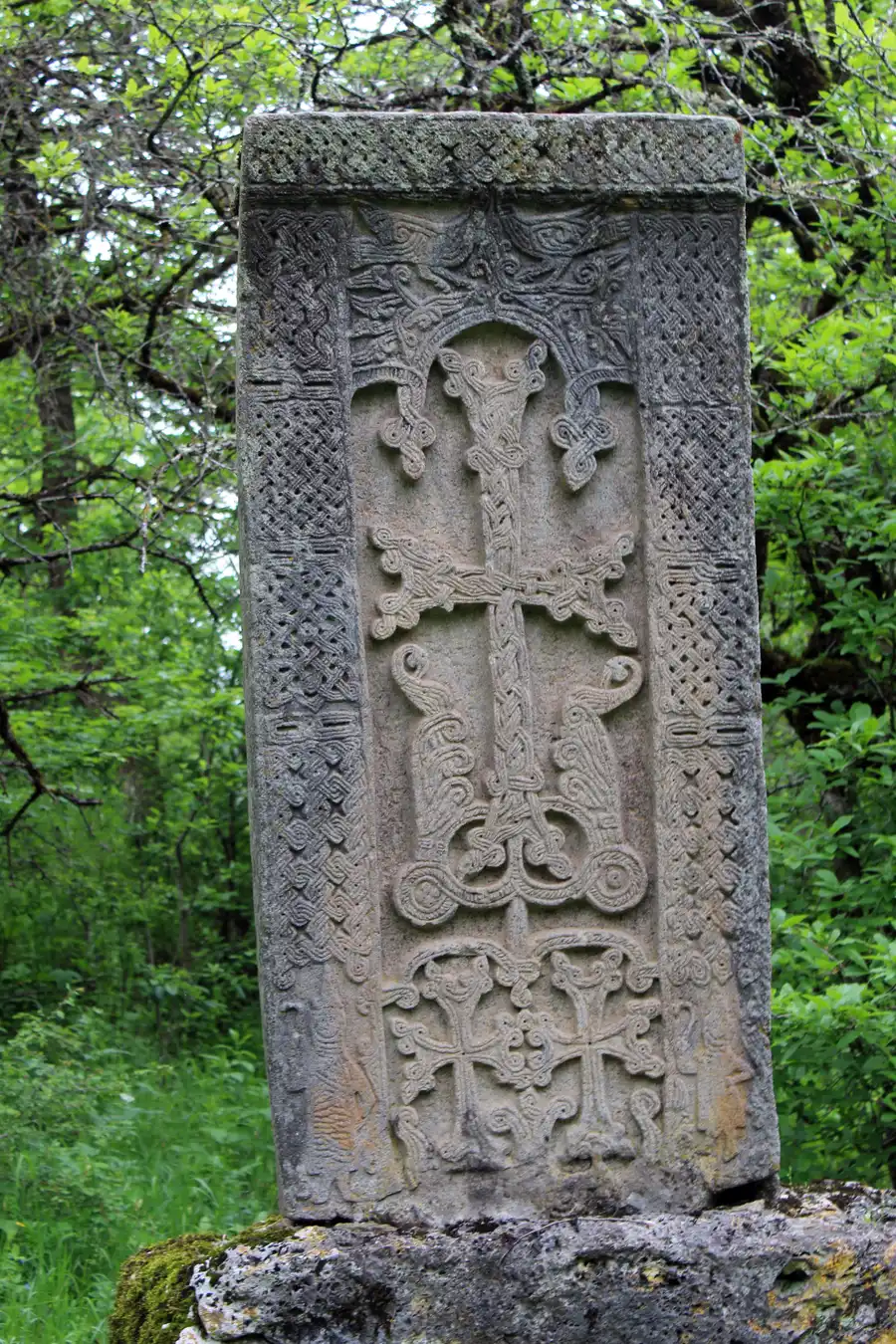
Around the churches, look for khachkars, the carved stone crosses Armenians raise for almost any occasion, from a death to a safe return from a journey. Haghartsin’s aren’t as famous as the lace-cut masterpiece at Goshavank, a good 20 km away by road in the next valley over (not the quick hop a few guides imply), but several are genuinely fine interlace carving and worth slowing down for rather than walking past on your way to the domes.
The one thing most day-trippers miss entirely: a signed trail leaves from the monastery car park and runs 1.6 km one way through the forest to a small hidden waterfall, dropping roughly 100 m in elevation on the way down, so budget the climb back up. It’s rated a moderate walk and takes around ninety minutes there and back, longer if the path is muddy, which it often is after rain. You won’t see this waterfall on any postcard of Haghartsin, and that’s rather the point.
The drive up from Dilijan and Yerevan
Haghartsin sits about 13 km up a side valley from Dilijan, roughly a 20-minute drive on a paved road, and around 110 km, or an hour and 45 minutes, from Yerevan if you’re coming straight from the capital. Almost nobody makes the trip on its own; it nearly always rides alongside a stop in Dilijan itself or a wider loop through the north. Your realistic options:
- Joining a day tour out of Yerevan is the low-effort choice: most operators bundle Haghartsin with Dilijan, Lake Sevan and often Goshavank into one well-paced day, and you don’t have to drive the mountain roads yourself.
- Driving yourself is the most flexible way to combine Haghartsin with Goshavank and Dilijan’s Sharambeyan craft quarter in a single loop, on your own schedule rather than someone else’s.
- Booking a taxi or private transfer from Dilijan is a straightforward fixed-price option if you’re already staying in town without a car.
- Arriving by marshrutka only gets you as far as Dilijan. The monastery sits up a side road with no public transport running along it, so budget a local taxi for the last stretch.
There’s no ticket booth. The monastery’s own site lists it as open daily from 8:00 to 20:00 and free to enter, with Sunday liturgy at 11:00, though that site hasn’t obviously been updated in years, so treat the hours as a guide rather than gospel and confirm locally if you’re planning a visit outside normal daylight. Go as early as you can manage anyway: Haghartsin draws a wave of coach groups by mid-to-late morning, and the clearing is a different, better place to stand when you can hear the forest instead of a crowd.
If you’ve got another ninety minutes in you after the churches, the walk to the hidden waterfall is the one addition worth making. If you don’t, Haghartsin is still a full hour well spent without it.
Photos
On the map
The map loads on click - to keep the page lightweight.
The map didn’t load. Check your connection and refresh the page.
Admission and opening hours
- Admission price
- Free (no entrance fee)
- Opening hours
- 8:00-20:00 daily per the monastery site; no ticket booth, hours not strictly enforced
Sunday liturgy starts at 11:00. A car park, bakery and small gift shop stand at the gate.
Details checked: August 19, 2026
Distance
- Yerevan ≈110 km · about 1 hour 45 minutes North on the M4 through Sevan and over the pass to Dilijan, then up a side valley on a paved road. Day tours and private transfers cover the whole run.
- Dilijan ≈13 km · about 20 minutes A paved side road climbs a forested valley from the Dilijan-Ijevan highway. No public transport runs up it, so you need a car, taxi or tour from town.
Read also

What to see · 10 min read
Soviet Modernist Yerevan: An Architecture Walk
Verified · September 5, 2026Walk Yerevan's Soviet modernism: Rossiya Cinema, Komitas Hall, Cascade, Hrazdan Stadium and Demirchyan Complex - dates, route order, and what still stands.

What to see · 9 min read
Kond: Walking Yerevan's Oldest Neighborhood
Verified · September 3, 2026Walk Kond, Yerevan's oldest living quarter: Surp Hovhannes, Tepebashi mosque walls, Leo Street alleys, and how to visit without treating it like a set.
What to see · 8 min read
Sardarapat Memorial: Armenia's 1918 Battle Site
Verified · August 31, 2026Sardarapat Memorial near Armavir: 1918 battle site, Israelyan's red-tufa complex, ethnography museum tickets, hours and how to reach it from Yerevan.
What to see · 12 min read
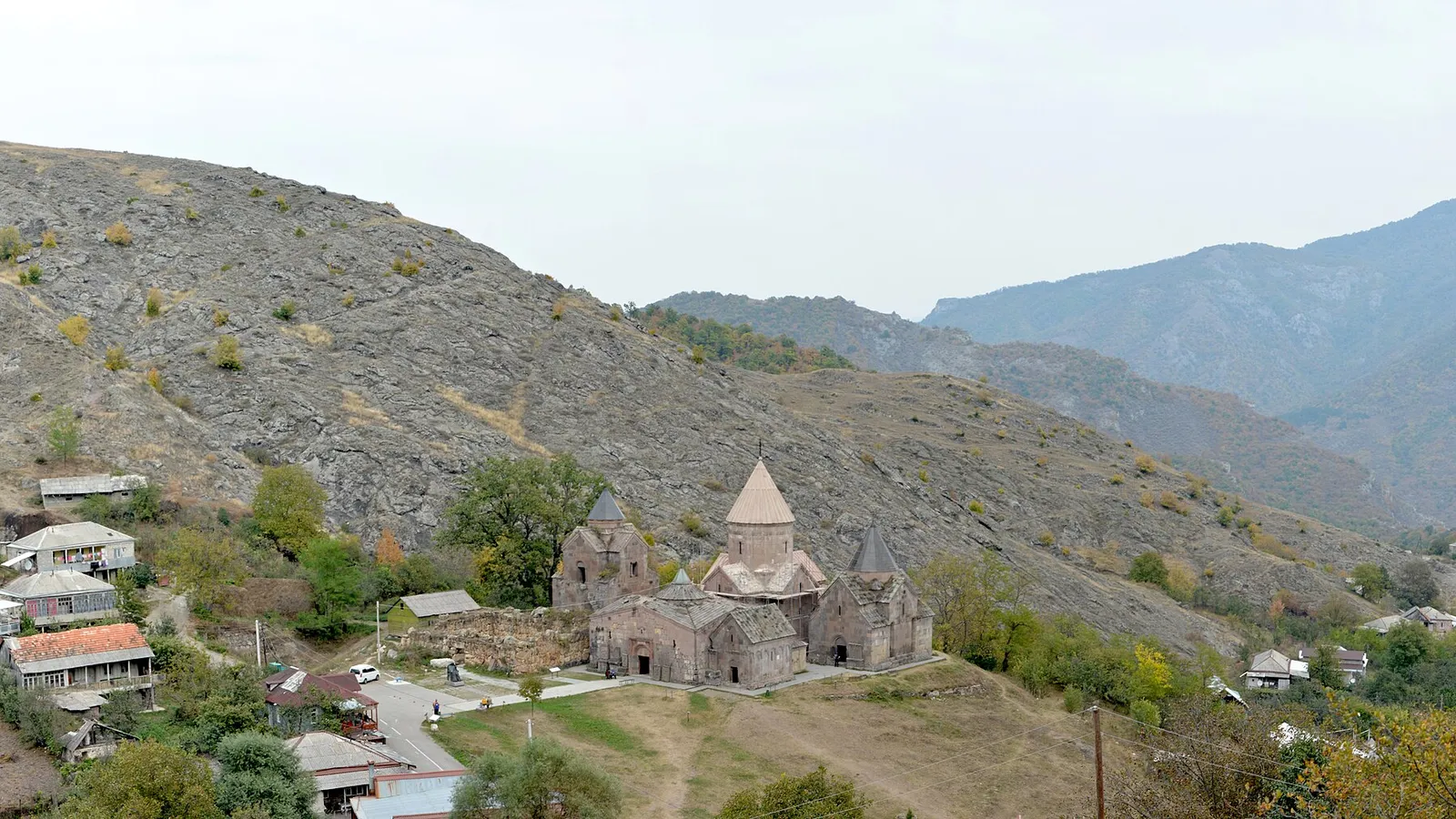
Goshavank Monastery & the Village of Gosh
Verified · August 29, 2026Visiting Goshavank: Mkhitar Gosh's law code that reached Poland, the 1291 embroidered khachkar, his statue and hillside tomb, and the drive from Dilijan.