Dilijan: Armenia's Little Switzerland
Visiting Dilijan, Armenia's forested spa town: Haghartsin and Goshavank monasteries, the Sharambeyan craft quarter, hiking, and getting there from Yerevan.
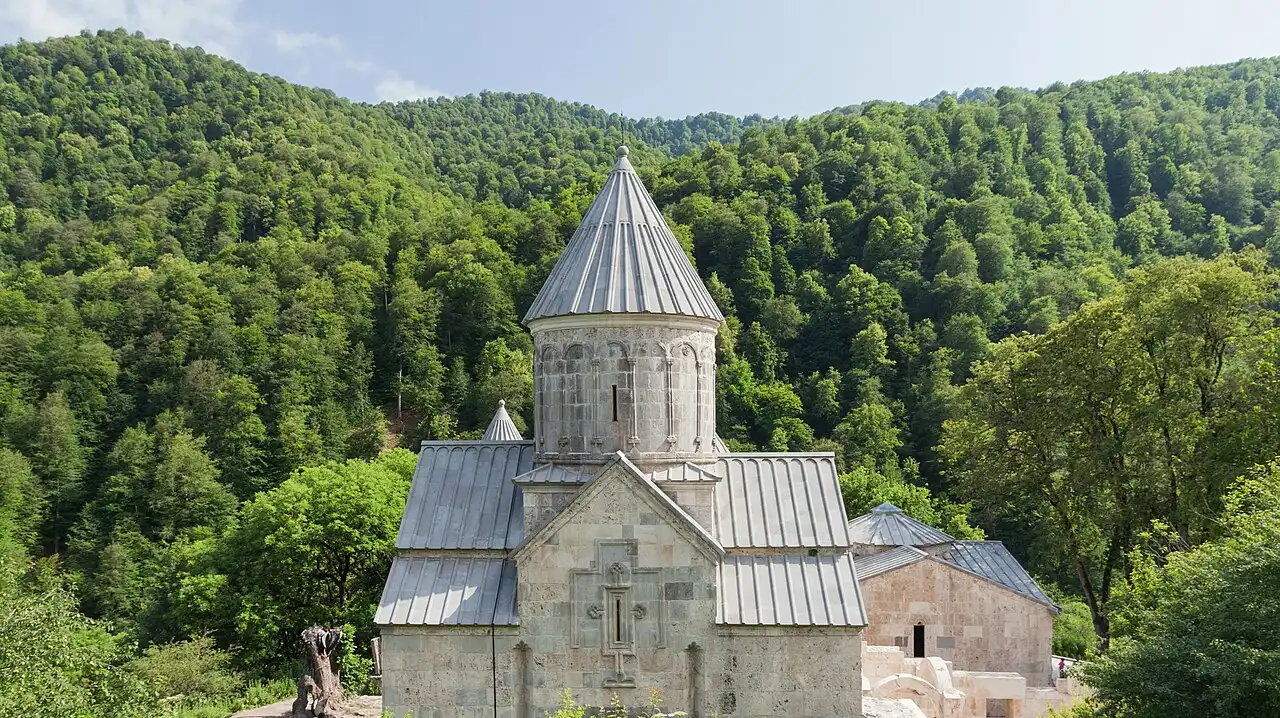
Dilijan is the green surprise of a country most people picture as bare and sun-baked: a small spa town wrapped in beech and oak forest at about 1,500 m in the northern province of Tavush, roughly 100 km and an hour and a half north of Yerevan. Armenians call it their “Little Switzerland,” and while every mountainous corner of the world claims that title, Dilijan half-earns it - wooded ridges, cool damp air, a river running through, and mist that hangs in the valleys after rain. It’s the base for two of the country’s loveliest monasteries, a restored craft quarter, a national park laced with hiking trails, and the mineral-water sanatoriums that made its name. This guide covers what to see, how to fold it into a trip north with Lake Sevan, and how to get here. For the pick of places to sleep, see where to stay in Dilijan.
Why Dilijan feels different
Drive up from Yerevan and the change is abrupt. You climb out of the dry Ararat plain, thread the Sevan Pass and the long 2.25 km Dilijan tunnel under the ridge, and drop out the far side into a different climate: suddenly there are trees on every slope, the light goes soft and green, and the temperature drops a few degrees. That contrast is the whole appeal. Most of Armenia is high steppe and rock; Dilijan is the country’s damp forested pocket, which is exactly why Soviet planners turned it into a health resort and why city-dwellers still come up to breathe.
The forest isn’t scenery you look at from the road - it’s the reason to stop. Dilijan sits inside the Dilijan National Park, and the wooded mountains around it cover more than 34,000 hectares, protected as a state reserve since 1958 and a national park since 2002. Broadleaf woods of beech, oak and hornbeam climb the ridges; springs and small lakes hide in the folds. It’s the greenest, wettest part of a mostly arid country, and after the stone-and-sky drama of the south it lands like a cold drink.
Haghartsin: the monastery in the woods
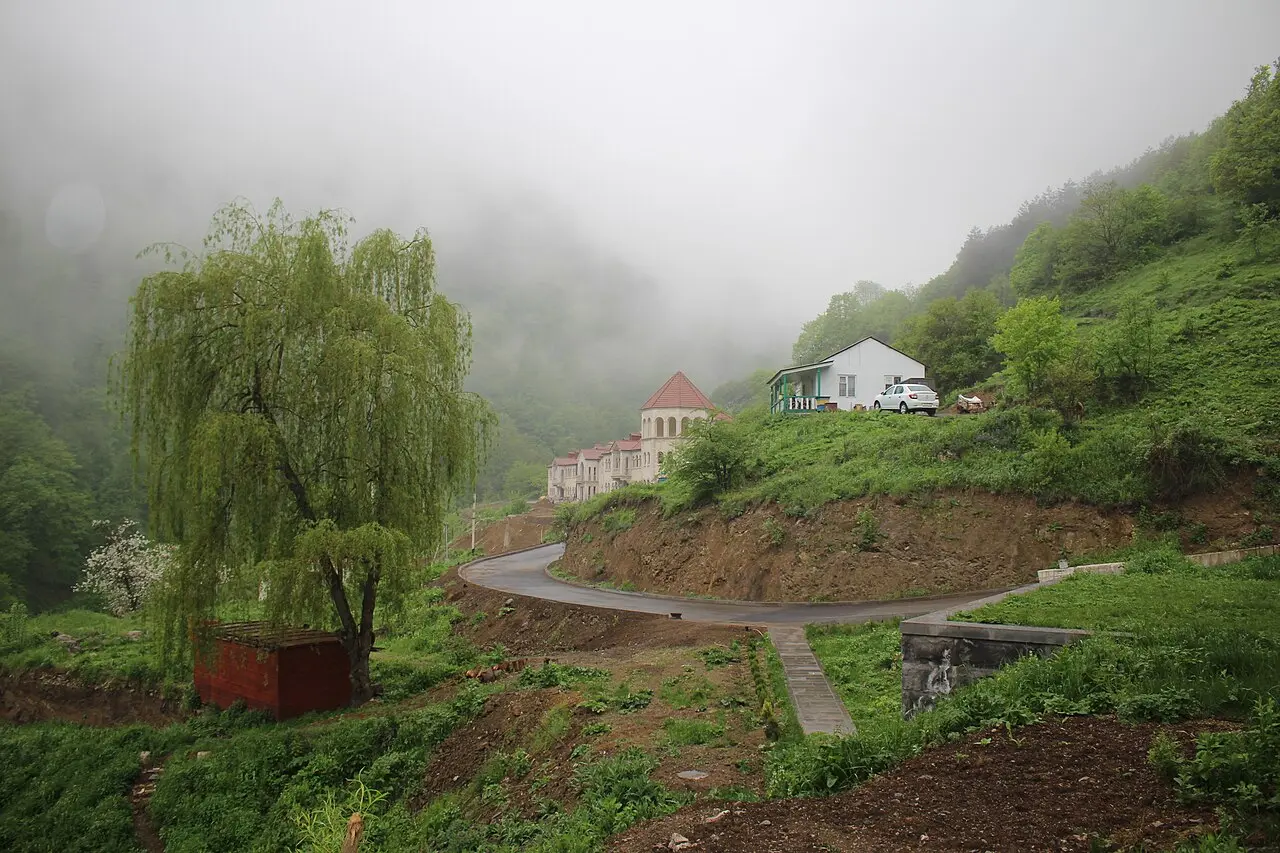
If you see one thing here, make it Haghartsin, about 13 km from town up a side valley, and one of the most atmospheric monasteries in Armenia purely for where it sits - a cluster of pale stone churches in a clearing hemmed by forest, so that on a grey morning the buildings seem to float in the green. It was built up over three centuries, between the 10th and 13th, and each part shows its age. The small Church of St. Gregory (Surb Grigor) is the oldest, roughly 10th-century; St. Stephen (Surb Stepanos) was finished in 1244; and the largest, St. Astvatsatsin (Holy Mother of God), was completed in 1281. Off to one side stands a rare survivor - a great vaulted refectory raised by the architect Minas in 1248, its two halls of intersecting arches among the finest medieval secular buildings in the country.
Haghartsin was a near-ruin for much of the 20th century, and what you walk through today is the result of a restoration that ran from 2008 to 2013, funded by the ruler of Sharjah, Sheikh Sultan bin Muhammad Al-Qasimi, through the Armenia Fund and formally inaugurated in October 2013 - which is also why there’s now a smooth access road, a car park and a little bakery at the gate. Purists grumble that the polish took some soul out of the stones; most visitors just find it a beautiful, easy stop. Entry is free (it’s a working church), and there’s no ticketed timetable, so treat it as a daylight site and go early to have the clearing to yourself before the tour vans arrive. Our full guide to Haghartsin monastery covers the three churches, the debated royal tomb and the short hike to a hidden waterfall in more depth.
Goshavank and the lace-cut cross-stone
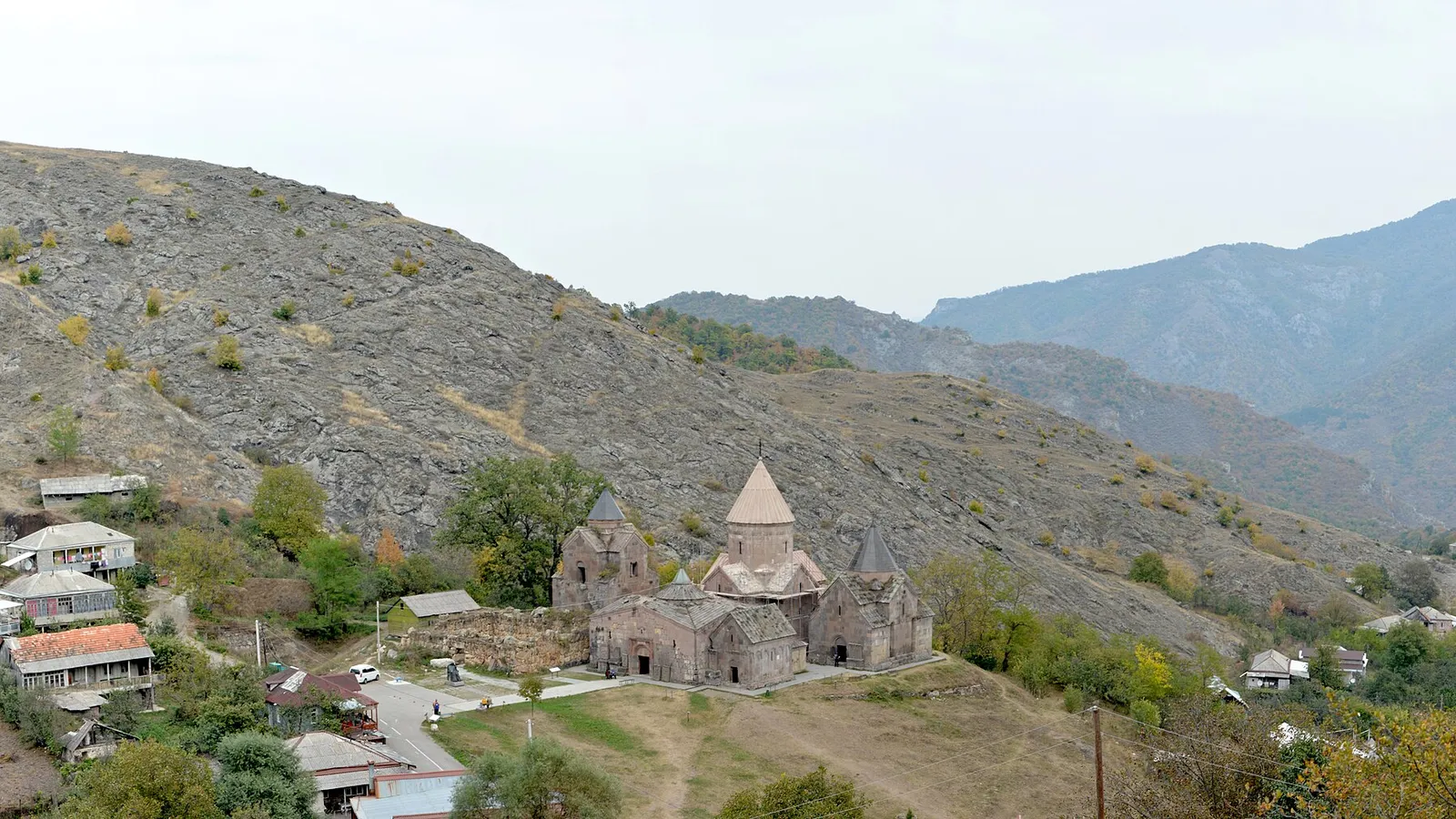
The second monastery, Goshavank, sits about 22 km the other side of Dilijan in the village of Gosh, and it’s a different experience - no forest theatre here, just a compact complex of grey churches sitting right among village houses, with no defensive wall around it. What makes it worth the drive is the man behind it and one extraordinary stone. The monastery was founded in 1188 by Mkhitar Gosh - a scholar, statesman and fabulist who wrote Armenia’s first proper law code - on a new site the Zakarid princes granted him after an earthquake wrecked the older Getik monastery, which stood in what is now Gegharkunik province; the village and the monastery both took his name. Its main church, Surb Astvatsatsin, went up between 1191 and 1196, and a school here trained the historian Kirakos Gandzaketsi.
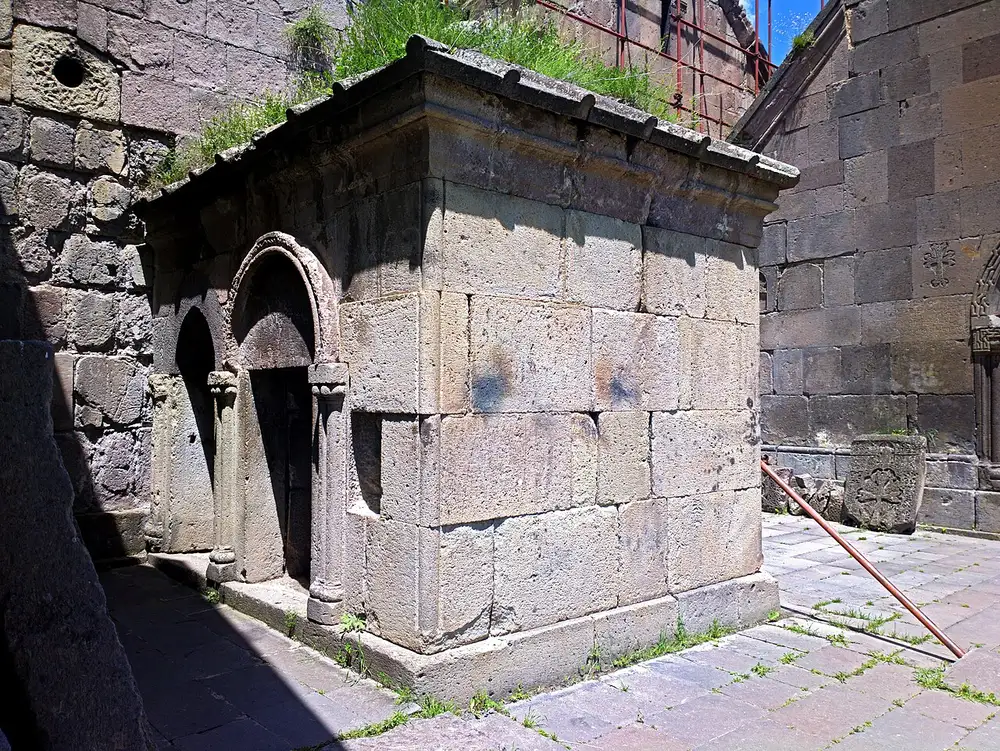
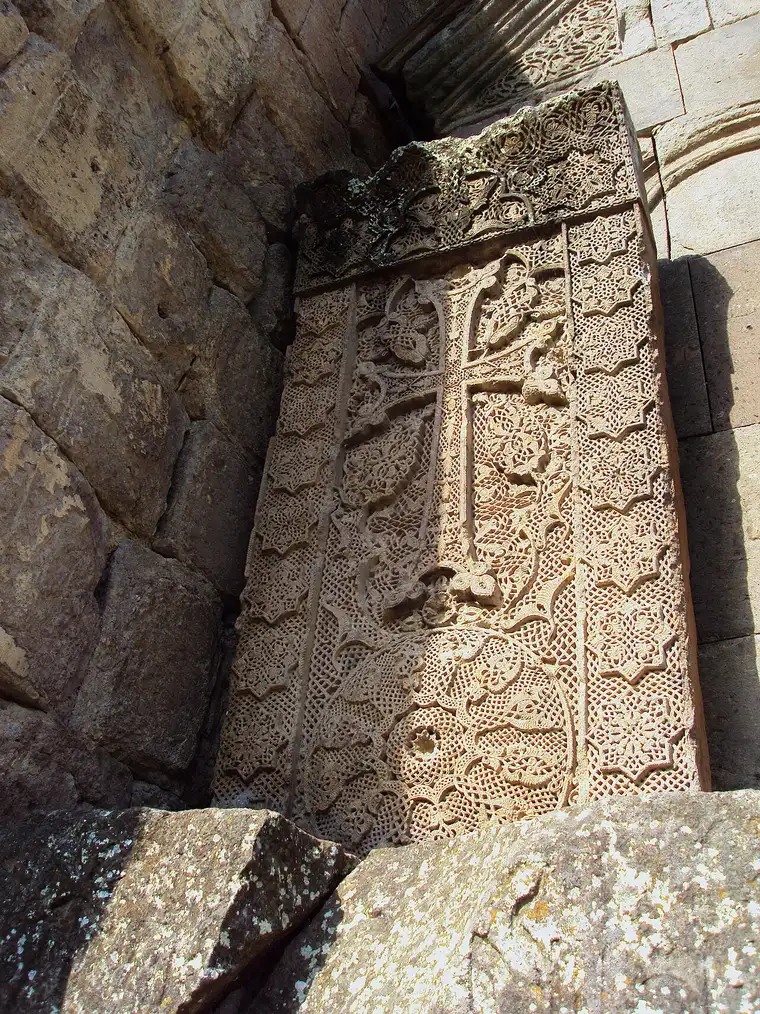
The stone to look for is a khachkar - an Armenian carved cross-stone - cut by a master named Poghos in 1291, and widely rated one of the two or three finest ever made. Stand close and the carving stops looking like rock: it’s openwork so fine it reads as lace, a cross set on a shield-shaped rosette above an eight-pointed star, every surface knotted with interlace. Armenians nicknamed it the “needle-worked” khachkar for good reason. In a country that carved thousands of these things, this is the one connoisseurs travel for - and it’s easy to walk straight past if nobody points it out, so seek it out on the church wall.
The Sharambeyan old town and the craft revival
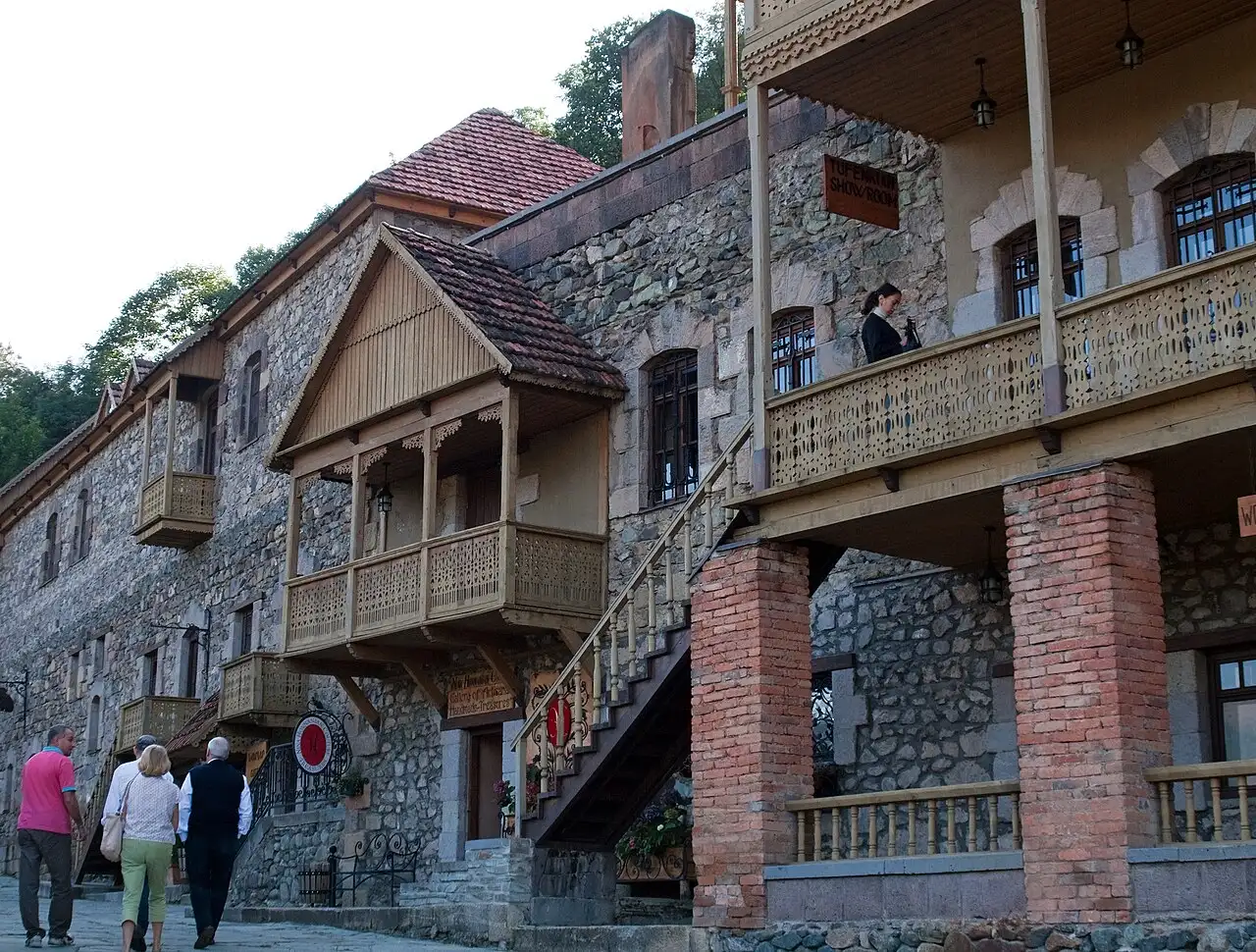
Back in Dilijan itself, the one urban sight is Sharambeyan Street, a short restored stretch of the 19th-century old town on the edge of the centre. It’s a single cobbled lane of low houses with carved wooden balconies, done up as a living craft quarter: potters, woodcarvers and other makers keep open-fronted workshops here, there’s a small gallery and museum, and the anchor is the Tufenkian Old Dilijan Complex, part boutique hotel, part artisan arcade. It is unabashedly done up for visitors - a couple of hundred metres, not a whole quarter - but it’s genuinely pretty, the crafts are real, and it’s the natural place for lunch and a coffee between monasteries. For tables worth booking, see best restaurants in Dilijan.
While you’re in the mood for old Dilijan, the town’s other claim is liquid. Its mineral springs - bottled since Soviet days and still sold across the country - are what first drew Russian imperial visitors and then made Dilijan a major sanatorium town, where generations came to take the air and the water for their lungs. You’ll still see public drinking fountains running the local mineral water in the centre; it’s an acquired, faintly fizzy, mineral taste, and free to try. The old resort culture has faded, but the springs and a scatter of spa hotels remain.
Hiking: the national park and the Transcaucasian Trail
Dilijan is one of the best places in Armenia to actually walk in a forest, and the trail network has been transformed in the last decade. A self-contained 80 km section of the Transcaucasian Trail runs through the national park, built by volunteers from 2017 onward and - crucially for a country where paths are often unmarked - waymarked with red-and-white blazes and signposted at the junctions. The full stretch is a four-to-five-day trek, but you don’t have to commit to that: it’s built to be sampled in day-length pieces, and several of the best short walks link the sights you’re already visiting, including the paths between the monasteries and up to the lakes.
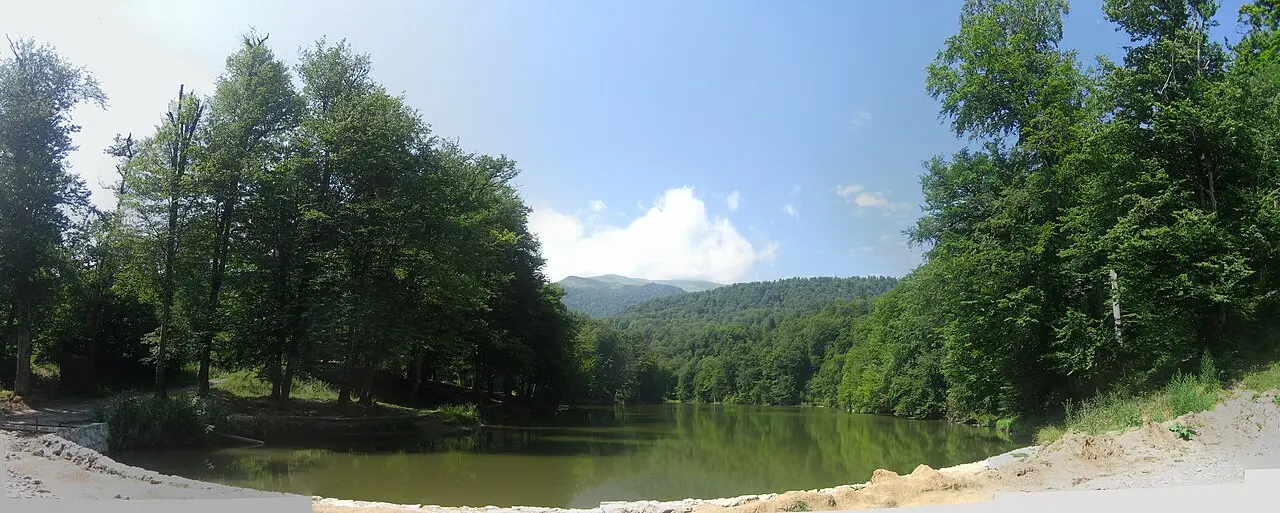
The gentle favourite is Parz Lake (“Clear Lake”), a small forest-ringed lake northeast of town with a café, rowing boats and short zip-lines (for the serious version, the five cables at Yell Extreme Park are 45 minutes further north above Yenokavan) - reachable by car or as a walk, and a popular jump-off for longer trails toward Gosh. Weather and wind also put Dilijan on the tandem paragliding map when pilots launch over Tavush forest. If you’d rather earn your monastery, the marked path from Parz Lake over to Goshavank is a classic half-day through the woods. Come prepared for mountain weather even in summer: the forest holds the damp, afternoon rain is common, and it’s cooler up here than on the plain. For trail-by-trail detail inside the park itself - marked routes, real distances and elevation - see our dedicated guide to hiking in Dilijan National Park. Dilijan’s forest paths are the gentle end of the spectrum; to see where they sit against the country’s high volcanic summits, our roundup of the best hikes in Armenia lays out the full range.
How to get to Dilijan from Yerevan
Dilijan is an easy trip because it’s straight up the main road north. It’s roughly 100 km from Yerevan on the M4, about 1.5 hours by car - the same highway that runs past Lake Sevan, which is why the two are so often paired into one northern day. Your options are the usual ones:
- A day tour is the low-effort pick, and most operators bundle Sevan, Dilijan and the two monasteries (Haghartsin and Goshavank) into a single well-paced day out of Yerevan - you turn up and someone else drives the mountain roads.
- A rental car is the one I’d choose if the forest is the point: it lets you reach Parz Lake and the trailheads, linger over lunch on Sharambeyan Street, and carry on to a quieter shore of Sevan on the way back.
- A private transfer or taxi gives you a fixed price and your own timing without driving.
- A marshrutka (shared minibus) is the budget route: they leave from Yerevan’s Northern Bus Station roughly through the day and take about two hours, a little longer than a car. They drop you in Dilijan town, so you’ll need a local taxi to reach the monasteries and the lake. Confirm the current fare and departure times at the station.
Our dedicated guide to getting from Yerevan to Dilijan lays out each option side by side - the marshrutka fare and route numbers, taxi and ride-hailing prices, and why the drive over the Sevan pass is worth doing slowly.
The smart play for most visitors is to treat Dilijan as the back half of a northern loop: monastery and lakeside lunch at Lake Sevan in the morning, over the pass to Dilijan for the afternoon - the forest, a monastery and Sharambeyan Street - then home. It pairs with the country’s other great half-days too, from the temple at Garni and the Geghard cave-monastery to Khor Virap under Mount Ararat. Dilijan is one of the standout escapes in our guide to things to do in Yerevan, and it slots naturally alongside Lake Sevan on the same road north. Push a little further and you reach Lori, Haghpat and Sanahin, the UNESCO monasteries of the deeper north. Browse the full attractions section to build the rest of your route.
Photos
On the map
The map loads on click - to keep the page lightweight.
The map didn’t load. Check your connection and refresh the page.
Distance ≈100 km · ≈1.5 h
- Yerevan ≈100 km · ≈1.5 h North on the M4 through the 2.25 km Dilijan tunnel; marshrutkas run from the Northern Bus Station (~2 h).
Read also

What to see · 10 min read
Soviet Modernist Yerevan: An Architecture Walk
Verified · September 5, 2026Walk Yerevan's Soviet modernism: Rossiya Cinema, Komitas Hall, Cascade, Hrazdan Stadium and Demirchyan Complex - dates, route order, and what still stands.

What to see · 9 min read
Kond: Walking Yerevan's Oldest Neighborhood
Verified · September 3, 2026Walk Kond, Yerevan's oldest living quarter: Surp Hovhannes, Tepebashi mosque walls, Leo Street alleys, and how to visit without treating it like a set.
What to see · 8 min read
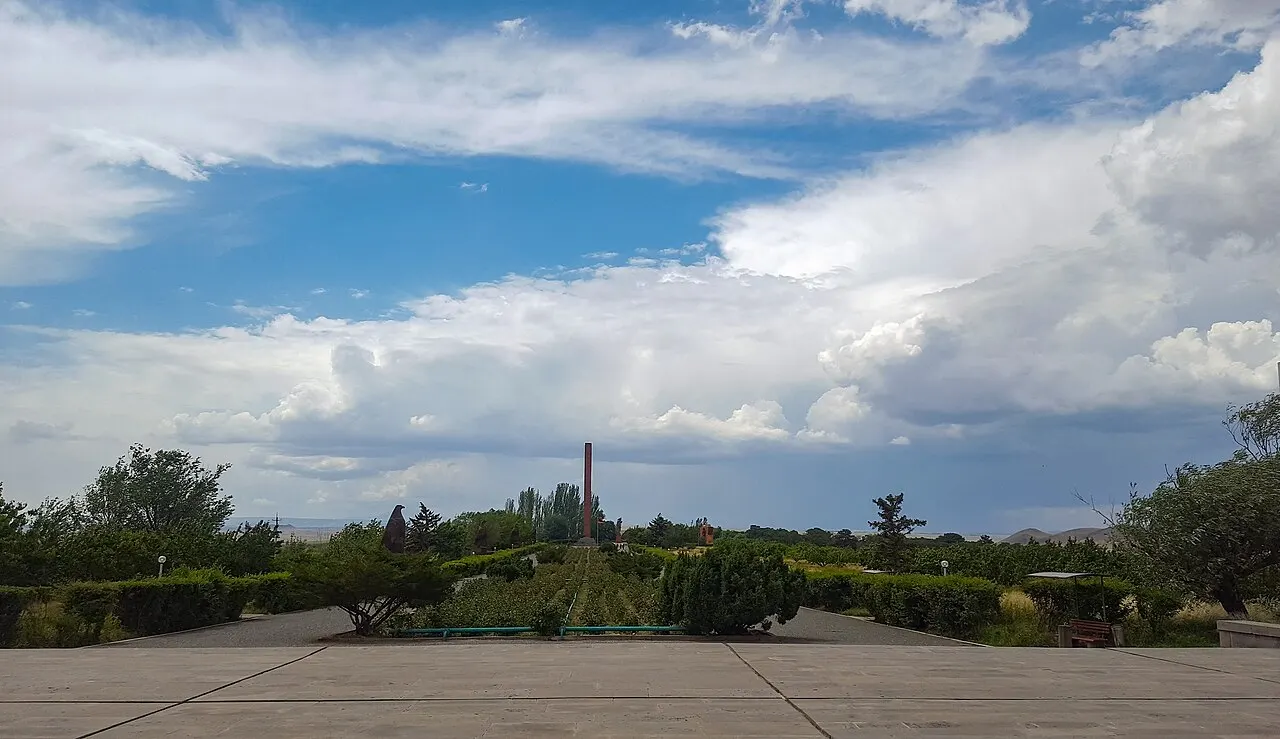
Sardarapat Memorial: Armenia's 1918 Battle Site
Verified · August 31, 2026Sardarapat Memorial near Armavir: 1918 battle site, Israelyan's red-tufa complex, ethnography museum tickets, hours and how to reach it from Yerevan.
What to see · 12 min read
Goshavank Monastery & the Village of Gosh
Verified · August 29, 2026Visiting Goshavank: Mkhitar Gosh's law code that reached Poland, the 1291 embroidered khachkar, his statue and hillside tomb, and the drive from Dilijan.