Garni Temple & Geghard Monastery: Day Trip from Yerevan
Garni and Geghard in a half-day from Yerevan: the only Greco-Roman temple in the region, a cliff-carved UNESCO monastery, Symphony of Stones and lavash.
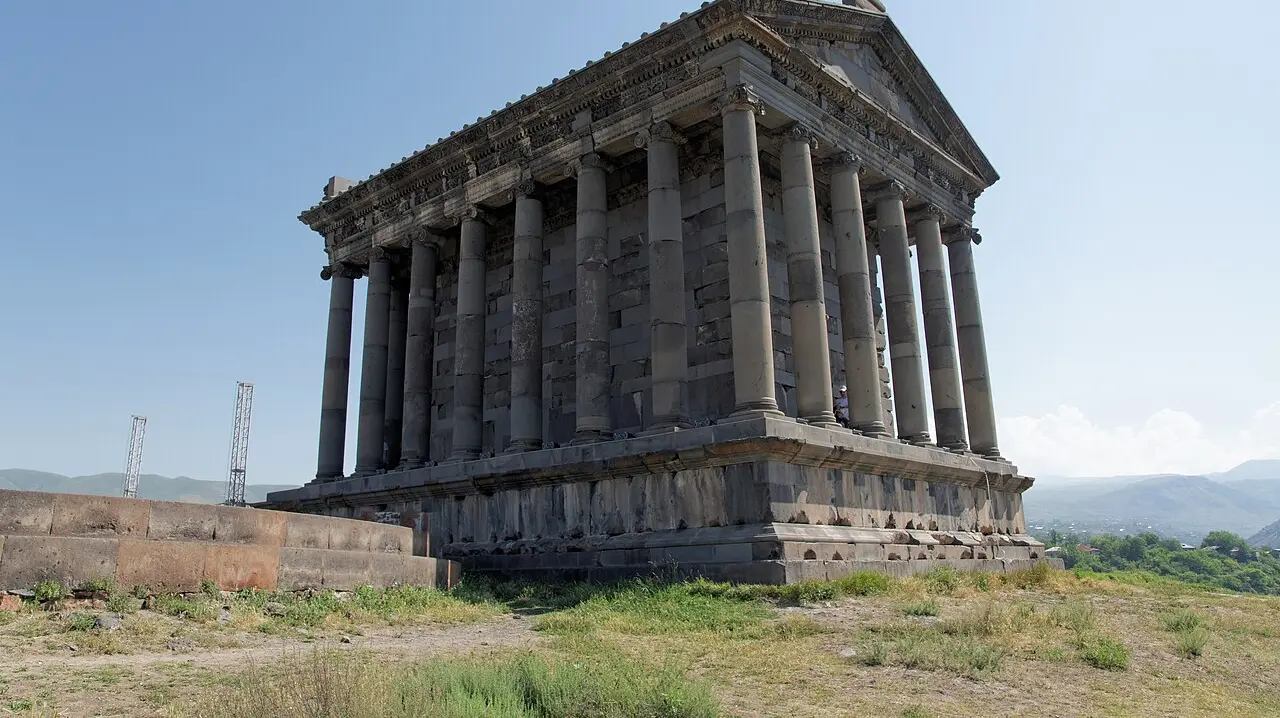
Garni and Geghard are the easiest big day out from Yerevan - two of Armenia’s headline sights, about 30 km east of the city and roughly 10 km apart, doable together in half a day. Garni is a first-century Greco-Roman colonnaded temple on a clifftop, the only one of its kind left in the whole former Soviet Union; Geghard is a medieval monastery half carved into the rock face of a gorge, a UNESCO World Heritage Site. Between the two you can climb down to the “Symphony of Stones” - a cliff of basalt organ pipes - and watch lavash baked in a fire pit. Without a tour, Armenia’s taxi apps cover the round trip from the city. This guide covers what you’re seeing at each, the money and the hours, and exactly how to string the two together in an afternoon.
Garni: a Roman temple where you least expect one
Come round the last bend and there it is, floating on the edge of a plateau above the gorge: a colonnade of grey basalt columns holding up a classical pediment, looking for all the world like it wandered off from Athens. Garni is the only standing Greco-Roman colonnaded building anywhere in the former Soviet Union, and it catches almost everyone off guard - you don’t expect a pagan temple in the Caucasus.
The prevailing view dates it to the first century AD and credits King Trdat I (Tiridates I) with raising it around 77 AD, probably as a temple to the sun-god Mihr. It’s built in the Ionic order - count the volutes curling at the top of each column - from 24 columns of local basalt fitted without a drop of mortar. For most of its life it was a royal summer residence and stronghold; the kings kept a bath house here too, and you can still see a Greek mosaic on its floor beside the temple.
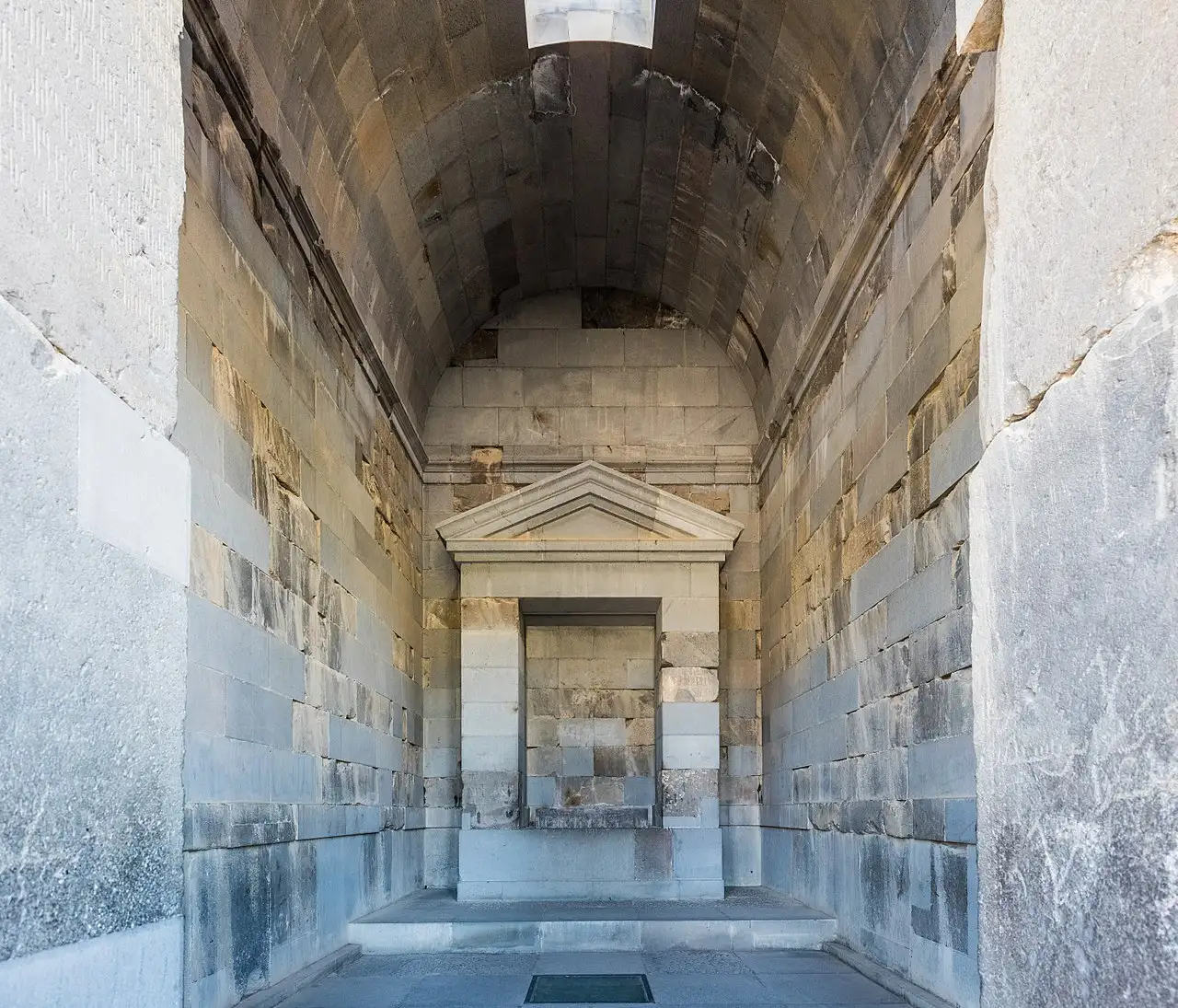
The part most guides skate over: what you’re looking at is largely a reconstruction. A savage earthquake in 1679 flattened the temple, and it lay in a heap of its own columns for nearly three centuries. Soviet-era archaeologists rebuilt it stone by stone between 1969 and 1975, slotting the original fallen blocks back into place and filling the gaps with fresh, paler basalt - look closely and you can pick out old stone from new. That doesn’t make it a fake; it makes it a rare piece of anastylosis, and it’s still genuinely moving to stand under a real Roman colonnade this far east. Give yourself twenty minutes to walk right round it - the view back over the gorge is half the point.
The Symphony of Stones, just below
Don’t leave Garni without the sight almost nobody photographs from the temple: right below it, in the Garni gorge along the Azat river, the cliff walls break into thousands of near-perfect hexagonal basalt columns. Cooling lava fractured into these regular pillars, some hanging dozens of metres overhead, curving and fanning like the pipes of a giant stone organ - which is why locals call it the “Symphony of Stones.”
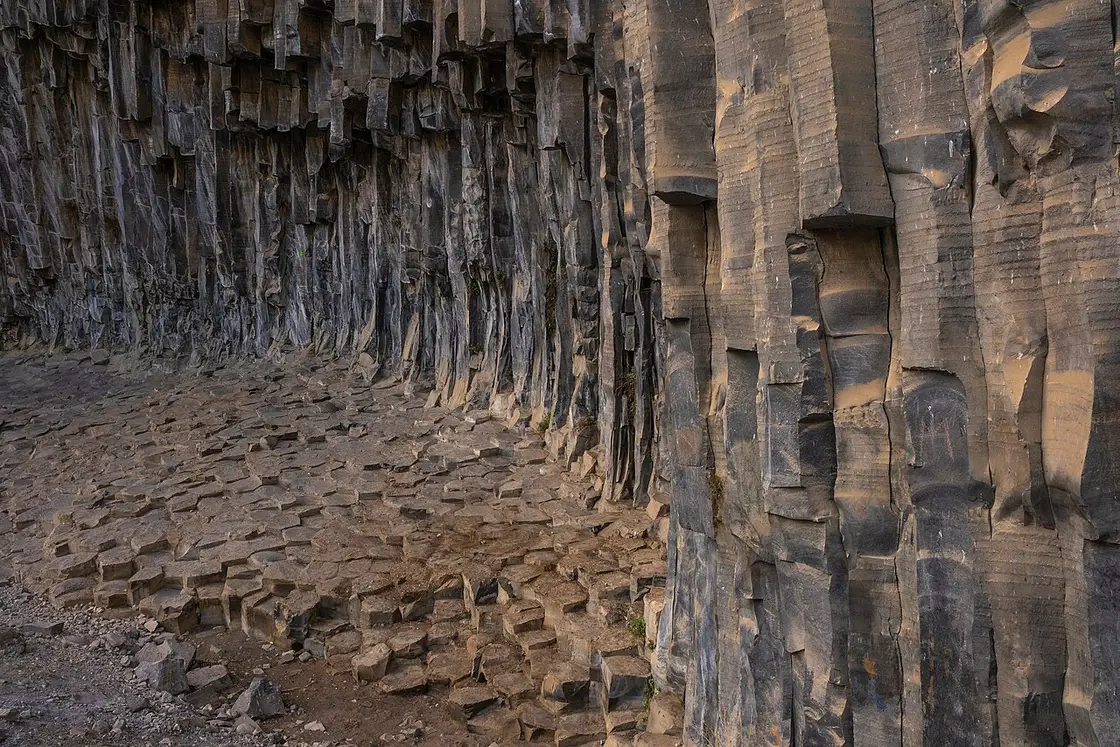
It sits at the bottom of the canyon, and there are two ways down. A narrow paved road drops from Garni village to the gorge floor - a five-to-ten-minute drive, and the move if you have a car or a willing taxi. On foot it’s a steep walk of roughly 2 km each way (allow half an hour down, longer back up in the heat); the trail is uneven in places, so wear proper shoes. There’s now a small entry fee (a few hundred dram - carry cash), and if you’re driving yourself it’s the easiest thing in the world to add - most tour groups, tight on time, skip it, which is exactly why it’s worth doing on your own.
Lavash in a tonir: the village stop
Garni village is also the classic place to see lavash made the old way. This thin, floppy flatbread - recognised by UNESCO as part of Armenia’s living heritage, a story our full guide to lavash covers in depth - is baked by slapping the rolled dough onto the searing wall of a tonir, a clay oven sunk into the ground like a well and fired with wood or vine cuttings. The baker reaches in bare-armed, presses the sheet to the wall, and peels it off blistered and smoking half a minute later.
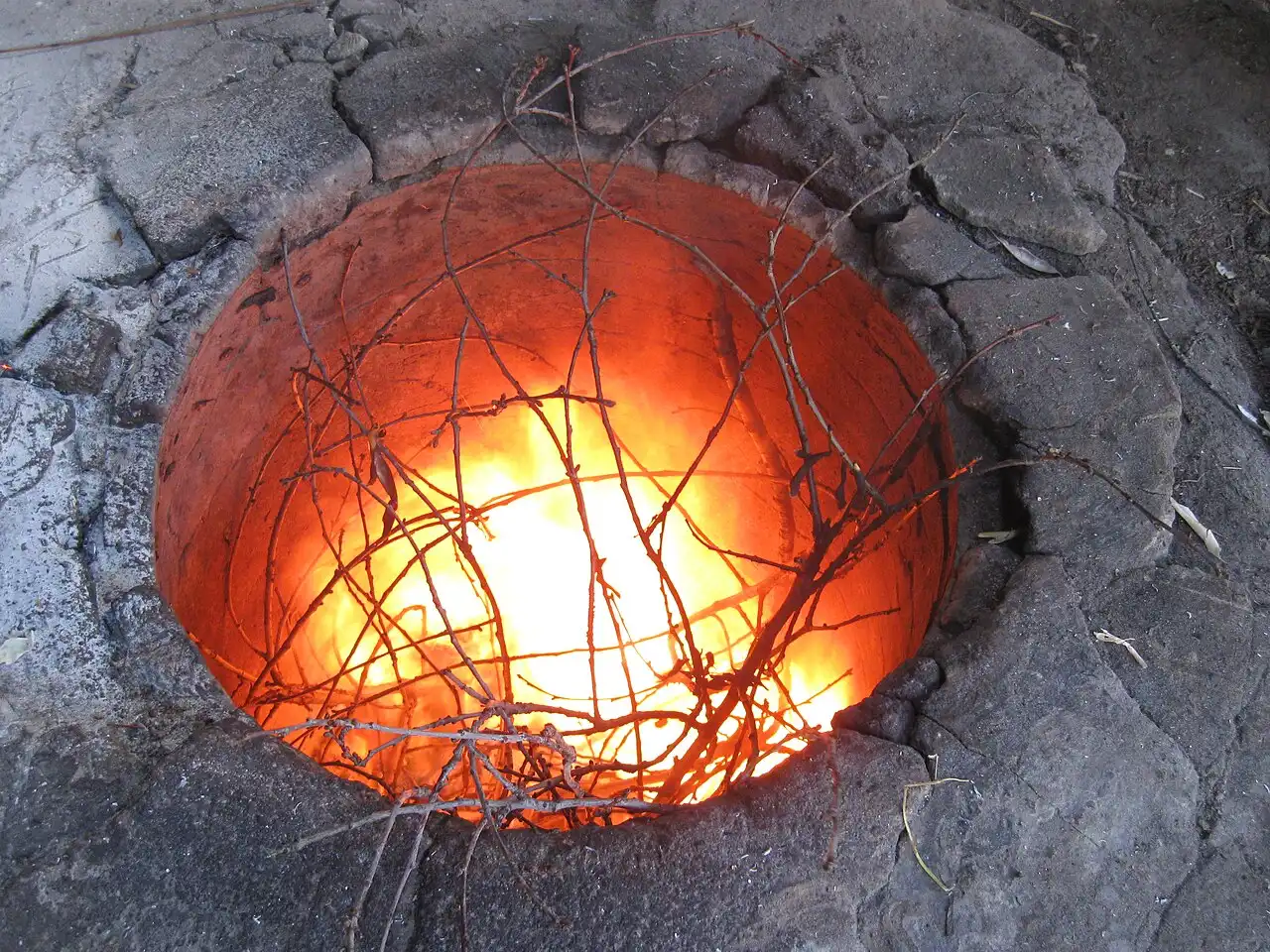
Yes, it’s laid on for visitors - but it’s the good kind of tourist stop, because the bread is real, still warm, and usually handed round with local cheese, herbs and a shot of something. Most organised Garni-Geghard tours fold a lavash-baking demonstration into the day; if you’re driving, look for the family houses in the village advertising it, or the roadside bakeries along the way.
Geghard: the monastery carved into the mountain
Ten kilometres on, the road runs out at the head of the Azat gorge, and Geghard rises straight from the rock. From the outside it reads as a normal fortified monastery - a domed main church built in 1215 by the Zakarid princes Zakare and Ivane - but step inside and the walls keep going into the cliff. Several of the chapels and halls are hewn directly out of the solid mountain, hollowed by hand from the living tuff, with rock-cut columns, altars and tombs that were never built so much as carved away.
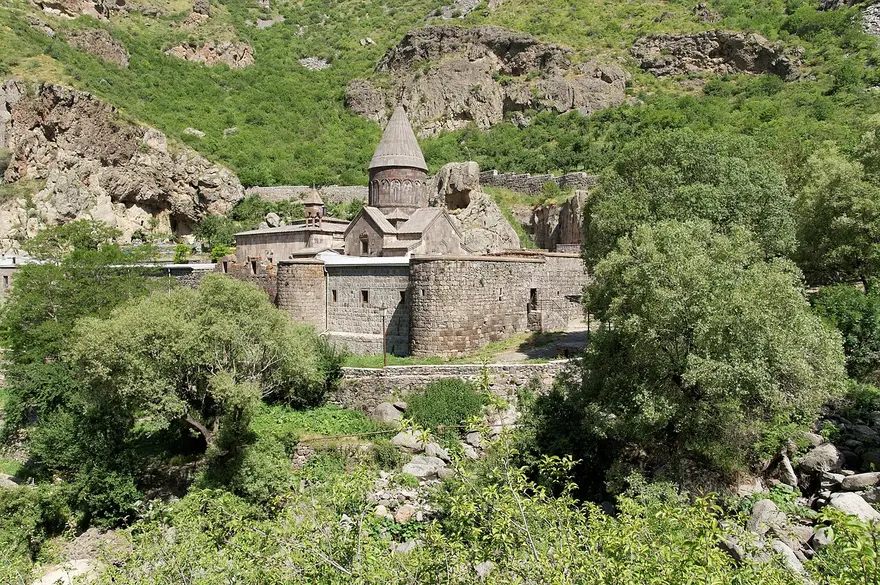
The name means “spear.” Geghard is short for Geghardavank, “the Monastery of the Spear,” after the lance said to have pierced Christ at the crucifixion - a relic reputedly kept here for centuries (it now sits in the treasury at Echmiadzin). Its older name, Ayrivank, means “Monastery of the Cave,” and the place was founded, by tradition, back in the fourth century by Gregory the Illuminator at a sacred spring inside a cave - the spring still runs, cold and clear, inside one of the rock-cut chambers, and pilgrims splash it on their faces for a blessing.
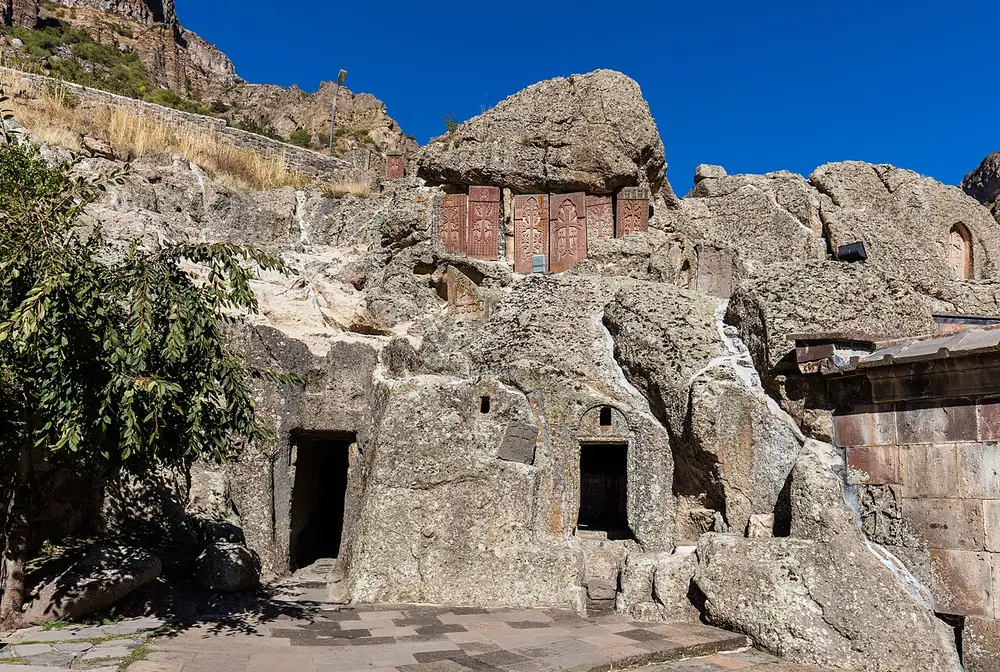
Two things to do inside, beyond simply gawping at the ceilings. First, hunt for the khachkars - the intricate Armenian cross-stones - carved by the dozen into the walls and the cliffs outside; some are nearly a thousand years old. Second, and don’t skip this: the deep rock-cut halls have extraordinary acoustics. If a small choir or even a lone singer starts up in the upper zhamatun (it happens most days, and a coin in the box keeps it going), the sound wells up out of the stone and hangs there. It is, for many people, the single best moment of the whole trip.
Geghard earned its UNESCO World Heritage listing in 2000, alongside the upper Azat valley around it - recognition of both the rock-cut architecture and the gorge it’s wedged into.
Money, hours and what to know before you go
Garni charges an entrance fee - 1500 AMD per adult (a few dollars) when we checked with the official museum-reserve; an optional guided tour costs more on top. The site is generally open daily, with longer summer hours and shorter winter ones, but the schedule shifts, so treat any posted time as a guide and confirm on the day rather than turning up at opening or closing on a promise.
Geghard is a living monastery and free to enter; there’s usually a small parking fee (a few hundred dram) and stalls at the gate selling dried fruit, gata pastry and sujukh. Because it’s an active church, dress modestly - cover shoulders and knees, and women may want a scarf indoors - and keep your voice down if a service is on.
A couple of practical notes. The Symphony of Stones charges only a token fee (a few hundred dram) but needs its own half-hour if you walk down. And there’s no clean public-transport link between the two. Bus No. 266 does reach Garni: on the ministry timetable, as we checked it on 2 October 2026, it leaves Yerevan’s Nor Nork terminus at the north end of Gai Avenue, by the Mercedes-Benz showroom, every 20-30 minutes from 07:50 to 19:20 and pulls into Garni village 55 minutes later, and the timetabled last bus back leaves Garni at 19:15; confirm the last return with the driver on your way out (no fare is printed either, so ask as you board). But it ends at Goght, the next village, and the only other bus through Garni, No. 52, runs three times a day between Abovyan and Geghard village, so neither goes up to the monastery. From Garni to Geghard you’re on your own for the last stretch - which is why almost everyone does this pair by car or tour.
How to combine the two in a half-day
The whole loop - Garni, the Symphony of Stones, a lavash stop and Geghard - packs neatly into about five hours round-trip from Yerevan, and there are three sensible ways to do it:
- An organised day tour is the popular default, and usually the best value: a driver-guide bundles Garni, Geghard and a lavash demonstration (often the Symphony of Stones too), and you just show up. Ideal if you don’t want to think about logistics.
- A private transfer or taxi buys you a fixed price and your own clock - good if you’d rather set the pace, linger at the temple, and be sure of getting down to the basalt columns.
- A rental car is the pick if you want to do all four stops properly, dodge the coach crowds by timing your own morning, and maybe push on somewhere else afterwards.
If you have only a couple of days in the country, this is the day trip to prioritise alongside the run south to Mount Ararat - and the two pair naturally. It is the second day of our 3 days in Yerevan itinerary for exactly that reason. Garni and Geghard are the top half-day in our guide to things to do in Yerevan, and the easiest trip on our roundup of the best day trips from Yerevan. The postcard monastery under Ararat gets its own write-up in our Khor Virap visiting guide. For the bigger southern loop to the Wings of Tatev cableway, and more canyons, caves and monasteries to build a route around, browse the full attractions section. To see where Geghard sits among the country’s finest churches and how to pace them, read our roundup of the best monasteries in Armenia. Geghard is also one of Armenia’s three UNESCO sites, mapped out in our guide to the UNESCO World Heritage Sites in Armenia.
Photos
On the map
The map loads on click - to keep the page lightweight.
The map didn’t load. Check your connection and refresh the page.
Read also

What to see · 10 min read
Soviet Modernist Yerevan: An Architecture Walk
Verified · September 5, 2026Walk Yerevan's Soviet modernism: Rossiya Cinema, Komitas Hall, Cascade, Hrazdan Stadium and Demirchyan Complex - dates, route order, and what still stands.

What to see · 9 min read
Kond: Walking Yerevan's Oldest Neighborhood
Verified · September 3, 2026Walk Kond, Yerevan's oldest living quarter: Surp Hovhannes, Tepebashi mosque walls, Leo Street alleys, and how to visit without treating it like a set.
What to see · 8 min read
Sardarapat Memorial: Armenia's 1918 Battle Site
Verified · August 31, 2026Sardarapat Memorial near Armavir: 1918 battle site, Israelyan's red-tufa complex, ethnography museum tickets, hours and how to reach it from Yerevan.
What to see · 12 min read
Goshavank Monastery & the Village of Gosh
Verified · August 29, 2026Visiting Goshavank: Mkhitar Gosh's law code that reached Poland, the 1291 embroidered khachkar, his statue and hillside tomb, and the drive from Dilijan.