Karahunj (Zorats Karer): The Armenian Stonehenge
Visit Karahunj (Zorats Karer), Armenia's answer to Stonehenge: 223 standing stones near Sisian, the whistling holes, the real age, and how to get there.
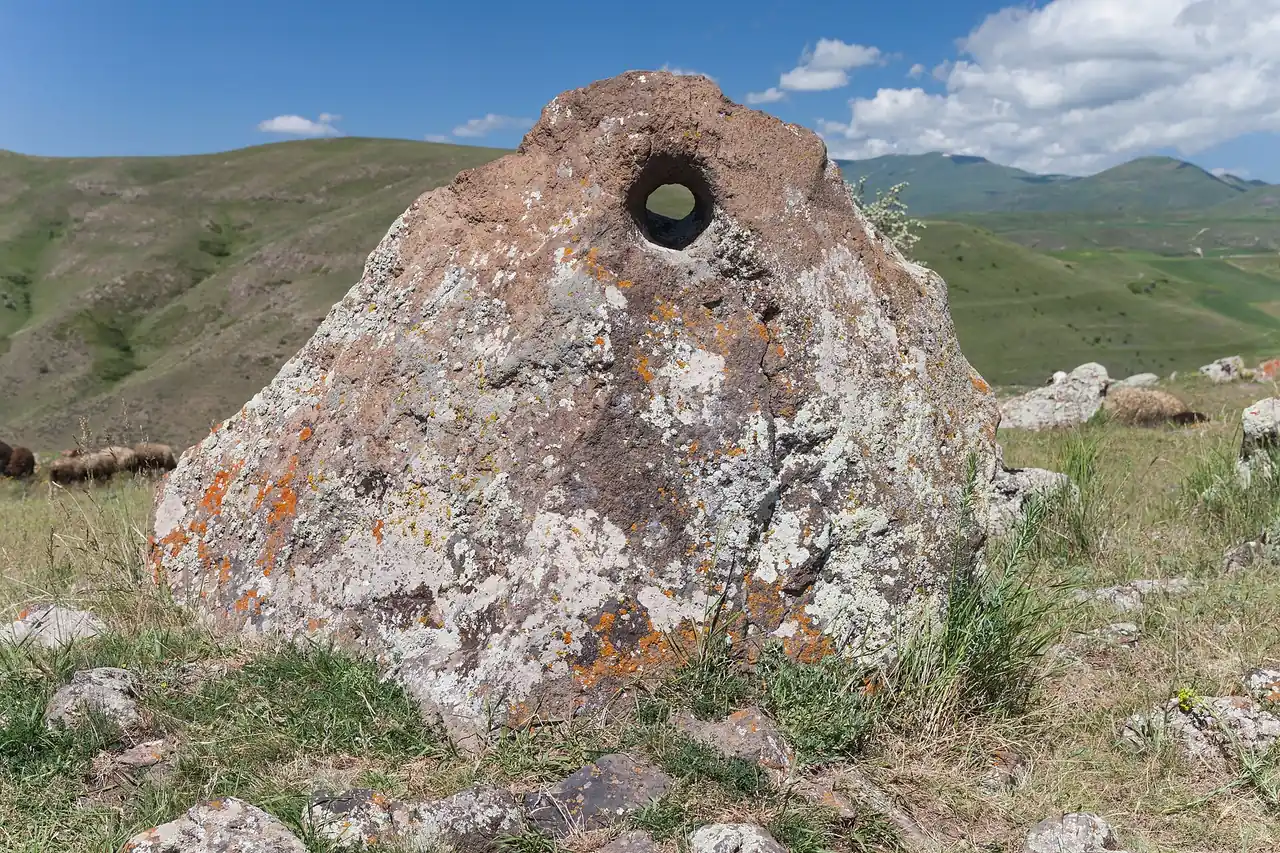
Karahunj is a field of 223 upright stones on a windswept plateau near Sisian in southern Armenia, and for years it has been sold as “the Armenian Stonehenge.” Some of the stones are pierced with clean round holes, the whole site is said to be the world’s oldest observatory, and a popular figure puts it at 7,500 years old - older than Stonehenge and the Egyptian pyramids. Entry is free, it sits about 3.5 hours south of Yerevan, and it’s far more rewarding once you know which of those claims are solid and which are hopeful. So it is worth knowing what you are actually looking at - and how the stones fit into a trip through the south.
A field of standing stones
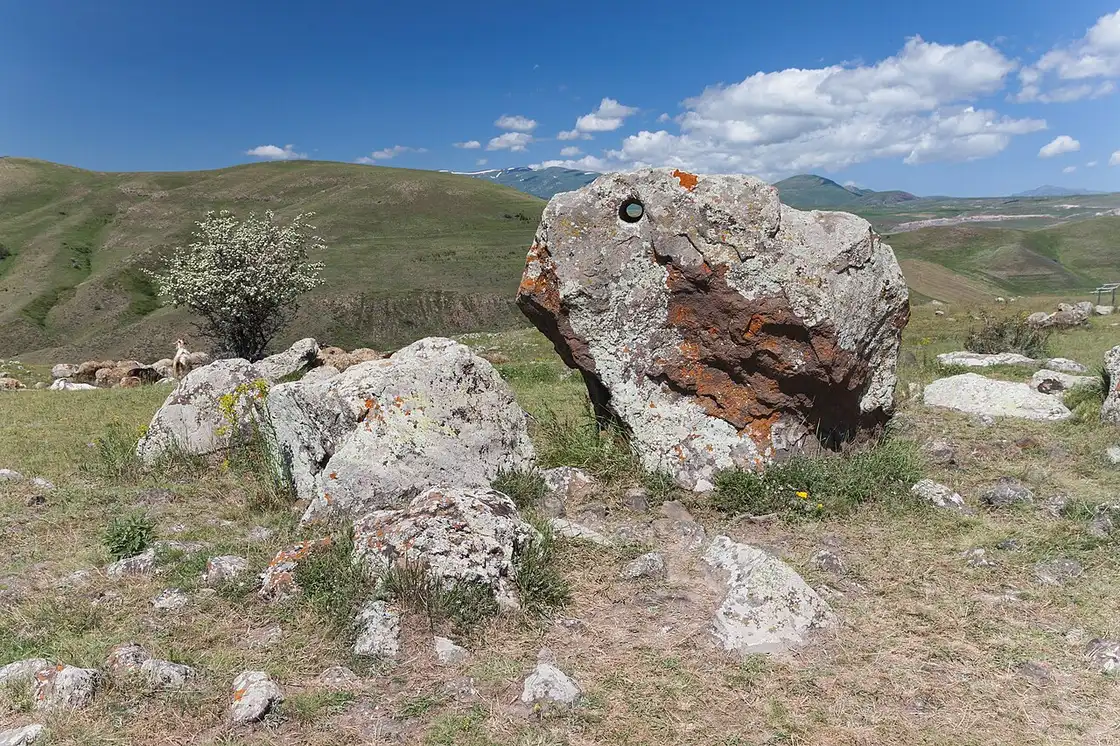
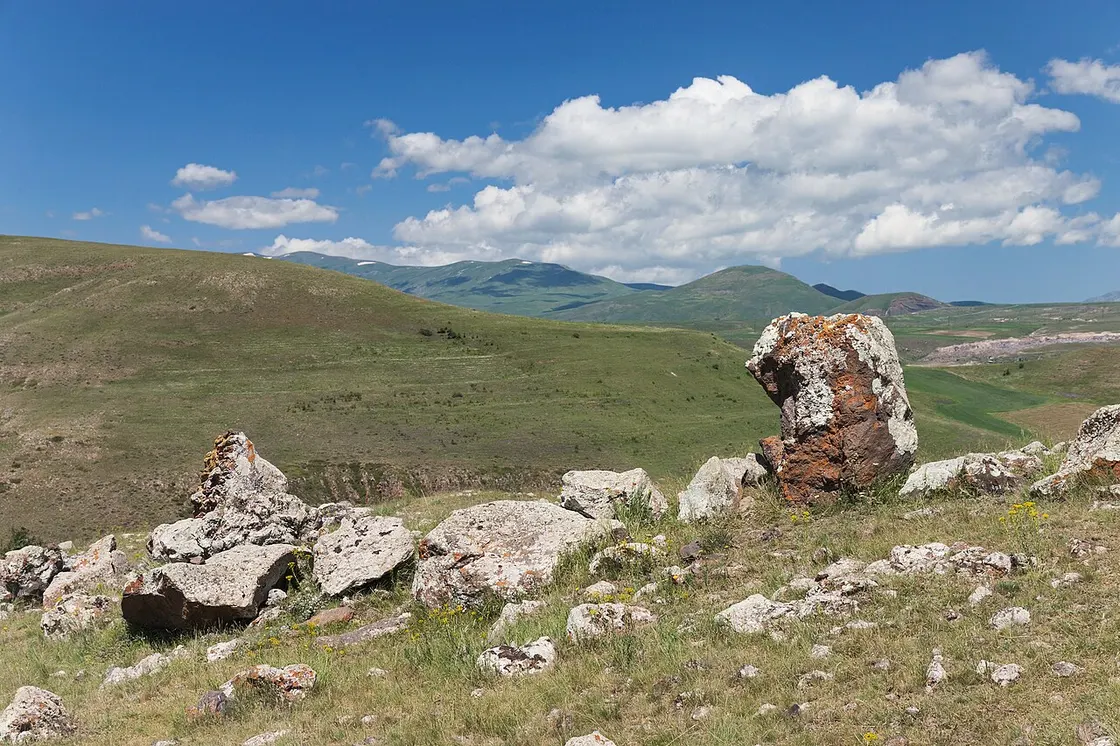
The site spreads over roughly 7 hectares of high plateau at 1,770 m, a treeless, wind-scoured shelf ringed by the green Zangezur mountains. Across it stand 223 stones of basalt and andesite, most between half a metre and three metres tall, the biggest weighing up to ten tons, set upright in rough arms and an oval that reads, from the right angle, like a deliberate plan. There’s no ticket booth and no fence: you walk straight in among them, put a hand on the lichen, and have the place largely to yourself outside the odd tour van.
Look closer and there’s a plan in the scatter. Most of the stones cluster in a central group, and from it two longer arms of monoliths run out to the north and south, with more stones set off on their own around the edges. At the heart of that central group are the remains of stone-lined graves, and those are the strongest clue to what at least part of the site was for: a burial ground. Whether the arrangement also tracked the sky is the argument that has run for decades, and it is worth knowing the shape of that debate before you decide what you’re standing in.
It carries two names, and the difference matters. The older Soviet-era label is Zorats Karer, usually translated “army stones” or “stones of power.” The name that stuck in the guidebooks is Karahunj (also spelled Carahunge), from the Armenian car, stone, and hunge, voice or sound - “the speaking stones.” That’s not just poetry.
The holes that whistle
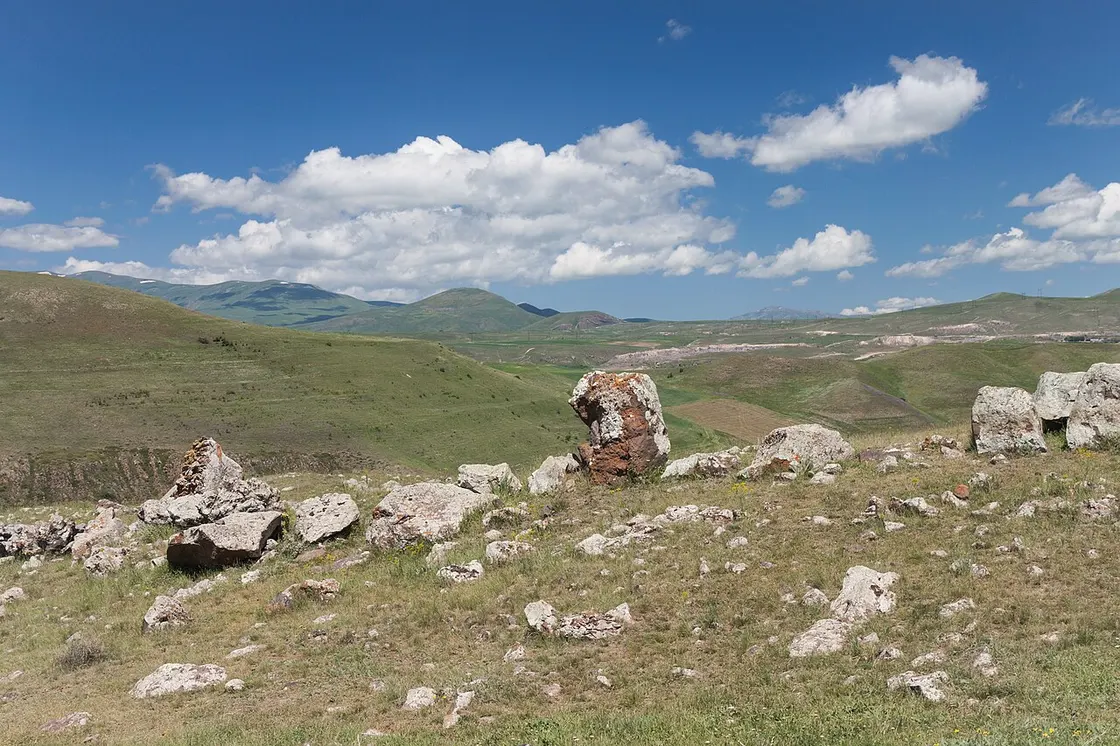
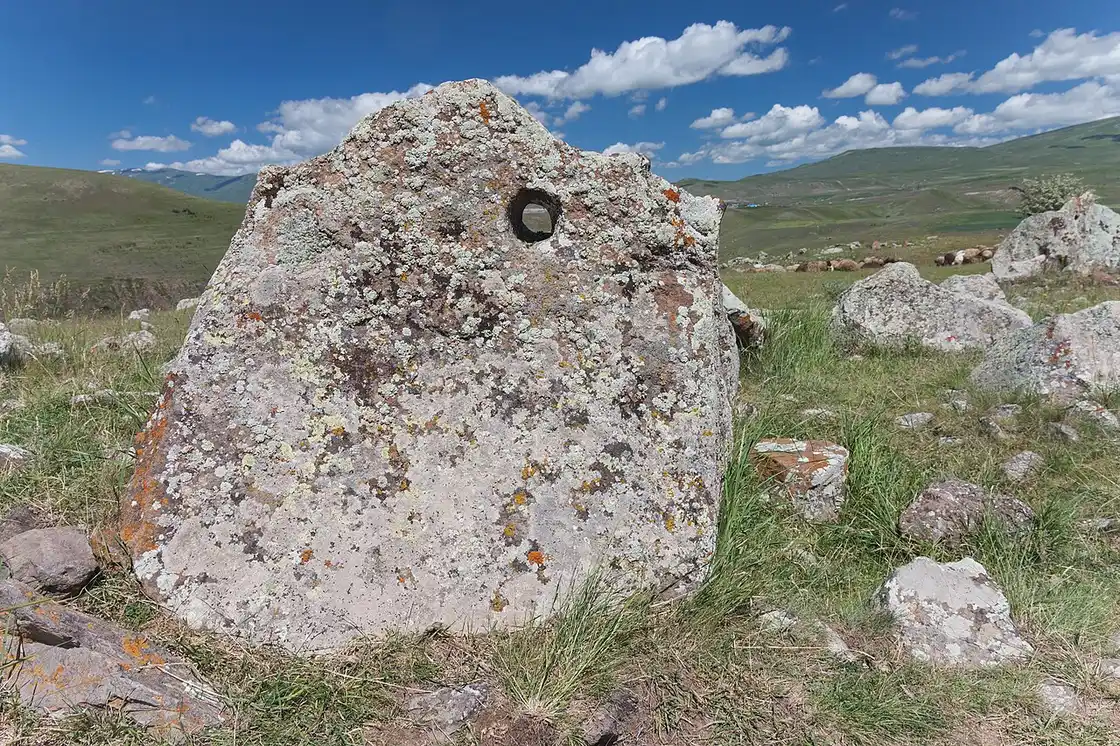
The signature of Karahunj, and the thing you should walk over to find, is the holes. About 80 of the stones were bored through with smooth round openings, roughly five centimetres across, angled through the rock; today 37 of those holed stones are still standing, carrying 47 holes between them. On a gusty day, and this plateau is rarely still, the wind moving through them produces a low whistle. Stand close and you understand where “speaking stones” comes from: the field murmurs.
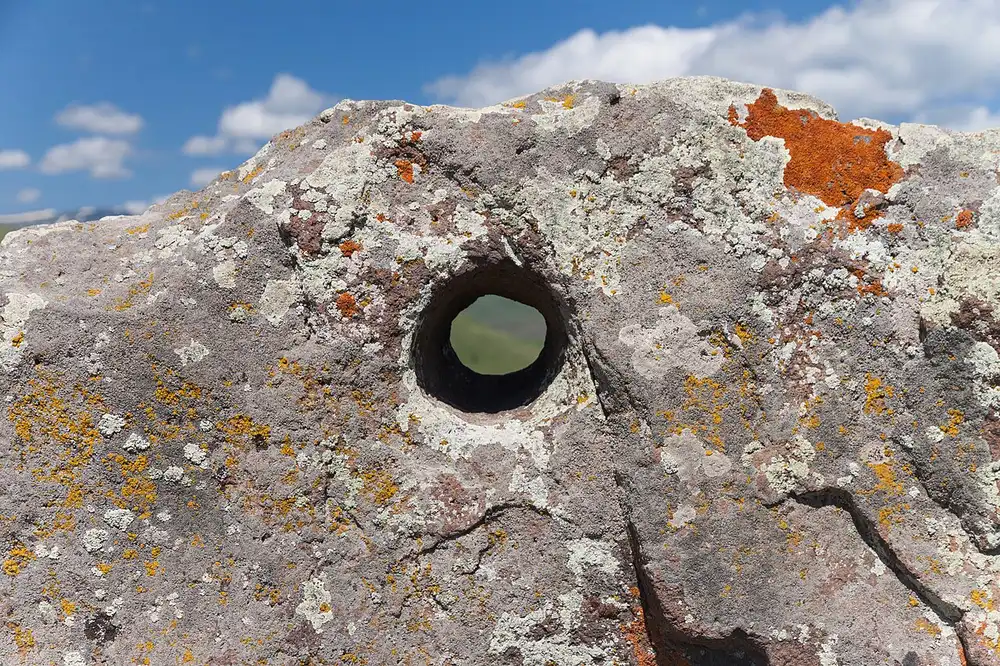
Those holes are the whole basis of the observatory theory. In the 1990s the Armenian physicist Paris Herouni and his team surveyed the site (1994-2001) and concluded it was “the world’s oldest astronomical observatory”: they read 17 stones as aligned to sunrise and sunset at the solstices and equinoxes, and 14 more to the extremes of the Moon, arguing that ancient astronomers sighted the horizon through the holes. The British-American astronomer Gerald Hawkins, who had made his name decoding Stonehenge, endorsed Herouni’s conclusions in 1999. In 2004 Armenia’s government made it semi-official, naming the site the “Karahunj (Carahunge) Observatory” by decree.
How old is it, really?
This is where a good visit needs a clear head, because the headline numbers are the shakiest part. The famous 7,500-year age, and the “older than Stonehenge” line, come from Herouni himself and are tied to his observatory reading. Mainstream archaeology doesn’t accept them. A German survey team working around 2000 read Karahunj primarily as a necropolis - a burial ground of stone-cist tombs dating mostly from the Middle Bronze Age to the Iron Age, which puts the bulk of it in the second and first millennia BC, not the sixth. Specialists in archaeoastronomy, including Clive Ruggles and A. César González-Garcia, have gone further and called the star-alignment claims untenable, noting that the holes themselves may not even be prehistoric.
So what should you believe? That Karahunj is genuinely ancient and genuinely mysterious, that people were buried and gathered here thousands of years ago, and that nobody has proved what the holes were for. The tidy story of a 7,500-year-old observatory is a hypothesis wearing an official name, not a settled fact. If anything that makes standing in the field better, not worse: you’re looking at a real unsolved question, not a museum caption. Bring the skepticism and the wonder both.
What it is actually like to be there
Manage your expectations on scale and you will love it. The comparison with Stonehenge is worth taking with a pinch of salt once you’re on the ground. Stonehenge is a tightly engineered ring of shaped stones, some weighing around 25 tons, capped with stone lintels and dated to roughly 3000 BC; Karahunj is the opposite - unshaped basalt boulders standing in rough lines across an open plateau with nothing balanced on top. These are not the house-sized trilithons of England; Karahunj is lower, rougher and more scattered, a waist-to-head-height field you wander rather than circle from behind a rope. Come picturing a windswept highland scatter of lichen-covered stones rather than a cathedral in stone, and you will read it right. That openness is the point. You can walk the arms, sight through the holes at the horizon, and work out for yourself whether the alignments feel real - a far better experience than any fenced-off site, and a hands-on one that small children tend to enjoy.
Come dressed for a bare plateau at altitude. There’s no shade and no shelter: the midday sun is fierce, the wind almost constant, and a clear morning can still be cold up here. Early and late are the best light and the fewest people, and sunset over the stones is the shot everyone wants. Give it about an hour and a half to do properly, bring water and a wind layer, and watch your footing on the uneven, stony ground. Entry and parking are free at the time of writing, and while local guides sometimes offer a walk-through for a small fee, confirm anything on the day rather than banking on it.
Getting there and building it into the south
Karahunj is about 210 km and roughly 3.5 hours south of Yerevan on the M2, and only 3 km from the town of Sisian, which is where you turn off. There’s no useful public transport to the stones themselves, so in practice you either drive or reach Sisian or Goris first and take a taxi out (agree the fare and ask the driver to wait, as there’s nothing to flag down on the plateau).
Because it sits so deep in Syunik, almost nobody comes for Karahunj alone, and you shouldn’t either. The smart move is to treat it as one stop on a southern loop, and there’s one pairing worth planning around. The Shaki waterfall is a few kilometres the other side of Sisian, but its flow is controlled by a hydro plant and only released from 11:00. So do the stones first, in the early light while the plateau is empty, and drive over to the falls for eleven; reverse the order and you lose the best hour of the morning at a dry cliff. If you’re overnighting in Sisian in July-September, the high crater of Ughtasar is the other prehistoric stop - a 4x4 morning to a lake at 3,300 m, not another field of standing stones. Goris is only about 35 minutes away and makes the natural base; from there you’re within reach of the region’s headline sights. You can, in theory, chain Karahunj with Tatev as a single enormous day from the capital, but that’s close to 500 km of driving and forces you to rush both - an overnight in the south is far kinder.
The pairing that makes the drive worth it’s with the region’s two other headline sights. Half an hour past Goris is Tatev monastery and the Wings of Tatev cableway, the longest reversible ropeway in the world, and just east of town is the cave village and swinging bridge of Khndzoresk. Our guide to Goris covers where to sleep and eat as the southern hub, the leg-by-leg drive down is in Yerevan to Goris and Tatev, and if you’re still weighing whether the far south earns two days, see where it lands among the best day trips from Yerevan. Do it as part of that loop, stand in the whistling field at sunset, and the argument about 7,500 years stops mattering - the place holds you either way.
Photos
On the map
The map loads on click - to keep the page lightweight.
The map didn’t load. Check your connection and refresh the page.
Admission and opening hours
- Admission price
- Free
- Opening hours
- Open field, no gate - accessible any time
Entry and parking free at the time of writing; optional local guides reported around AMD 3,000-5,000. Confirm on the day.
Details checked: July 18, 2026
Distance ≈210 km · about 3.5 hours by road
- Yerevan ≈210 km · about 3.5 hours by road South on the M2 to Sisian, then ~3 km to the plateau. No useful public transport to the stones; reach Sisian or Goris first, then taxi or drive. Confirm locally.
Read also

What to see · 10 min read
Soviet Modernist Yerevan: An Architecture Walk
Verified · September 5, 2026Walk Yerevan's Soviet modernism: Rossiya Cinema, Komitas Hall, Cascade, Hrazdan Stadium and Demirchyan Complex - dates, route order, and what still stands.

What to see · 9 min read
Kond: Walking Yerevan's Oldest Neighborhood
Verified · September 3, 2026Walk Kond, Yerevan's oldest living quarter: Surp Hovhannes, Tepebashi mosque walls, Leo Street alleys, and how to visit without treating it like a set.
What to see · 8 min read
Sardarapat Memorial: Armenia's 1918 Battle Site
Verified · August 31, 2026Sardarapat Memorial near Armavir: 1918 battle site, Israelyan's red-tufa complex, ethnography museum tickets, hours and how to reach it from Yerevan.
What to see · 12 min read
Goshavank Monastery & the Village of Gosh
Verified · August 29, 2026Visiting Goshavank: Mkhitar Gosh's law code that reached Poland, the 1291 embroidered khachkar, his statue and hillside tomb, and the drive from Dilijan.