
Shaki Waterfall: Syunik's 18-Metre Cascade
Shaki waterfall near Sisian runs to a hydro plant timetable: 11:00-19:00 in summer, 11:00-17:00 in spring and autumn. How to avoid a dry cliff.
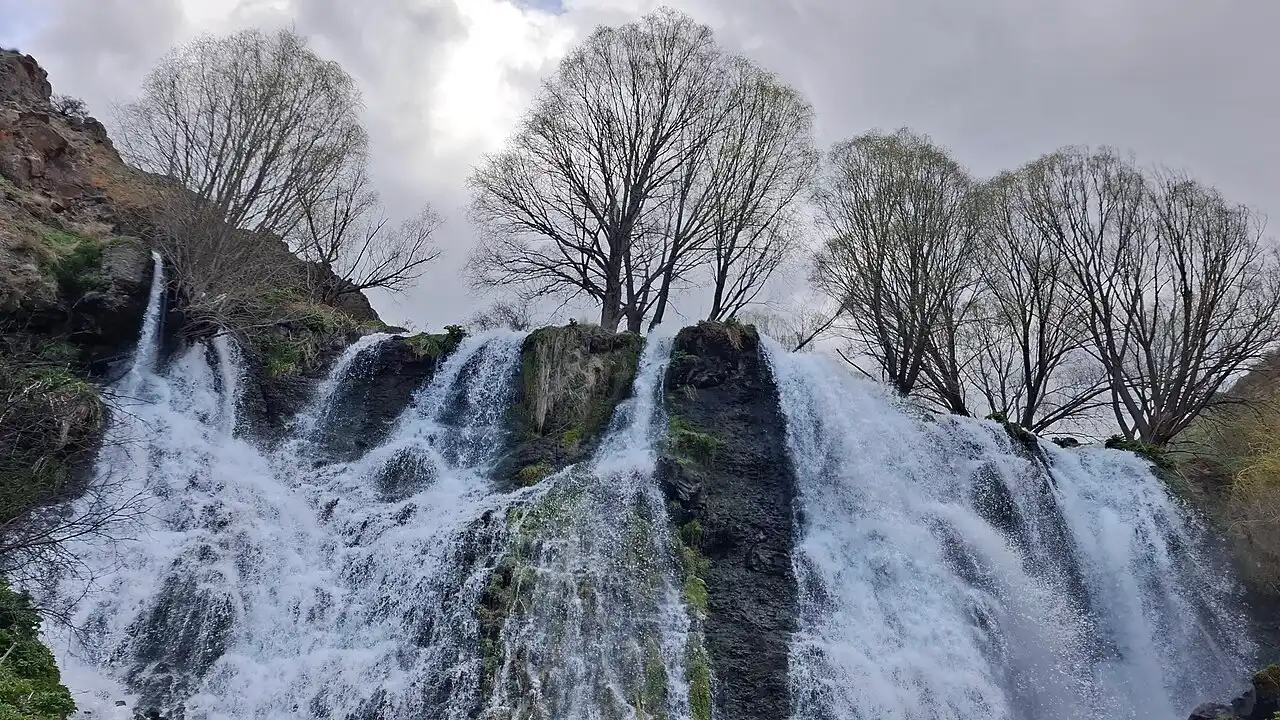
Shaki is an 18 m spread of water over a basalt ledge a few kilometres outside Sisian, and it keeps opening hours, which isn’t a sentence you often write about a waterfall. A small hydroelectric plant takes the river into a pipe above the drop, and an environment ministry order sends the flow back to the falls in the middle of the day: 11:00 to 19:00 from 1 May to 30 September, and 11:00 to 17:00 from 15 March to 30 April and again from 1 October to 15 November. Arrive at nine in the morning and you’ll photograph a damp cliff.
Coach tours out of Yerevan land inside the window without ever learning the arrangement exists. Independent drivers, who start early to get ahead of the heat and the traffic, are the ones who fall into the trap. Time it right and Shaki is the best stop on a drive that badly needs one. Time it wrong and you’ve burned an hour on a wet rock.
The timetable, and who holds the valve
The plant dates from 1934, was privatised in 1997, sits on the Shaki river above the ledge and is run by a company called Hakobjanyan and Galstyan HPP. By 2016 Armenian environmental reporting described the falls as effectively gone: the water piped off, the site fenced as the plant’s private property, and artificial fish ponds nearby taking still more of the river.
After a campaign by the environmental group EcoLur, the ministry rewrote the plant’s water-use permit in April 2017, and the arrangement is now law. Order N 68-N of 21 March 2018, the natural monument passport for Shaki, makes the hours above a condition of that permit, caps abstraction at 1.5 cubic metres per second and requires an ecological release of 200 litres per second the rest of the time. The order is still listed as in force, which is why the hours have not moved in years.
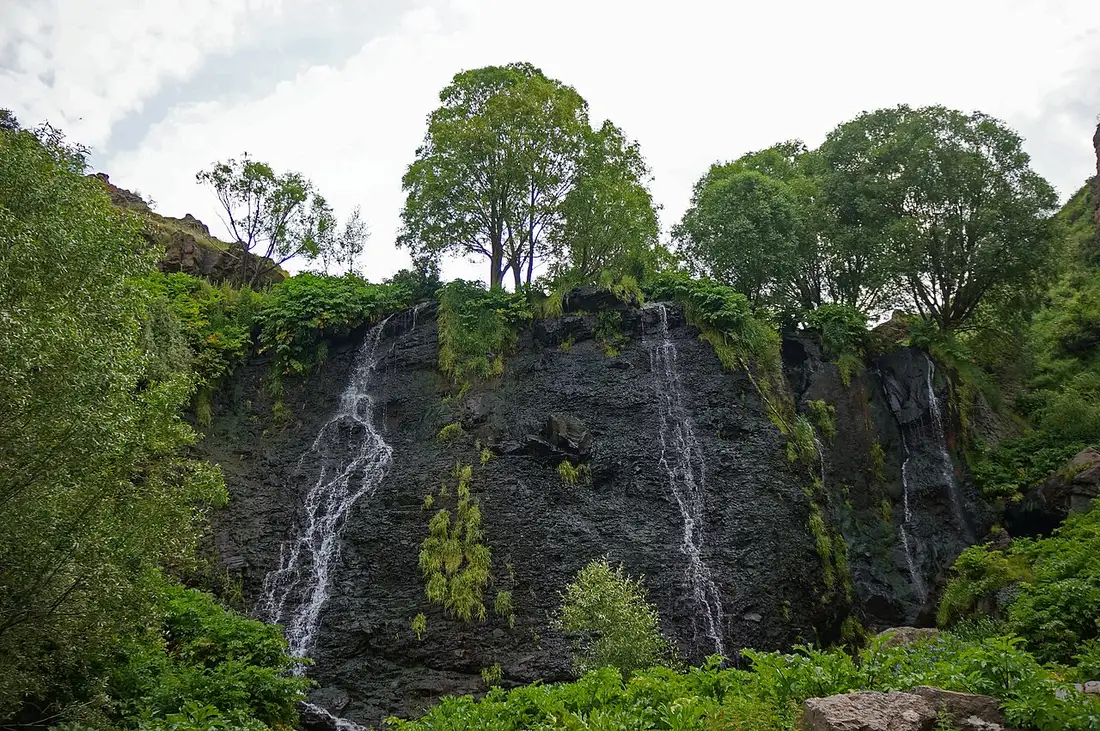
Now the honest part, because it changes how you plan. The schedule has been broken more than once. On 2 May 2020 the falls were almost dry, as EcoLur reported two days later, and the environmental inspectorate answered that it can only check the plant if somebody files a written complaint. That August the same group filmed water being drawn off at midday, inside the prohibited window. In September 2020 reporters from the newspaper Haykakan Zhamanak stood at the falls at 10:00, found them almost completely dry, and were told the water would be given in an hour, with a suggestion to hand the plant 5,000 drams to switch it on early. That was journalism about one specific morning, not a service on a price list, and it’s not something to plan around.
More useful is a line from April 2022, when the head of Shaki settlement told EcoLur the falls can be seen roughly from 9:30 to 20:00 depending on how many tourists there are. Read that carefully: the valve is worked by people who watch the car park. A minibus full of visitors is an argument for water. A single couple at 09:15 isn’t.
So treat the published hours as a firm plan rather than a guarantee. If you’re staying in Sisian, ask your guesthouse to check on the morning you drive out, because the hours live in a legal act and nowhere a visitor would look: there’s no phone number and no opening-hours page for the falls. The freshest evidence they’re still kept is the cover photograph at the top of this page, taken at 11:34 on 24 April 2026, thirty-four minutes into the spring window, at full flow. And mind the season: between 16 November and 14 March the schedule does not apply at all.
What you are actually looking at
The ledge is a flow of basalt lava that solidified on the left side of the Vorotan gorge, and Shaki photographs so well because the water does not come down as one jet. It fans out across the whole face in dozens of separate threads, with trees growing along the lip, which is why the same wall can look like a white curtain one week and a set of trickles the next.
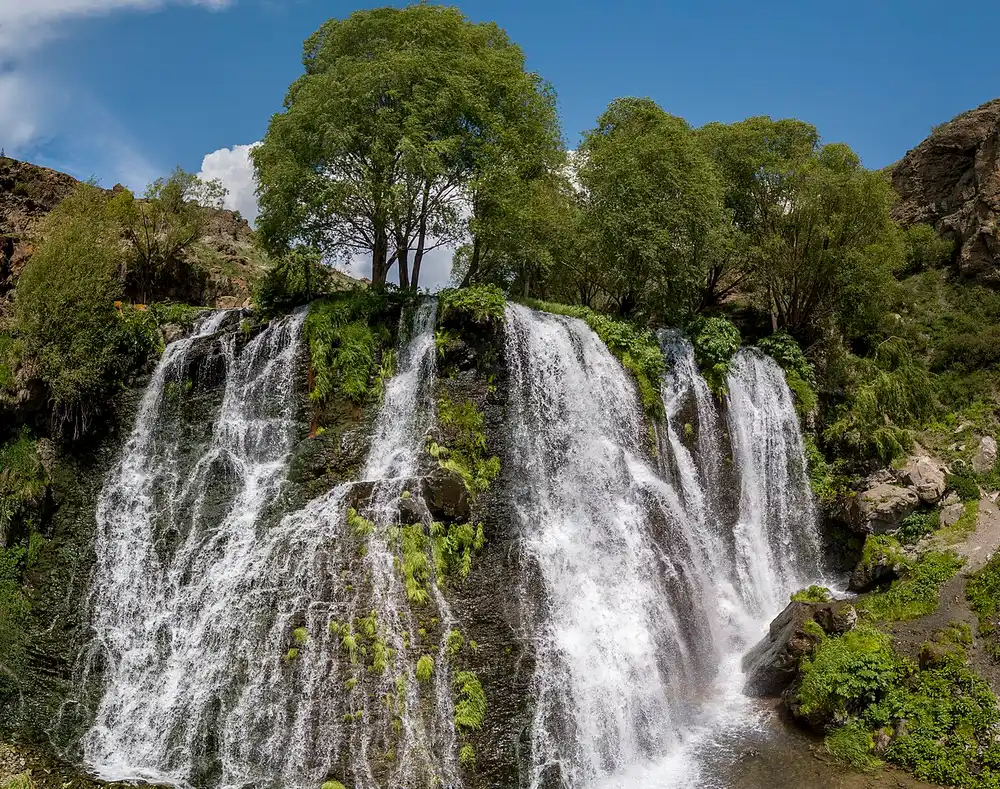
Nobody quite agrees on the height. 18 m is the figure printed everywhere, the official passport says 18-20 m, Armenian encyclopaedias give 15-17 m, so anything in that range is honest. The passport is firmer on the rest: 12 m wide, at 1,720 m above sea level, the river running 2.57 cubic metres per second in May and down to 0.57 by December. Local media also like to call Shaki the highest waterfall in Armenia, and that’s simply not so: the fall at Jermuk drops around 70 m. Shaki’s claim is more practical. It’s the best-known waterfall in the country and the one the southern tour buses actually stop at, minutes from the road every visitor to Syunik already drives.
It has been a state natural monument since a government decree of August 2008, the status the campaign to make the plant share the river leaned on, and the 2018 passport is what turned that status into hours on a clock. The same document records ash dated to the Palaeolithic in the caves around the gorge, so the archaeology here is not folklore: it sits in the legal description of the site.
Getting there, and the bus problem
The falls sit on the Shaki river just above where it joins the Vorotan, about 1 km south of Shaki village. Armenian sources put them 3 km northwest of Sisian and English Wikipedia says 6 km, which is roughly the difference between the straight line and the road; either way it’s a short hop from town rather than an excursion, and the turn is signposted. Sisian itself is 217 km from Yerevan at 1,600 m of altitude, so from the capital reckon on about 3.5 hours down the M2.
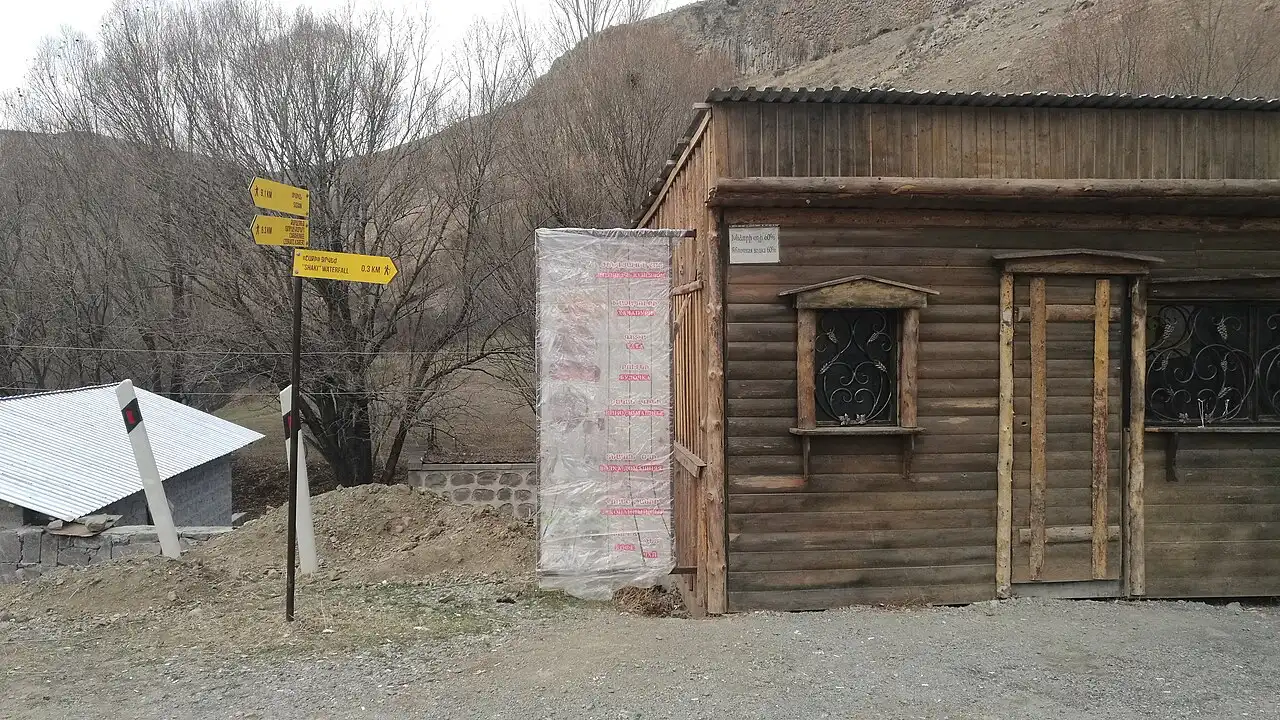
From the car park it’s a short walk in, put at about 600 m and rated easy in ordinary shoes. The caveat is weather: the ground is rocky and turns muddy after rain, so if it has rained in the last day or two you want a sole with some grip. It is not a wheelchair-accessible site. No source names a ticket price and visitors report walking straight in, but carry small notes for the kiosk and in case somebody is collecting for parking.
Public transport is where the timetable really bites. The bus to Sisian, No. 601 on the ministry’s Syunik timetable, leaves Yerevan’s Central Bus Station (Kilikia) every day at 09:00 and 14:30 and is due in Sisian at 14:10 and 19:40, so 5 h 10 min; the timetable prints no fare, so ask the driver. A taxi from Yerevan was quoted around 20,000 AMD one way. For Goris, No. 602 (often called 607) leaves the Southern Bus Station at 08:30 and 15:00 and is timetabled at 5 h 50 min, and travellers report shared taxis at about 4,500 AMD a seat. Between the two towns there’s a scheduled local bus as well, No. 08-001: it leaves Sisian at 09:00 and 16:00 and takes 1 h 15 min to Goris, coming back at 11:00 and 18:00. Confirm the lot locally, because none of it’s built around an 11:00 window and none of it covers the last few kilometres out to the falls. Realistically you come by car, by taxi held for the wait, or on a tour. Our guide to getting from Yerevan to Goris and Tatev has the southern buses in full, and car rental in Armenia covers what these mountain roads ask of a hire car.
Slotting it into the drive south
Here’s the ordering trick that makes the day work. The standing stones of Karahunj sit 3 km off the M2 on the other side of Sisian, free and unfenced and open at any hour, and they look their best in early light on an empty plateau. Do the stones at 09:00, have coffee in Sisian, and roll up at Shaki at 11:00 when the water is due. Reverse that order and the one good morning hour goes on staring at a pipe. The crater lake at Ughtasar sits above the same town, but that’s a 4x4 day of its own, not a stop you squeeze between the stones and the valve.
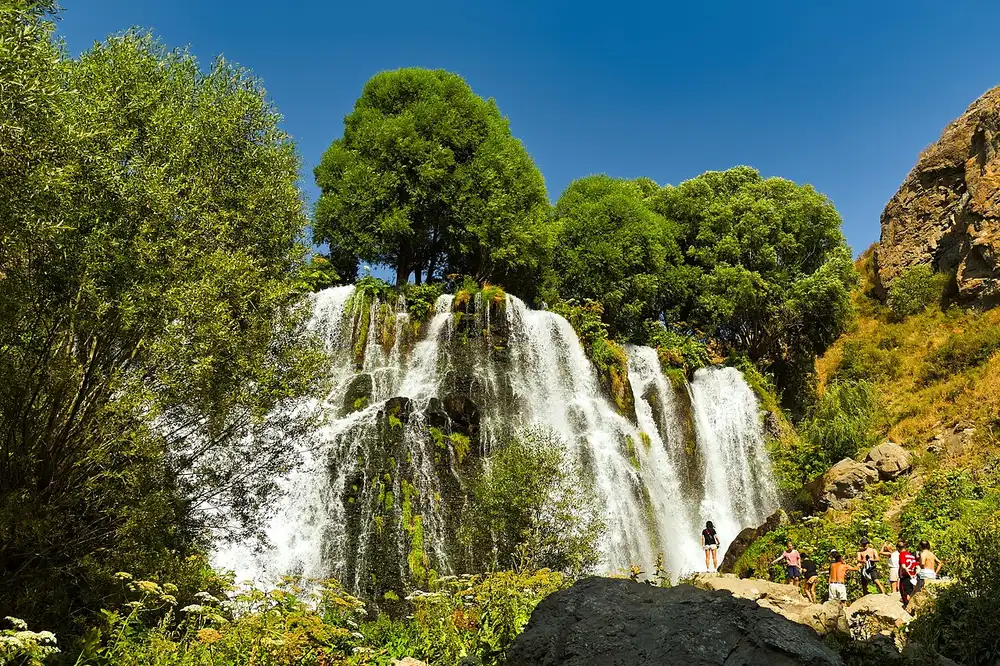
After that the road runs on to Goris, the cave village of Khndzoresk with its swinging bridge, and the cable car at Tatev; our three-day southern road trip strings the lot together with the overnight stops in the right places. If it’s waterfalls you’re after rather than a stop on the way, the 70 m fall at Jermuk is bigger, and it doesn’t run on anybody’s timetable. See how Shaki stacks up against the rest of the country’s falls in our roundup of Armenia’s best waterfalls.
Photographing water that runs to a clock
The timetable quietly removes the two hours photographers normally want. There’s no dawn shot of Shaki and, for most of the year, no dusk one either. You’re working between 11:00 and 19:00, and in July that means starting in hard overhead sun.
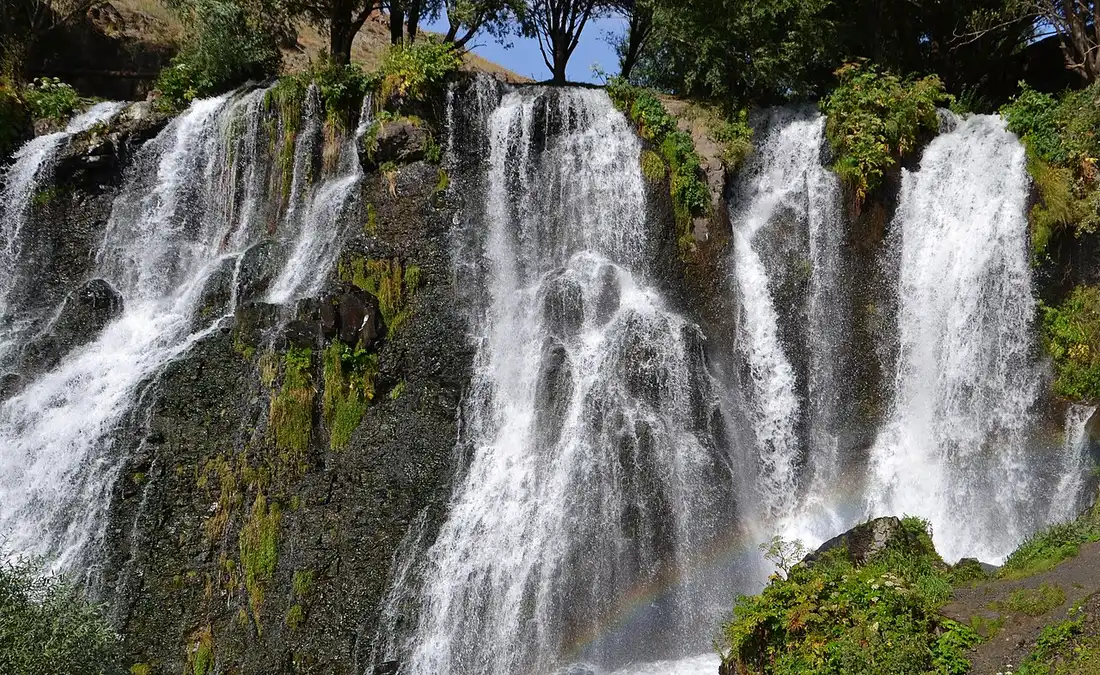
In high summer the useful light is the tail of the window, from about 17:00 on, when the sun sits low enough behind you to throw a rainbow through the spray without blowing out the white water. In spring and autumn that option disappears entirely, since the valve closes at 17:00. Bring a polariser for the glare off wet basalt and a neutral density filter if you want the long exposure, because f/16 and a full second isn’t happening in a Syunik afternoon.
Two more notes. Spray carries a long way on a windy day, so wipe the front element between frames. And if the wall is half dry when you get there, wait before writing the visit off: one traveller described a June visit when the water was off on arrival and plant staff let it through a few minutes later.
The girl called Shake
Armenian sources tell the story of the name three different ways, and the version in the monument’s own passport goes like this. Captive girls from Gegharkunik, carried off by an invading force, chose the river over slavery; one of them, blue-eyed Shake, was hidden by rock and falling water, and her name stayed on the waterfall and the village above it. The other versions swap the enemy, or have her jump with the hem of her white dress turning into the water.
Three versions of one story is the signature of folklore rather than history. It’s still worth hearing while you stand under the thing it describes.
What to bring, and when to come
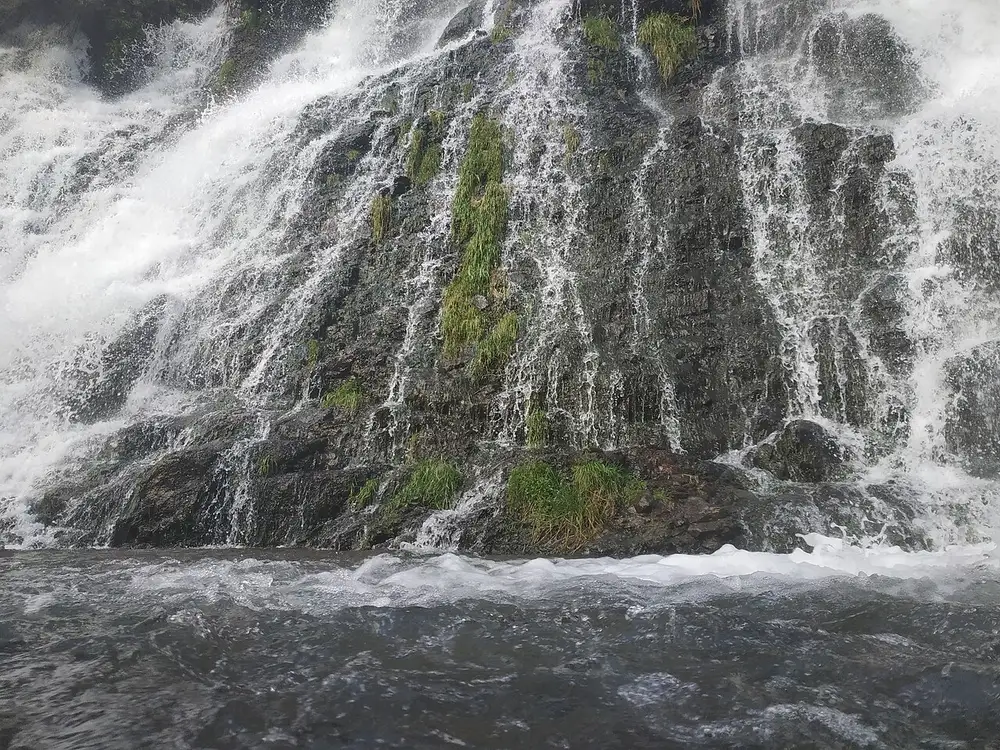
Rocks at the base stay wet all day, so shoes you don’t mind soaking. A layer more than you think, too: Sisian sits at 1,600 m and averages -6 °C in January against +18 °C in July, so a bright spring morning at the falls can be genuinely cold in the shade of the gorge.
For timing, mid-March to April should give the strongest water, since the schedule restarts as the snowmelt builds towards the May peak, at the cost of a six-hour window. May to September has the long window and the settled weather, and is when the tour traffic arrives. October to 15 November is quiet and the gorge colours up, but the short window is back and you are finished by mid-afternoon, tight if you drive from Yerevan the same morning. From 16 November the arrangement lapses until spring.
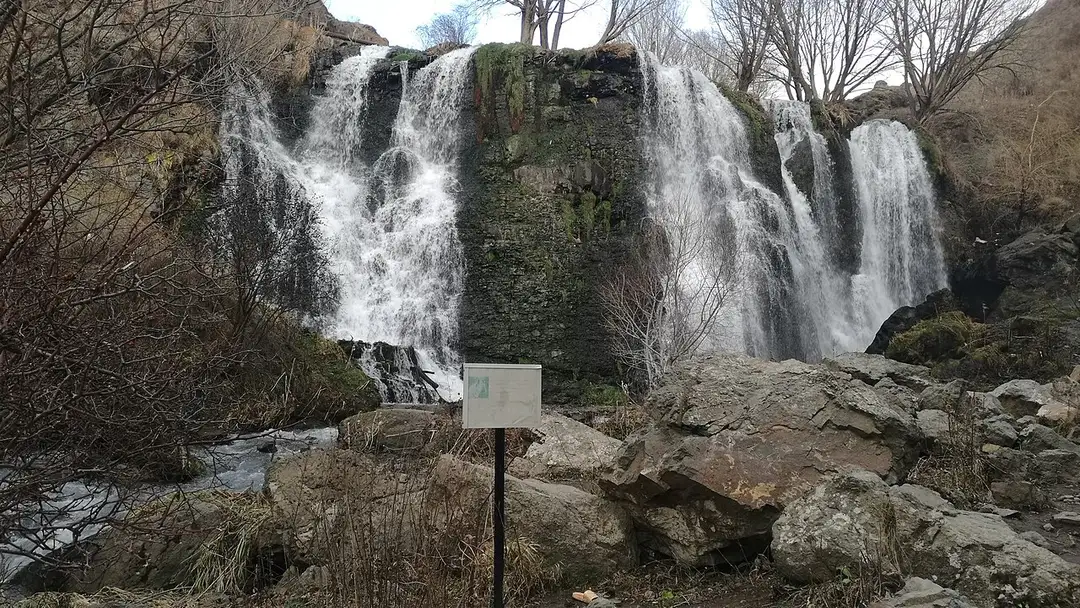
That’s a gamble, though, not a write-off. Even in December the river still runs at roughly a fifth of its May volume, and the photograph below shows the falls going well outside any obligation to open the valve.
The verdict: Shaki is worth thirty or forty minutes when you’re driving south anyway, and it’s not worth a 430 km round trip from Yerevan on its own. Build it into the Syunik day and check on the morning before you set out.
On the map
The map loads on click - to keep the page lightweight.
The map didn’t load. Check your connection and refresh the page.
Good to know
No source names a ticket price and visitors report walking straight in, but the flow is controlled by a hydro plant: under ministerial order N 68-N the water is released 11:00-19:00 from 1 May to 30 September, and 11:00-17:00 from 15 March to 30 April and 1 October to 15 November. Between 16 November and 14 March no schedule applies. Check locally before driving out.
Details checked: July 27, 2026
Distance ≈214 km · ~3.5 h by car
- Yerevan ≈214 km · ~3.5 h by car South on the M2 past Areni and over the Vorotan pass to Sisian, then a signposted turn to the falls. The water runs to a timetable, so time the arrival, not just the drive.
Read also

What to see · 10 min read
Soviet Modernist Yerevan: An Architecture Walk
Verified · September 5, 2026Walk Yerevan's Soviet modernism: Rossiya Cinema, Komitas Hall, Cascade, Hrazdan Stadium and Demirchyan Complex - dates, route order, and what still stands.

What to see · 9 min read
Kond: Walking Yerevan's Oldest Neighborhood
Verified · September 3, 2026Walk Kond, Yerevan's oldest living quarter: Surp Hovhannes, Tepebashi mosque walls, Leo Street alleys, and how to visit without treating it like a set.
What to see · 8 min read
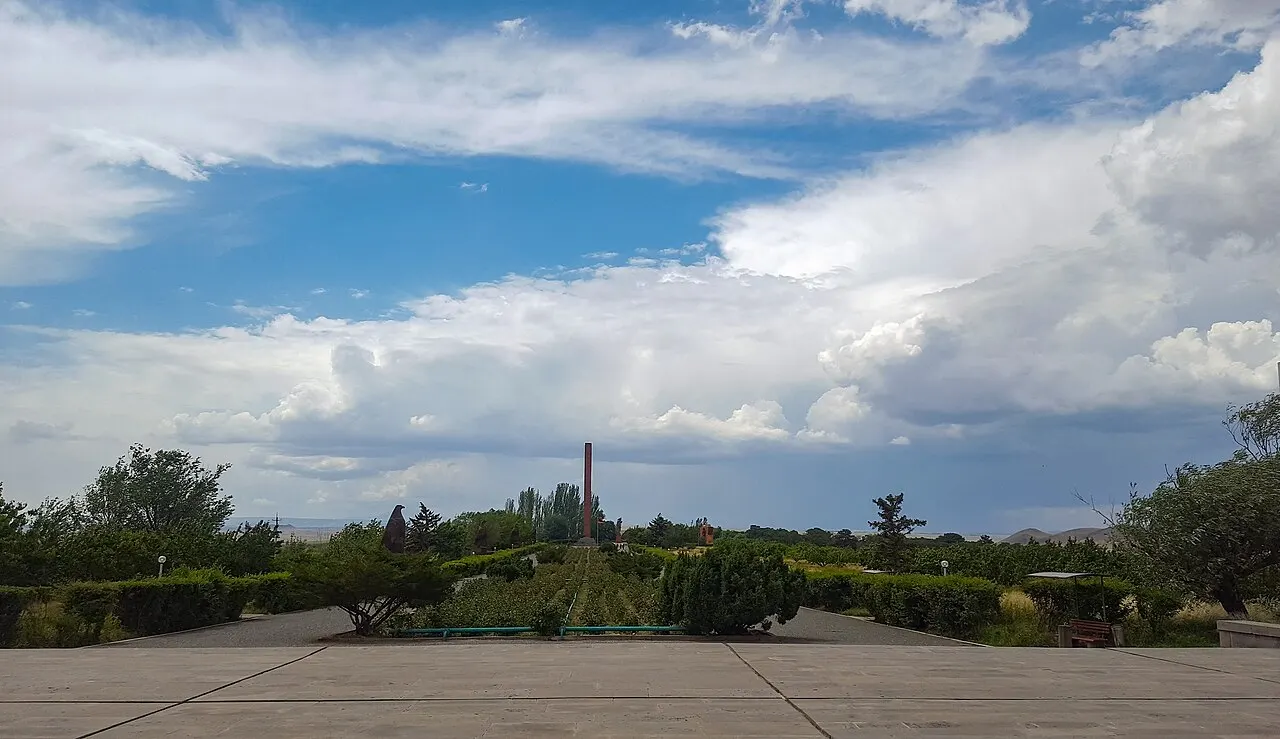
Sardarapat Memorial: Armenia's 1918 Battle Site
Verified · August 31, 2026Sardarapat Memorial near Armavir: 1918 battle site, Israelyan's red-tufa complex, ethnography museum tickets, hours and how to reach it from Yerevan.
What to see · 12 min read
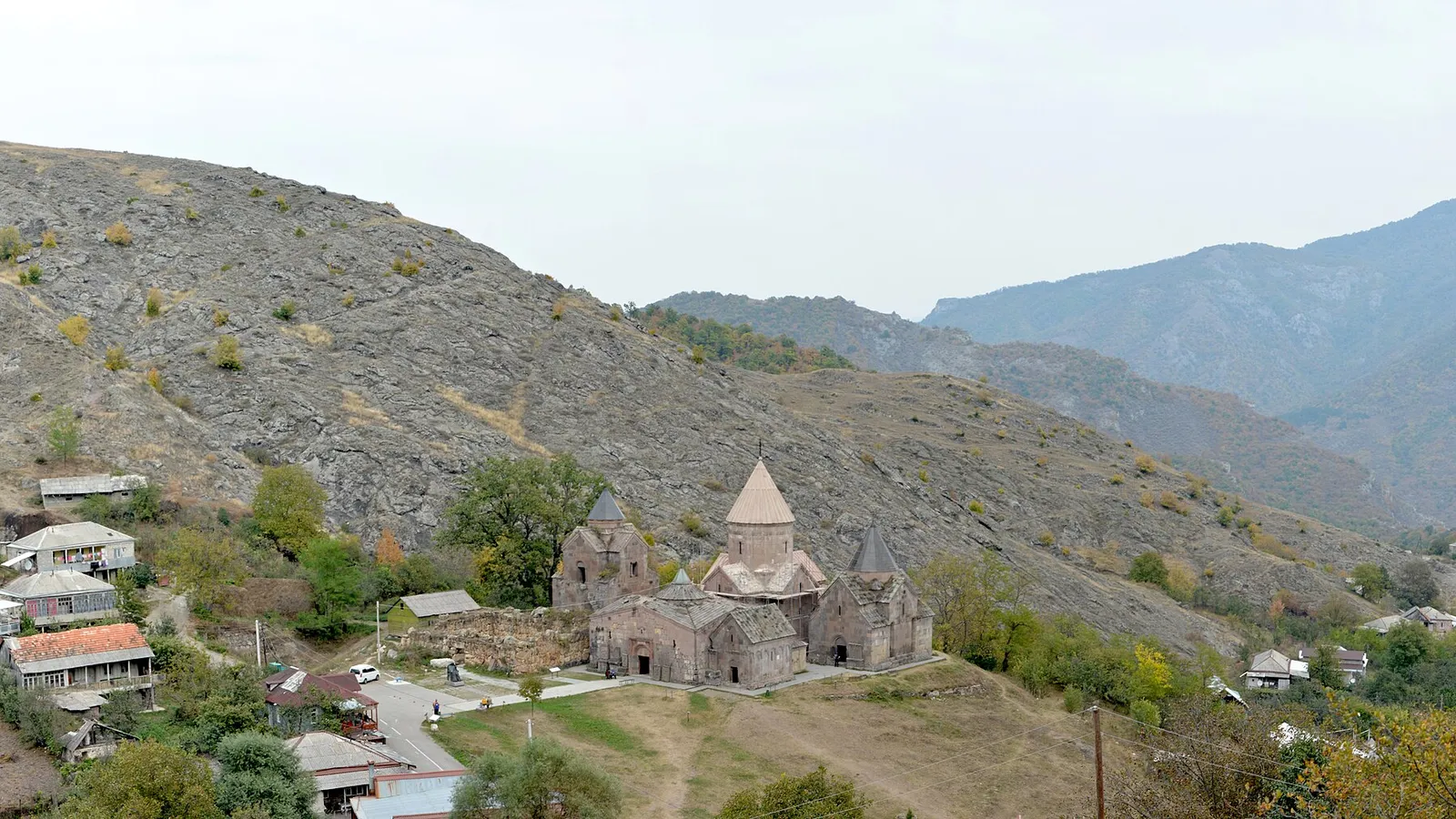
Goshavank Monastery & the Village of Gosh
Verified · August 29, 2026Visiting Goshavank: Mkhitar Gosh's law code that reached Poland, the 1291 embroidered khachkar, his statue and hillside tomb, and the drive from Dilijan.