Noravank Monastery: Armenia's Red-Cliff Gem
How to visit Noravank: the two-storey Burtelashen church and its narrow cliff-face staircase, the red Amaghu gorge, and the drive from Yerevan via Areni.
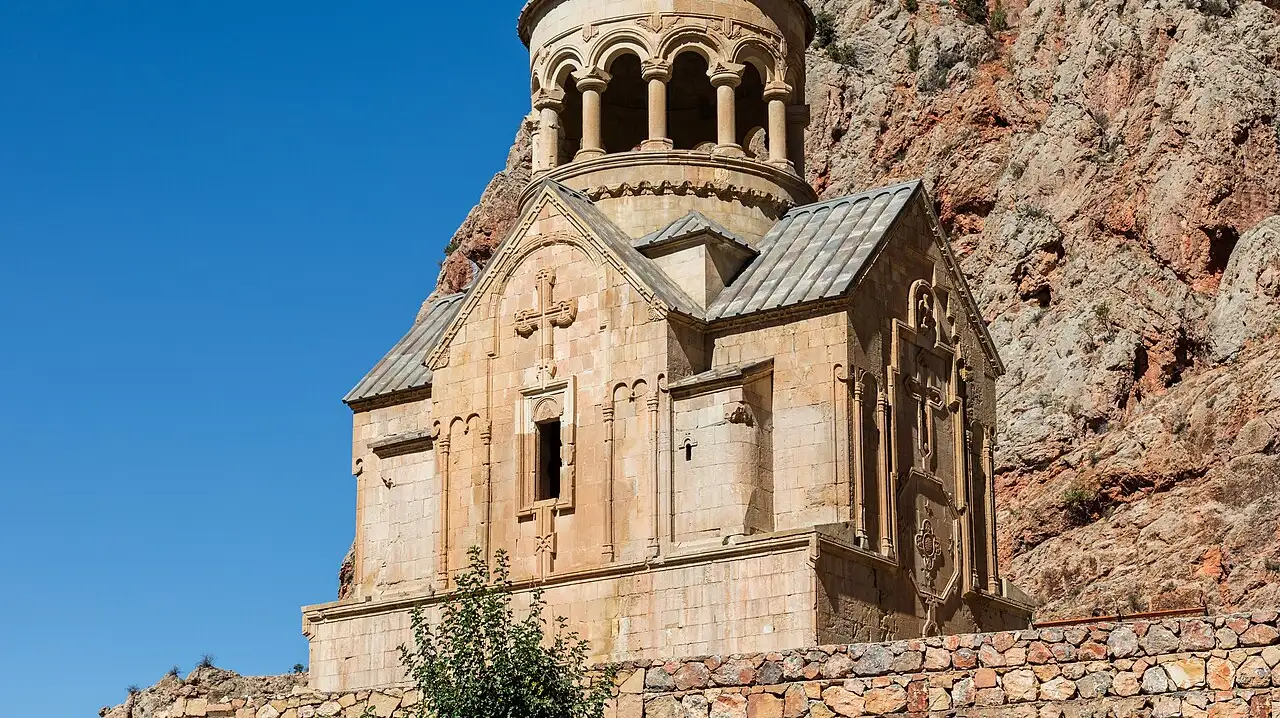
Noravank is a honey-coloured medieval monastery wedged into a side-canyon of sheer, brick-red cliffs in southern Armenia, and its showpiece church has a party trick you won’t forget: to reach the upper chapel you climb a set of narrow stone steps that jut straight out from the wall, with no rail and nothing but air on one side. It sits about 122 km south of Yerevan - roughly a two-hour drive - up the red Amaghu gorge near the wine village of Areni. This guide covers what you’re looking at, how to tackle that famous staircase, and how to string Noravank together with Khor Virap and a wine tasting into one of the best day loops in the country.
Why Noravank is worth the drive
Plenty of Armenia’s monasteries are older or higher; Noravank wins on setting and stonework. The complex fills the end of a narrow gorge where the walls glow rust-red in low sun, and the buildings - cut from a warm tan tuff - look as though they grew out of the rock. It became the seat of the Orbelian princes, the powerful family that ran this corner of Armenia in the 13th and 14th centuries, and it was their patronage that drew Armenia’s finest medieval craftsman here. The site was first founded back in 1105 by Bishop Hovhannes, but almost everything you come to see went up two and three centuries later, in Noravank’s golden age under the Orbelians.
That golden age has a name attached to it: Momik, a sculptor, manuscript illuminator and architect who worked here in the late 13th and early 14th centuries. His hand is all over the monastery - in the carved tympanums above the doors, in an extraordinarily intricate cross-stone (khachkar) he cut in 1308, and above all in the church that dominates the site. Come for the cliffs, but look closely at the carving; this is stone worked with the fineness of jewellery.
The Burtelashen church and its cliff-face staircase
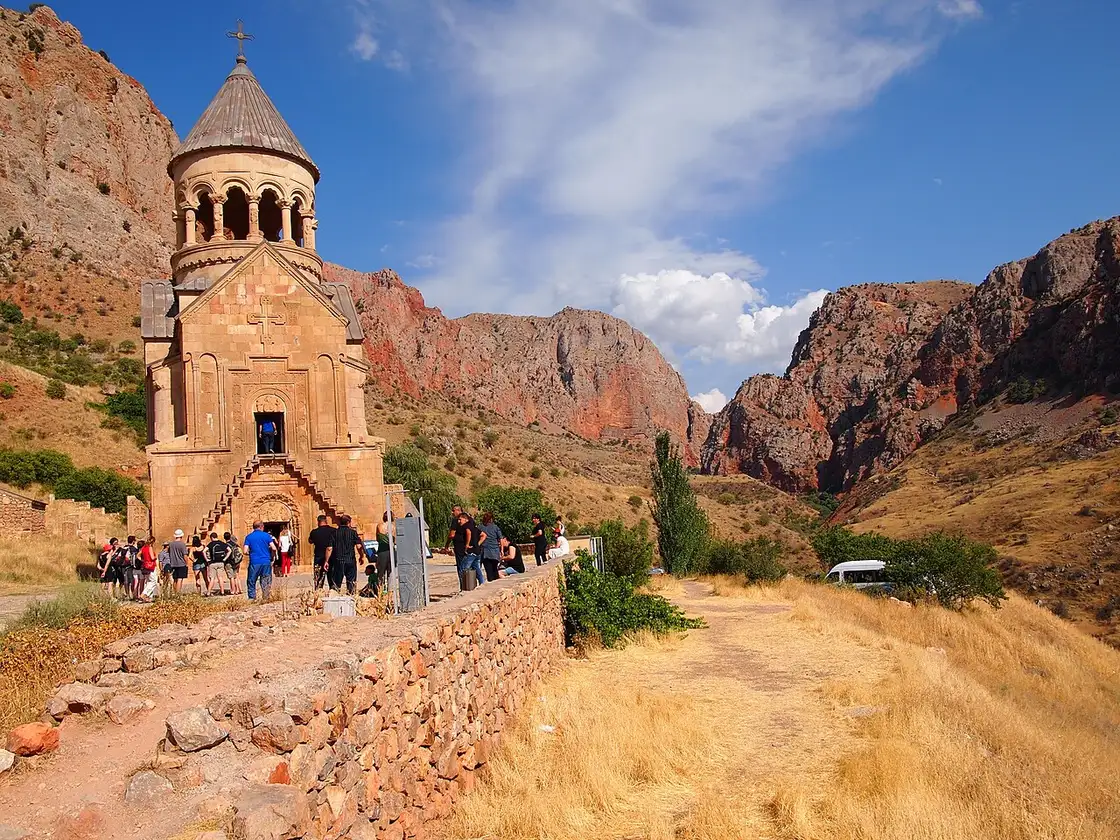
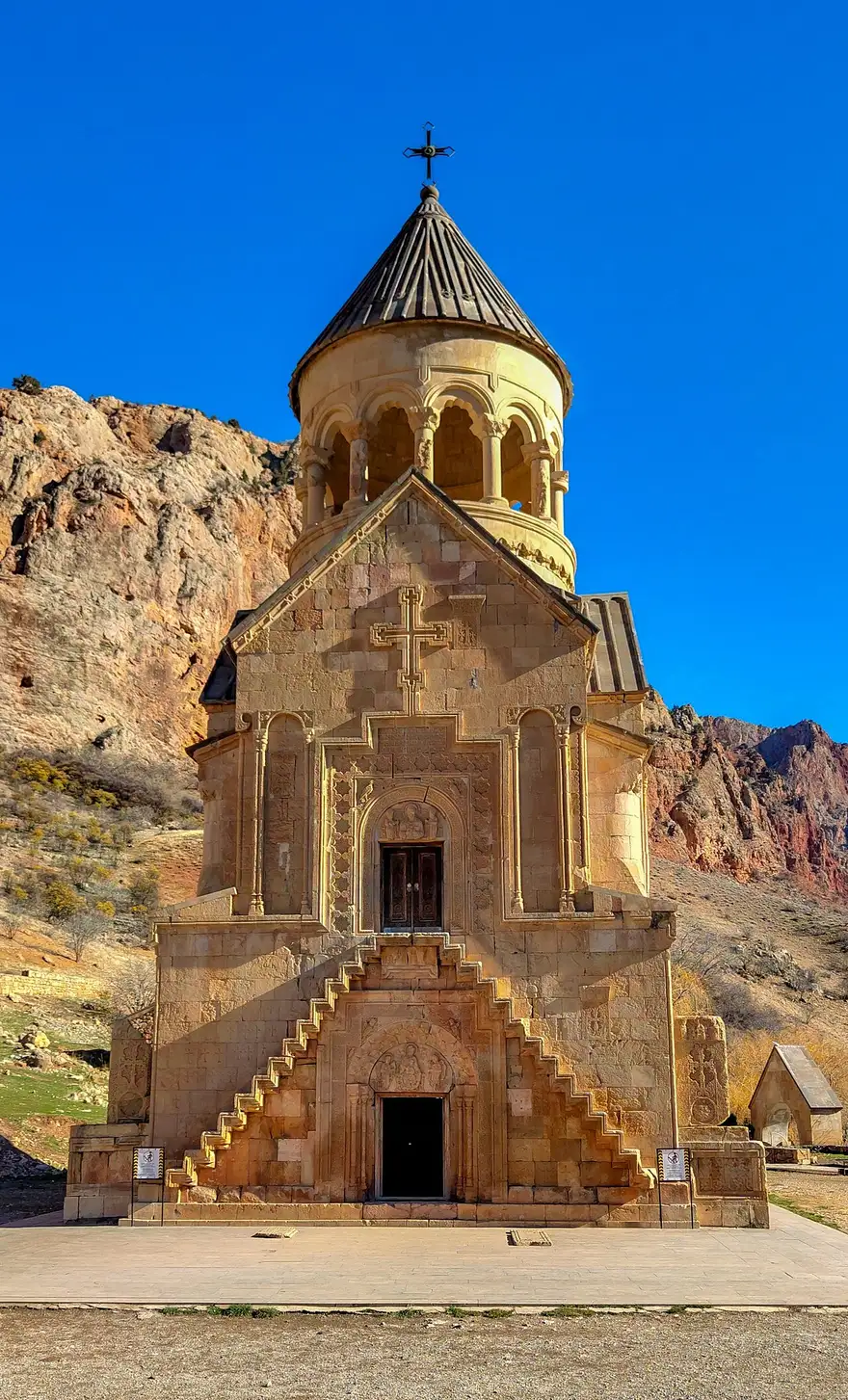
The building everyone photographs is Surb Astvatsatsin - the Church of the Holy Mother of God - better known by its nickname Burtelashen, “Burtel’s construction,” after the Orbelian prince Burtel who paid for it. It was completed in 1339 and was Momik’s last work; he died the same year, and it stands as his masterpiece. Where most Armenian churches are single-storey, Burtelashen is a rare two-storey design: a family mausoleum on the ground floor, with the elaborate tombs of Burtel and his kin, and a small memorial chapel stacked on top.
The catch - and the thrill - is how you get up there. Two sets of narrow stone steps cantilever straight out of the west façade, climbing in a tight V to a doorway on the upper floor. They’re shallow, steep, without any handrail, and they overhang the ground below. Plenty of visitors go up, carefully, hugging the wall, and the view back down over the complex is worth it - but this is genuinely not for anyone shaky on their feet or uneasy with heights, because a slip has nothing to stop it. Go up slowly, come down facing the steps as if descending a ladder, and don’t attempt it with a phone in one hand and a coffee in the other. If in doubt, the church looks just as good from the courtyard.
The other churches and the carvings to look for
Burtelashen isn’t the only thing here. The oldest surviving church is Surb Karapet (St John the Baptist), a cross-within-square design built between 1216 and 1227 on the ruins of an earlier chapel, with the little Surb Grigor chapel added onto its north side in 1275 as an Orbelian burial vault. Together they make a tight, walled cluster you can wander in twenty minutes - but it rewards slowing down.
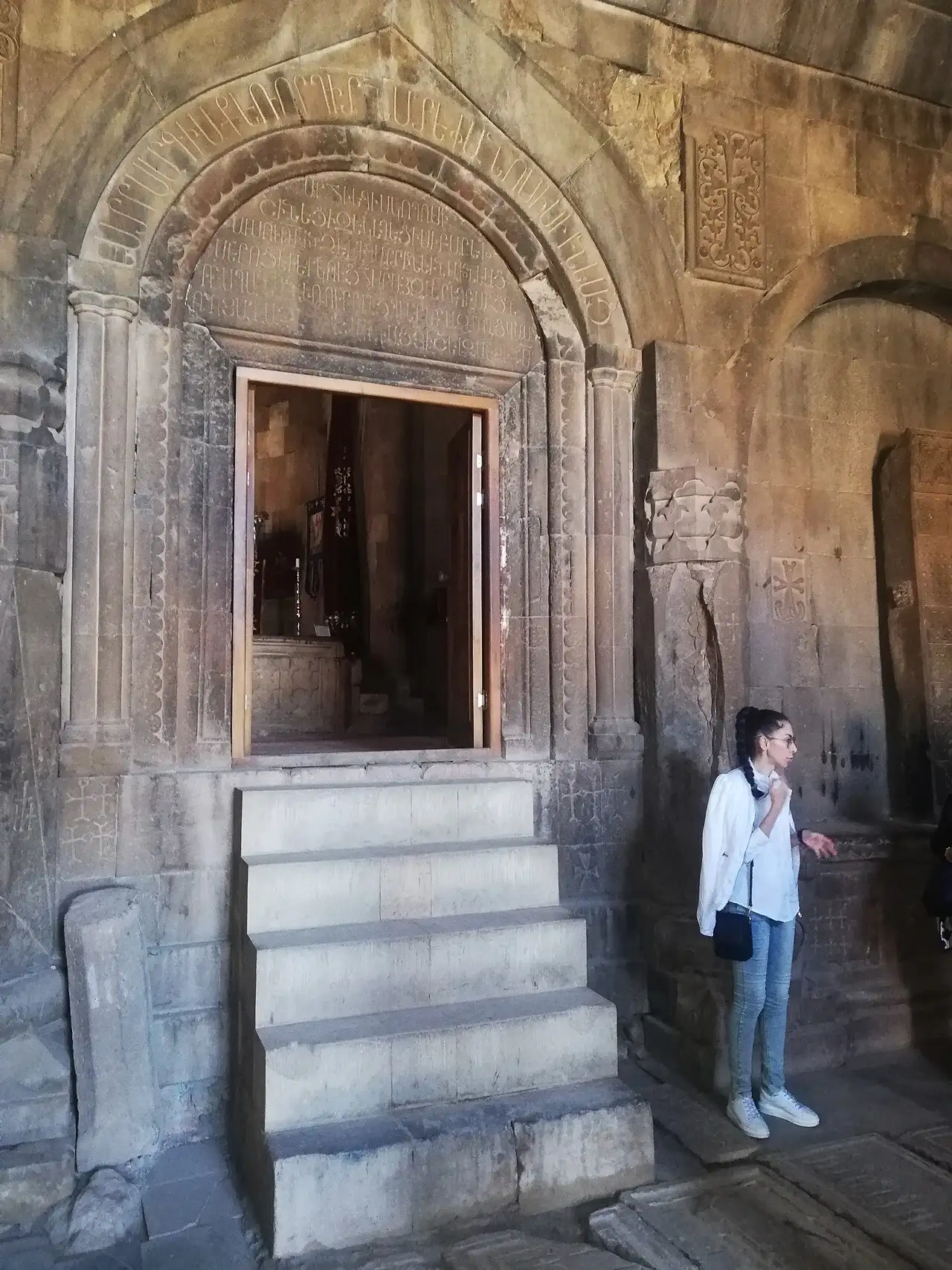
Look up as you go through the doorways. Momik and his workshop covered the tympanums - the half-moon panels over the entrances - with carved figures: Christ, the Virgin and Child, saints and Orbelian donors, all in the flat, expressive style of medieval Armenian relief. And near the churches stands the celebrated 1308 khachkar, one of the finest cross-stones in the country, its surface a dense lace of crosses, rosettes and eight-pointed stars. Bring nothing but your eyes; the detail is what you came for.
Getting to Noravank from Yerevan
Noravank is in Vayots Dzor, near the town of Yeghegnadzor, about 122 km and roughly two hours from Yerevan by car down the M2 highway. The last stretch is the treat: you turn off near Areni and follow an 8-km road up the Amaghu gorge, twisting between towering red walls until the monastery appears at the top. It’s one of the most scenic short drives in the country - take it slowly and stop for photos.
Getting there without your own wheels is the hard part. There’s no public transport to the monastery itself. Buses and shared vans (marshrutkas) on the Yerevan-Yeghegnadzor road can drop you near the Amaghu turn-off, but that leaves you 8 km up a canyon with no service, so it’s not a realistic plan. In practice you have two sensible options:
- A day tour from Yerevan is the easiest and usually the best value, because Noravank is almost always paired with Khor Virap and an Areni wine stop on the same loop - a driver handles the logistics and you just enjoy the gorge.
- A rental car gives you the freedom to set your own pace, chase the light on those cliffs, and linger over lunch and a tasting in Areni.
Whichever you choose, don’t treat Noravank as a there-and-back errand: half the reward is the road and the wine country around it. For where it sits in a wider itinerary, our guide to things to do in Yerevan frames it as the headline day trip to the south.
Hours, entry and what to wear
Entry to the monastery grounds is free - it’s a living church of the Armenian Apostolic Church, not a ticketed site - though a small on-site museum charges a nominal fee. Published visitor guides list the grounds as generally open daily from about 09:00 to 20:00, but treat that as a guide rather than a promise and check locally before a long drive, as hours shift with the season and with services. There’s a car park at the top and a small café by the monastery for a coffee or a bite.
Because it’s an active place of worship, dress modestly: cover shoulders and knees, and women may want a scarf for inside the churches. For the best of the light and the fewest people, come early or late - the cliffs turn their deepest red near sunrise and sunset, and the tour coaches cluster in the middle of the day. Summer in the gorge is hot and shadeless around midday, so a morning visit is kinder in every way.
Make a day of it: Areni wine and Khor Virap
The reason Noravank works so well is what surrounds it. Ten kilometres back down the road is Areni, the heart of Armenian winemaking, where family cellars pour the local dry reds made from the native Areni grape, several of them welcoming walk-in tastings right on the highway. On the eastern edge of the village is the Areni-1 cave, an unassuming hole in the rock that turns out to hold the world’s oldest known winery - a roughly 6,100-year-old setup of a grape press and fermentation vat - along with the world’s oldest leather shoe (about 5,500 years old, an EU size 37), both excavated here from 2007. It’s a genuinely mind-bending stop for such a small site; check its hours separately, as the cave usually closes earlier than the monastery. Our full guide to Areni’s wine country has the wineries worth booking and the story of the cave.
North of Areni, on the way back to the capital, sits Khor Virap, the fortress-monastery on the plain with Mount Ararat filling the sky behind it - the classic pairing, and the reason the standard tour is billed as “Khor Virap and Noravank.” A clear-morning start at Khor Virap, a tasting at Areni, and Noravank’s cliffs glowing in the afternoon is about as good as an Armenian day trip gets; the self-drive version with tasting prices and a sober-driver plan is our Vayots Dzor wine route. If you’re building a longer southern route, many people also fold in Tatev and the Wings of Tatev cableway further south, or overnight at the mineral-spa town of Jermuk up the same M2, though that’s really a second day rather than the same one. To go deeper into the Orbelians’ own valley, the Yeghegis valley loop leaves this main road for their fortress of Smbataberd, the medieval Jewish cemetery and the Silk Road caravanserai on the Selim Pass just up the mountain. To see how Noravank compares with the country’s other great churches and how to cluster them by region, read our roundup of the best monasteries in Armenia. Browse the rest of our attractions section to round out the itinerary.
Photos
On the map
The map loads on click - to keep the page lightweight.
The map didn’t load. Check your connection and refresh the page.
Distance ≈122 km · ≈2 h
- Yerevan ≈122 km · ≈2 h South on the M2 past Khor Virap and Areni; no public transport to the monastery itself.
Read also

What to see · 10 min read
Soviet Modernist Yerevan: An Architecture Walk
Verified · September 5, 2026Walk Yerevan's Soviet modernism: Rossiya Cinema, Komitas Hall, Cascade, Hrazdan Stadium and Demirchyan Complex - dates, route order, and what still stands.

What to see · 9 min read
Kond: Walking Yerevan's Oldest Neighborhood
Verified · September 3, 2026Walk Kond, Yerevan's oldest living quarter: Surp Hovhannes, Tepebashi mosque walls, Leo Street alleys, and how to visit without treating it like a set.
What to see · 8 min read
Sardarapat Memorial: Armenia's 1918 Battle Site
Verified · August 31, 2026Sardarapat Memorial near Armavir: 1918 battle site, Israelyan's red-tufa complex, ethnography museum tickets, hours and how to reach it from Yerevan.
What to see · 12 min read
Goshavank Monastery & the Village of Gosh
Verified · August 29, 2026Visiting Goshavank: Mkhitar Gosh's law code that reached Poland, the 1291 embroidered khachkar, his statue and hillside tomb, and the drive from Dilijan.