Etchmiadzin Cathedral: Armenia's Holy Mother See
Etchmiadzin Cathedral, the world's oldest cathedral and seat of the Armenian Church: the descent legend, the Holy Lance and how to visit from Yerevan.
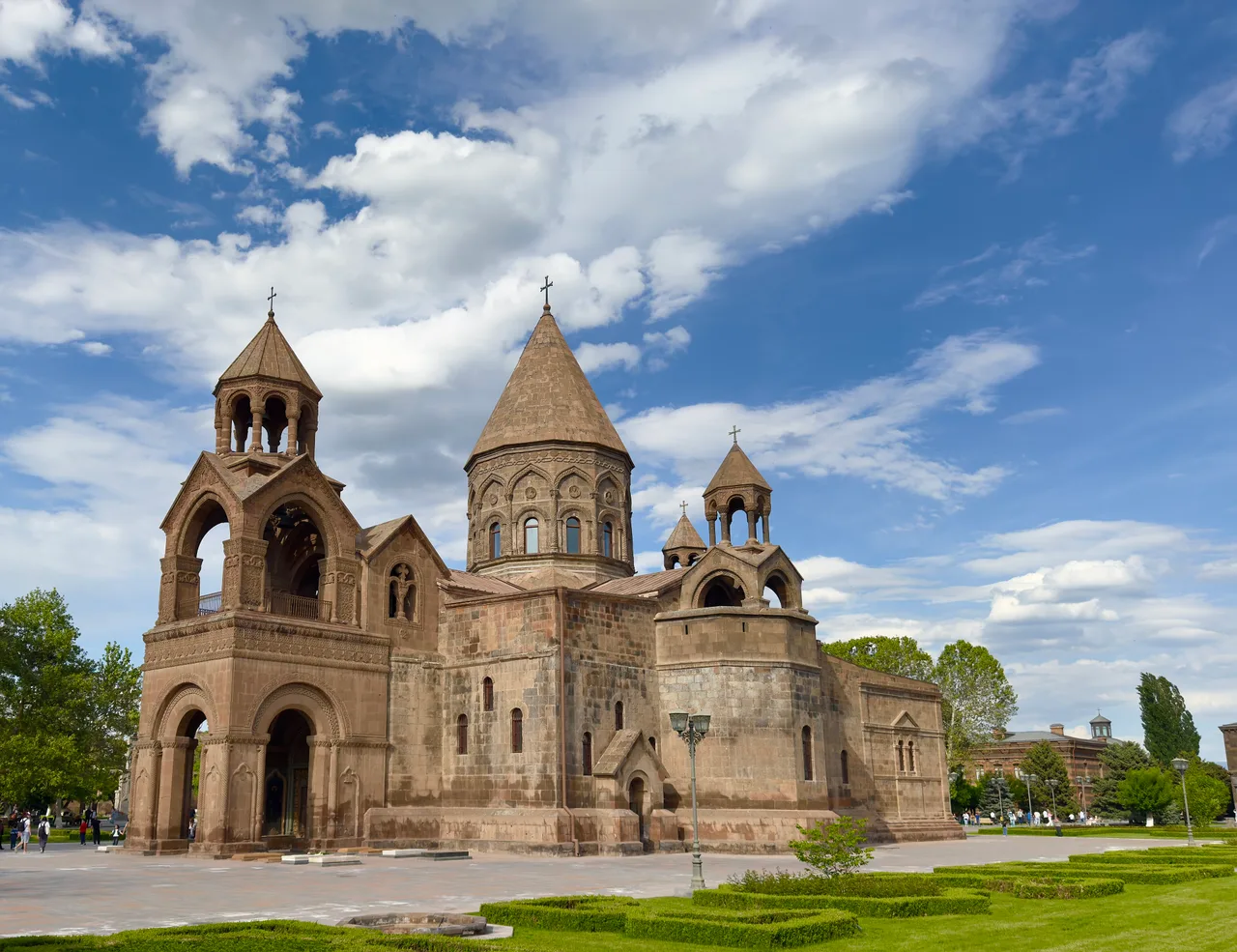
Etchmiadzin is where the Armenian Church begins. The cathedral in the city of Vagharshapat, about 20 km west of Yerevan, is widely called the oldest cathedral in the world - first built between 301 and 303 AD, right after Armenia became the first country to adopt Christianity as its state religion - and it’s still the Mother See, the seat of the Catholicos of All Armenians, the spiritual headquarters of the faith. Armenians sometimes call the walled complex around it their Vatican. After a long restoration the cathedral reopened in September 2024, cleaned back to its full stonework and repainted frescoes. What follows is the legend that gave it its name, what to see inside, the relics in the treasury, and how to visit. Half an hour further west, the Sardarapat memorial marks the 1918 battle that decided whether any of this survived, and pairs naturally with the same day out.
The oldest cathedral in the world
The date is the headline, and it holds up. When King Trdat III made Christianity the state religion in 301 AD, Gregory the Illuminator - the man who had converted him - set about building a cathedral, and it went up in 301-303 on the site of a pagan fire temple, a deliberate statement that one faith had replaced another. That makes Etchmiadzin the oldest state-built cathedral anywhere, older than the great churches of Rome or Constantinople.
The name carries the founding legend. Etchmiadzin means, roughly, “the place where the Only-Begotten descended.” The story goes that Christ appeared to Gregory in a vision, came down from heaven, and struck the ground with a golden hammer to mark the exact spot where the cathedral was to stand. Whatever you make of the legend, the spot has been continuously sacred ever since - which is a genuinely rare thing in a country that has been fought over as often as this one.
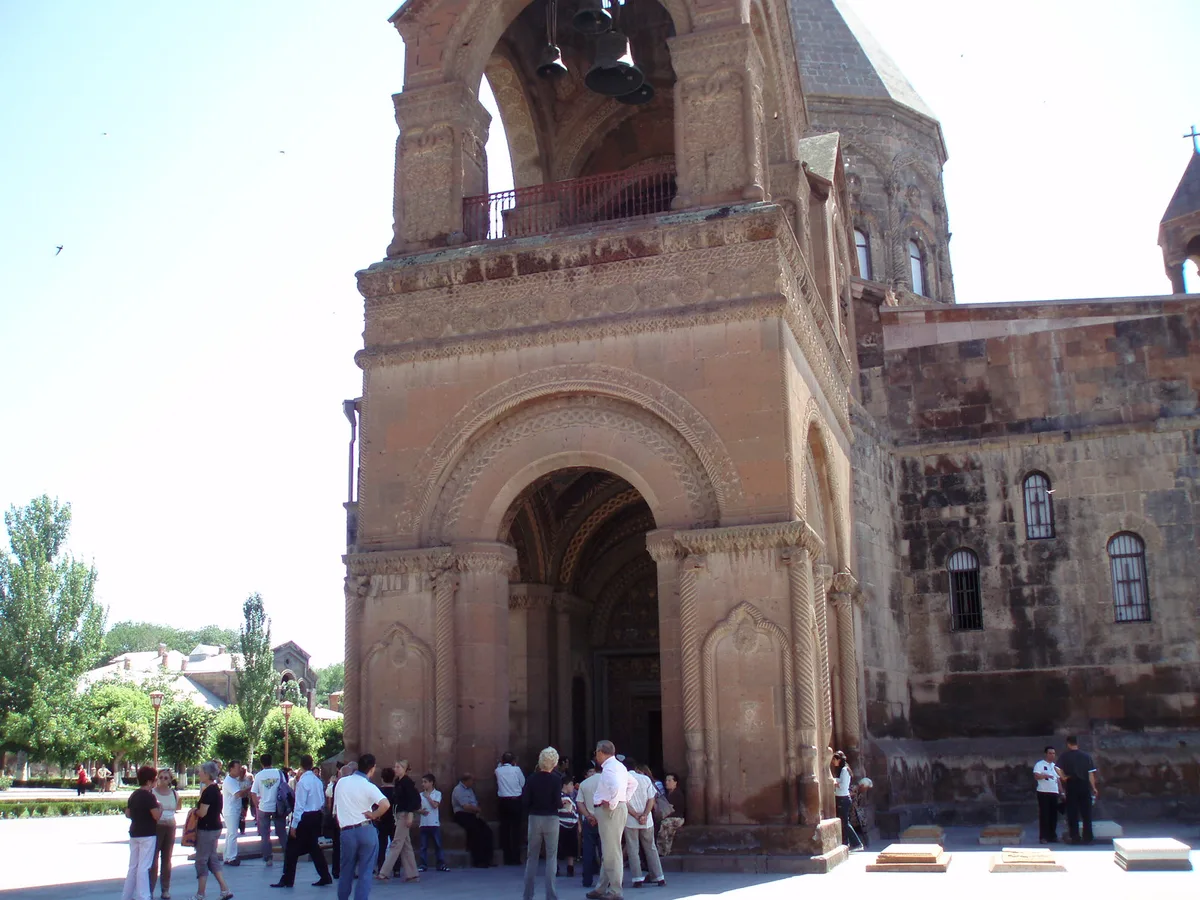
The building you see isn’t, of course, the original mud-brick church. The core of the present cathedral - a compact cruciform plan with four free-standing piers - was rebuilt in 483-484 by the general Vahan Mamikonian after a Persian invasion, and that is essentially the shape that survives. Later centuries added the parts that give it its skyline: the western bell tower in the 1650s and the smaller rotunda-topped bell towers in 1682. The cathedral measures about 33 by 30 m, and its dome rises roughly 34 m.
What you see inside, and the restoration
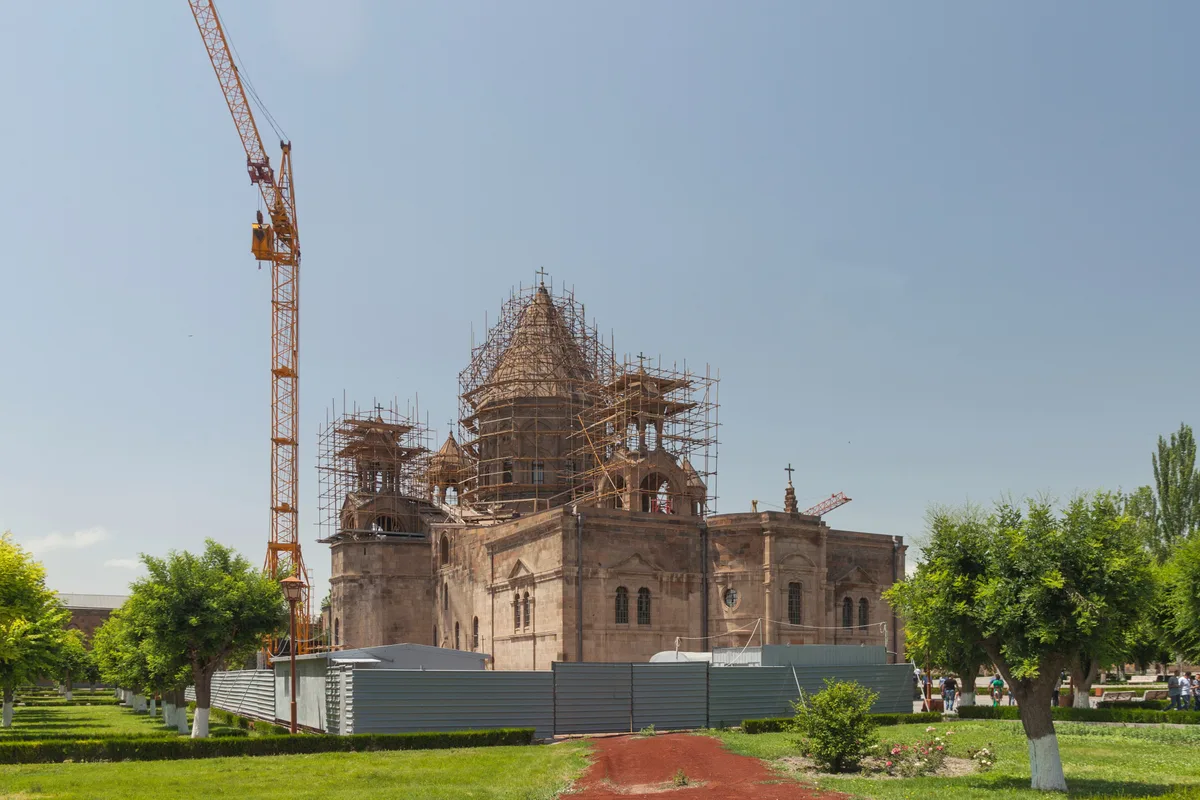
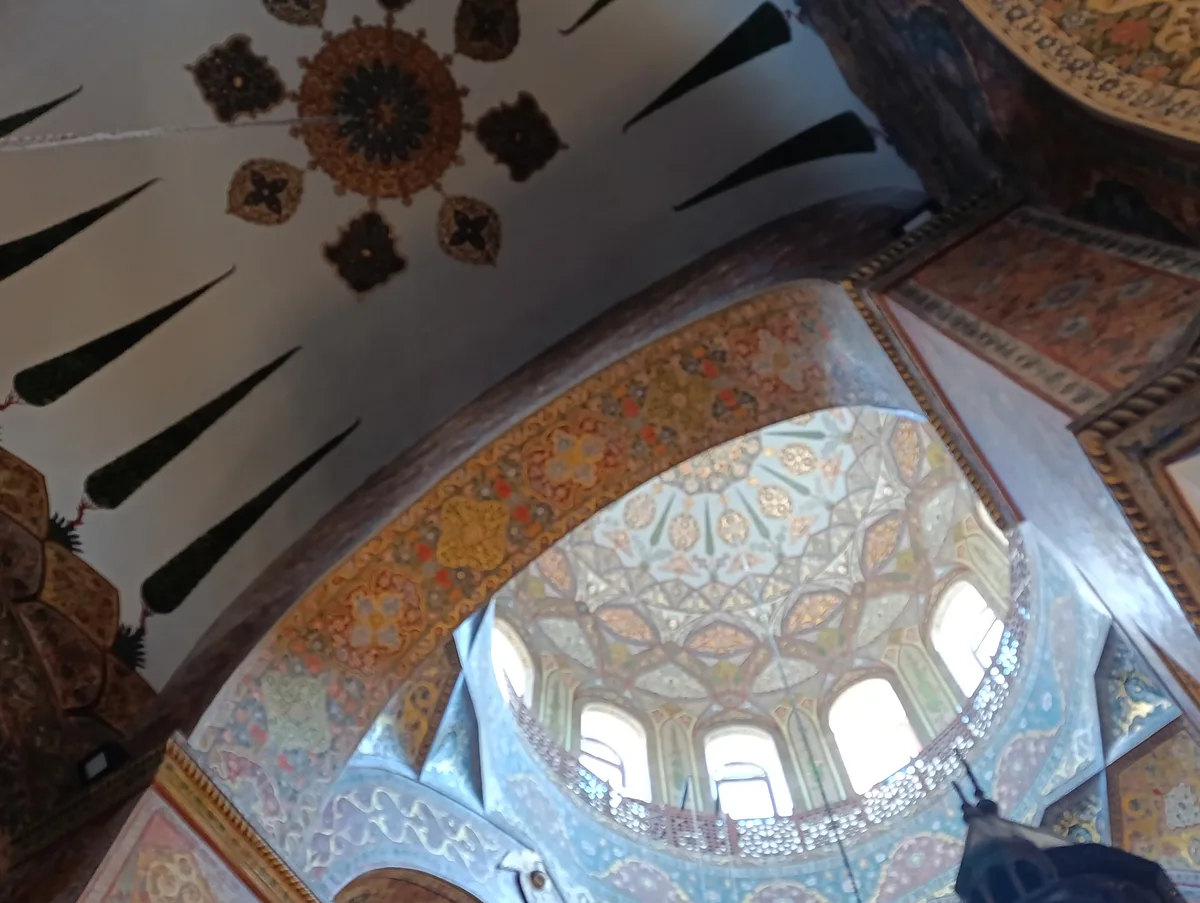
For years visitors found the cathedral behind scaffolding: a full restoration ran from 2012 and finished with a ceremonial reopening on 29 September 2024. If you were here before that and remember a dim, soot-darkened interior, the change is striking. The work went from the foundations up to the cross on the dome, and the biggest transformation was the frescoes, painted in the eighteenth century and long blackened by centuries of candle smoke, now cleaned back to their colours. It’s one of the few times you will see a monument this old looking, in effect, brand new. The dim, atmospheric church some guidebooks still describe is gone; what you get now is bright and freshly gilded, which not everyone loves, but the frescoes are legible again for the first time in generations.
At the centre of the church, under the dome, stands the Holy Descent altar - a canopied altar raised over the exact spot where, in the legend, Christ’s golden hammer struck the ground. It’s the symbolic heart of the whole complex, the reason the cathedral stands here rather than anywhere else, and worshippers make straight for it. Around the walls, pick out the eighteenth-century painted saints and, in the side chapels, the icons and reliquaries a working cathedral gathers over seventeen centuries.
Centuries of ruin, and the return of the Catholicos
Etchmiadzin’s long life was not a smooth one. As Armenia was fought over by Persians, Byzantines, Arabs and Mongols in turn, the seat of the church wandered - to Dvin, to Ani, and eventually far southwest to Sis, in the Cilician kingdom on the Mediterranean coast. For centuries the mother cathedral sat neglected and its town shrank, the spiritual centre of gravity somewhere else entirely. The turning point came in 1441, when a council of bishops, with the Cilician kingdom fallen and a cultural revival stirring back in the homeland, voted to bring the Catholicosate back to Etchmiadzin. It has stayed here ever since - which is why, to this day, the Armenian Church keeps two catholicosates, the senior one here and a second in Cilicia. Almost everything grand you now see, from the bell towers to the surrounding buildings, dates from after that return, as the reinstated Mother See slowly rebuilt its home.
The treasury: the Holy Lance and a piece of Noah’s Ark
Don’t leave without the treasury museum, which holds the relics that make Etchmiadzin a pilgrimage as much as a monument. The most famous is the Holy Lance - the Geghard, said to be the spearhead that pierced Christ’s side at the crucifixion, kept here for centuries and the object that gives the rock-cut monastery of Geghard its name. Beside it, the collection displays a fragment said to be a piece of Noah’s Ark - fitting, in a country that gazes at Mount Ararat, where the Ark is said to have come to rest. The Lance itself is kept in an ornate silver-gilt reliquary, a seventeenth-century masterpiece in its own right, and it’s the object guides linger on longest. There are also crosses, illuminated manuscripts and the relics of saints among the church treasures. The treasury is ticketed separately from the free cathedral; a small fee, usually a few dollars, and worth it for the Lance alone.
The Mother See: Armenia’s spiritual capital
It helps to understand that Etchmiadzin is not just an old building but a living institution. This is the Mother See of Holy Etchmiadzin, the residence of the Catholicos of All Armenians, the head of the Armenian Apostolic Church worldwide - the equivalent, loosely, of the Vatican for Roman Catholics. The walled grounds hold the Gevorgian Seminary, founded in 1874 to train the church’s priests, along with residences, a printing house and several museums, and the courtyard is dotted with khachkars - carved cross-stones - some of them rescued from destroyed cemeteries elsewhere in the Armenian world. On a Sunday or a feast day the whole compound fills with worshippers. Every seven years the church consecrates the Holy Muron, the sacred chrism, in a ceremony here that draws Armenians from across the diaspora. Come on an ordinary weekday and it’s calm and contemplative; come on a feast and you see the church at full voice.
Getting there, hours and what it costs
Vagharshapat sits about 20 km west of Yerevan, a 25-30-minute drive, and it is one of the easiest excursions from the capital. Buses and marshrutkas run frequently from the Kilikia bus station and from Barekamutyun; a taxi or rental car is simpler if you want to link it with the ruins of Zvartnots on the same road. Entry to the cathedral itself is free - it’s a living church - though a donation is welcome. The treasury museum charges a separate ticket, around 1,500 AMD, and confirm the current figure on the day. As a working church, it asks for modest dress: cover shoulders and knees, and a scarf for the head is appreciated inside.
Almost everyone pairs Etchmiadzin with the seventh-century ruined cathedral of Zvartnots, four kilometres back toward Yerevan - the two share a single UNESCO World Heritage listing from 2000, along with the nearby churches of St Hripsime (618) and St Gayane (630), both small masterpieces a short walk from the Mother See and both covered, with the rest of the town, in our guide to Vagharshapat. Drivers who also want Sardarapat and the Ararat view at Khor Virap can follow our Ararat plain heritage drive. Their stories are the prelude to everything else here: Hripsime and Gayane were among a band of Christian virgins who fled the Roman emperor Diocletian and settled at Vagharshapat, and when Hripsime refused King Trdat and was martyred for it, the calamity that then fell on the king - and his cure at Gregory’s hands - is what converted Armenia in the first place. The two churches stand over the spots where the women are said to have died, so they’re not just fine architecture but the very ground the whole conversion story rests on. A half-day covers the lot comfortably. Organised tours from Yerevan almost always run the cathedral, Zvartnots and the two churches as one loop.
For how Etchmiadzin sits among the country’s great churches, see our roundup of the best monasteries in Armenia and our map of Armenia’s monasteries and UNESCO sites by region. The story that starts here - Gregory the Illuminator and the conversion of 301 - runs straight on to Khor Virap, the monastery on the Turkish border where Gregory was imprisoned, so the two make a natural pair of pilgrimages. If you’re deciding what to fit in, our guide to how many days you need in Armenia slots Etchmiadzin into the essentials, and it appears among our best day trips from Yerevan. For the rest of the capital, see things to do in Yerevan.
Photos
On the map
The map loads on click - to keep the page lightweight.
The map didn’t load. Check your connection and refresh the page.
Read also

What to see · 10 min read
Soviet Modernist Yerevan: An Architecture Walk
Verified · September 5, 2026Walk Yerevan's Soviet modernism: Rossiya Cinema, Komitas Hall, Cascade, Hrazdan Stadium and Demirchyan Complex - dates, route order, and what still stands.

What to see · 9 min read
Kond: Walking Yerevan's Oldest Neighborhood
Verified · September 3, 2026Walk Kond, Yerevan's oldest living quarter: Surp Hovhannes, Tepebashi mosque walls, Leo Street alleys, and how to visit without treating it like a set.
What to see · 8 min read
Sardarapat Memorial: Armenia's 1918 Battle Site
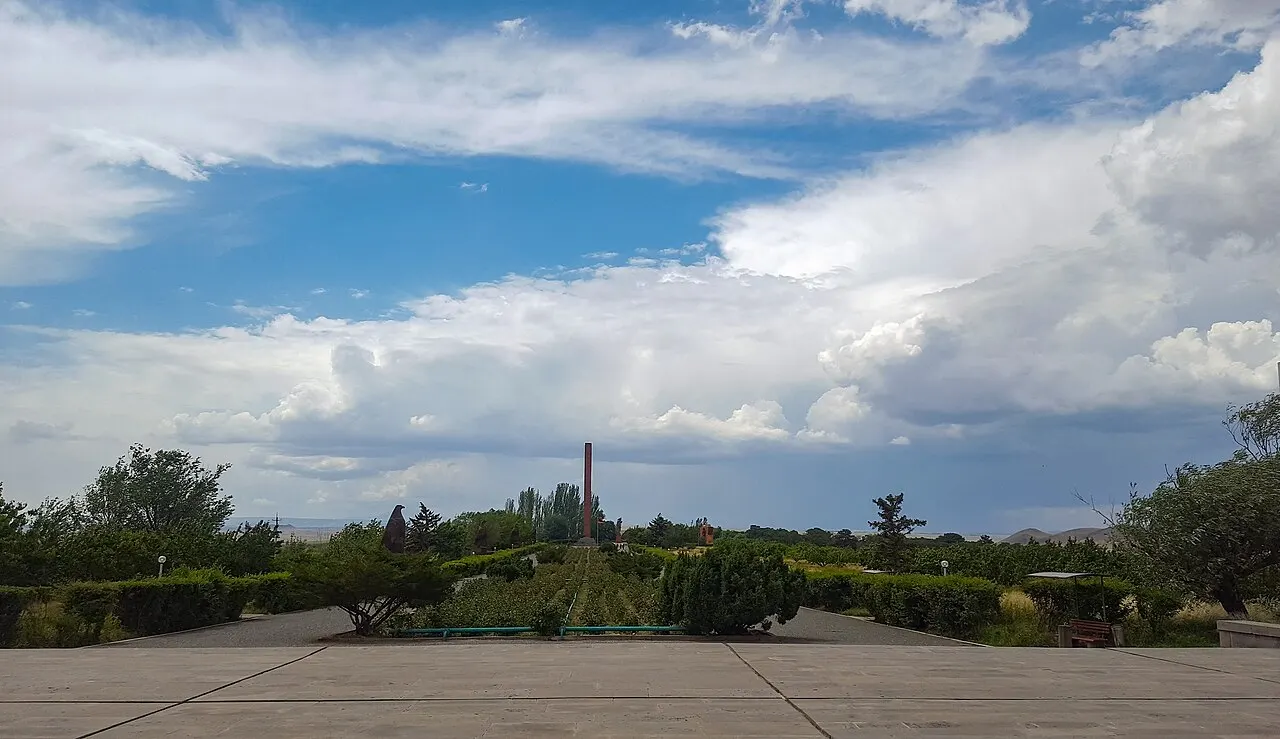
Verified · August 31, 2026Sardarapat Memorial near Armavir: 1918 battle site, Israelyan's red-tufa complex, ethnography museum tickets, hours and how to reach it from Yerevan.
What to see · 12 min read
Goshavank Monastery & the Village of Gosh
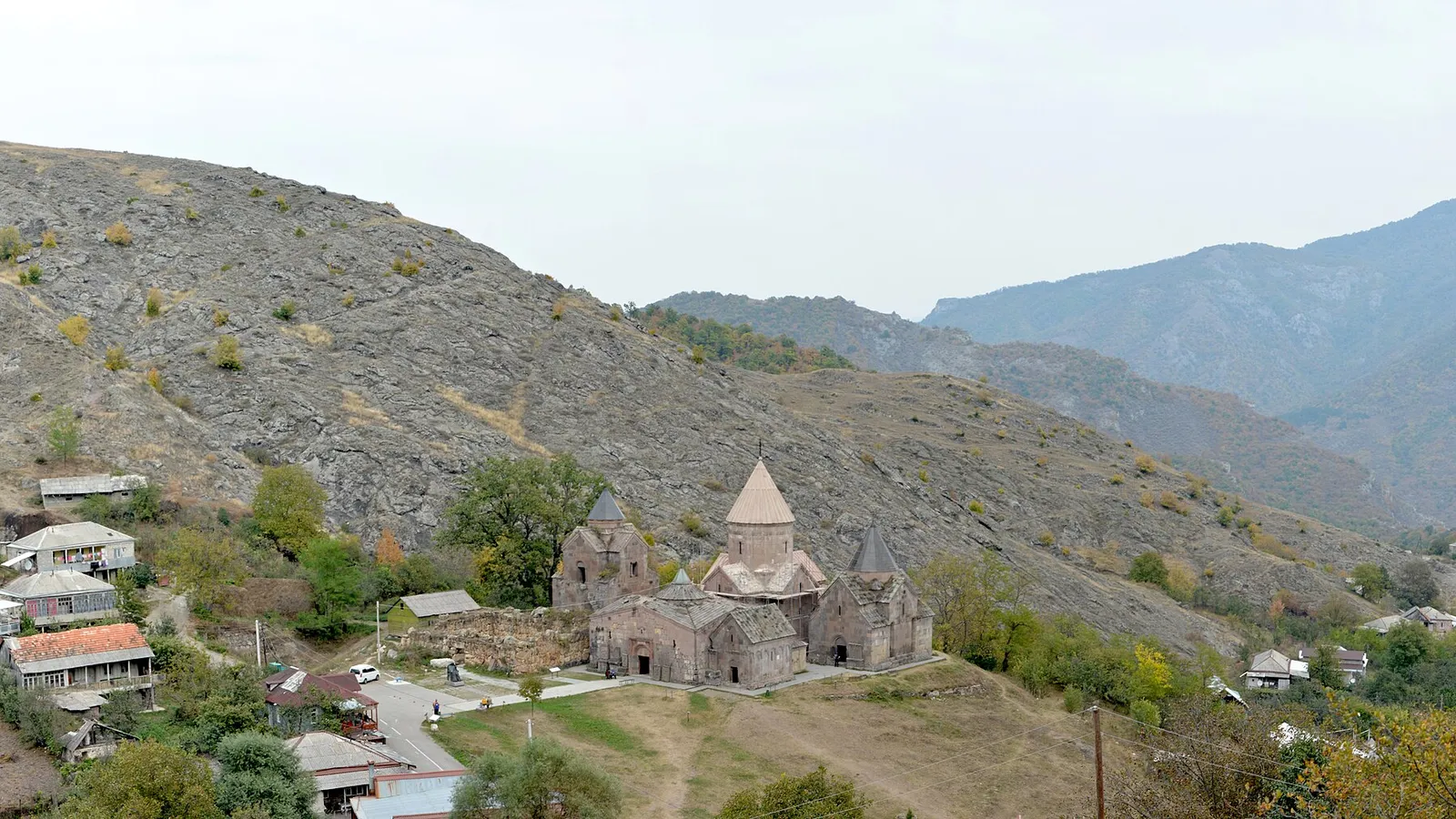
Verified · August 29, 2026Visiting Goshavank: Mkhitar Gosh's law code that reached Poland, the 1291 embroidered khachkar, his statue and hillside tomb, and the drive from Dilijan.