Noratus: The Largest Field of Khachkars
Close to a thousand carved cross-stones in a seven-hectare meadow near Lake Sevan: what to look for at Noratus, the folklore, and how to get there.
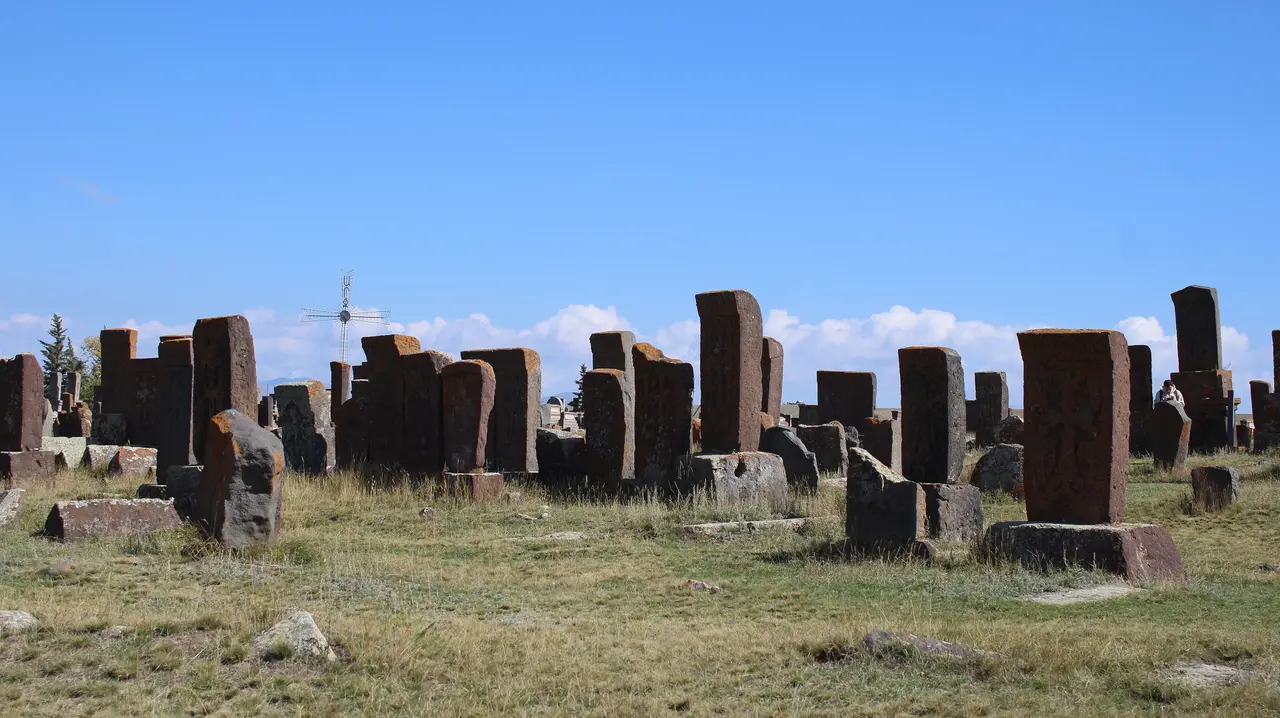
Noratus is a seven-hectare meadow on the western side of Lake Sevan holding close to a thousand khachkars - Armenian carved cross-stones - and it’s now the largest surviving field of them in the world. It sits by a working village about 90 km east of Yerevan and a few kilometres from the provincial town of Gavar. It costs nothing. There’s no fence, no ticket office and no gate, and most visitors give it twenty minutes when an hour is what it deserves.
The reason it deserves the hour is that Noratus isn’t a monument you look at, it’s a text you read. Every stone is different, and once you can tell a 13th-century carver from a 17th-century one - and spot the flat slabs that show what the dead person did for a living - the field stops being a picturesque graveyard and becomes centuries of village life recorded in stone. That takes a bit of knowing, and the site hands you almost none of it: there is no map, and rarely anyone to walk you round.
What a khachkar actually is
The word is literally cross-stone: khach (cross) plus kar (stone). The classic form is a slab, usually around 1.5 m tall, carved with a cross standing on a rosette or solar disc, with the rest of the face filled by interlace, leaves, grapes and pomegranates. Most were raised for the salvation of a soul - of someone dead, but sometimes of someone still living - and others marked a victory, the founding of a church, or protection against disaster.
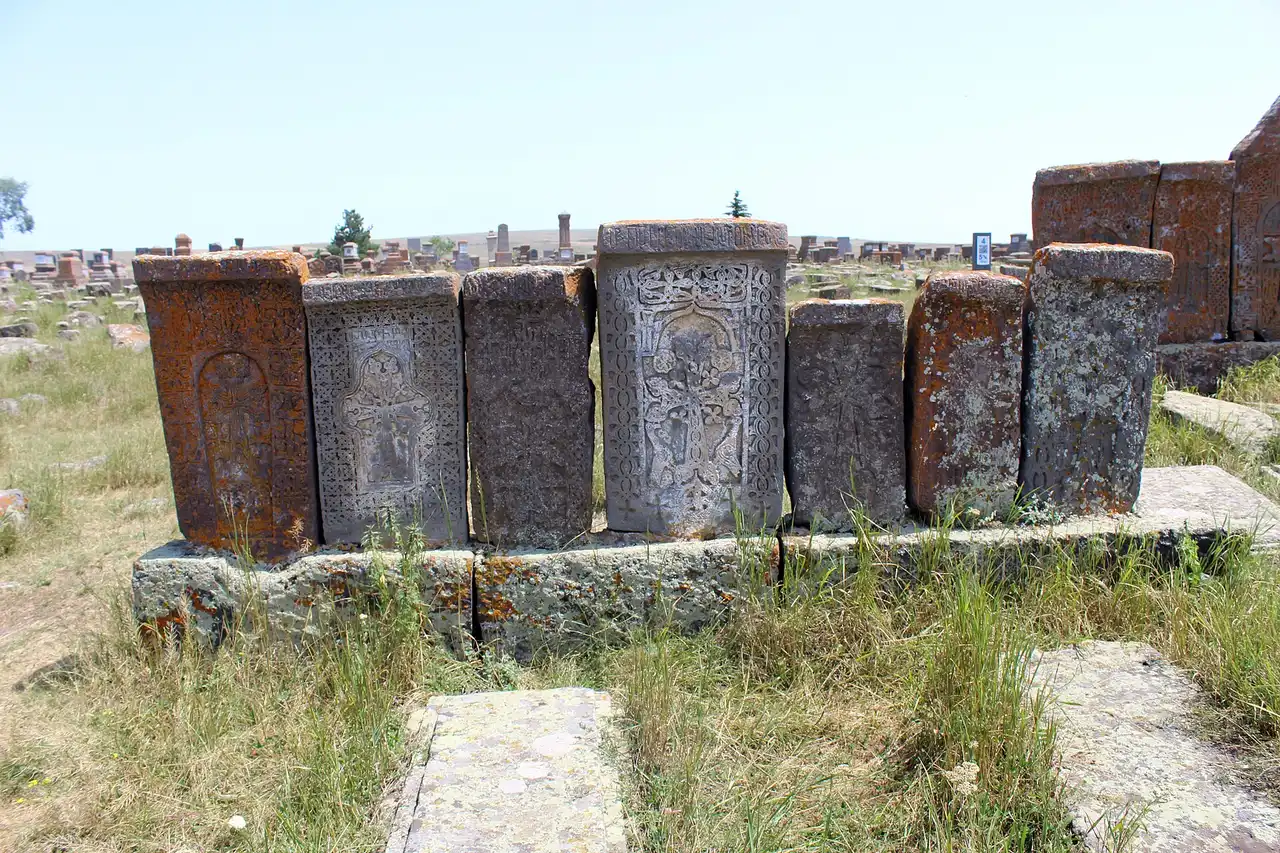
The first true khachkars appear in the 9th century, after Armenia came out from under Arab rule, and the oldest one with a date on it was cut in 879 at Garni for queen Katranide I. The art peaked between the 12th and 14th centuries, collapsed with the Mongol invasions at the end of the 14th, and revived in the 16th and 17th without ever regaining the earlier finesse. Surviving khachkars run into the tens of thousands; UNESCO alone counts more than 50,000 in Armenia, and in 2010 it put the craft on its Representative List of the Intangible Cultural Heritage of Humanity under the name Armenian cross-stones art: symbolism and craftsmanship of khachkars, noting that among all of them no two carry the same pattern.
The field: close to a thousand stones
Sources put the count at around 900 to roughly 1,000, and nobody seems to have a final number, which tells you something about the place. The oldest stones go back to about the late 10th century; Armenian heritage catalogues push the earliest to the 9th and say the bulk belong to the 13th and 14th centuries. Most are crusted in orange and grey lichen, which isn’t neglect so much as altitude, wind and six or seven centuries of weather.
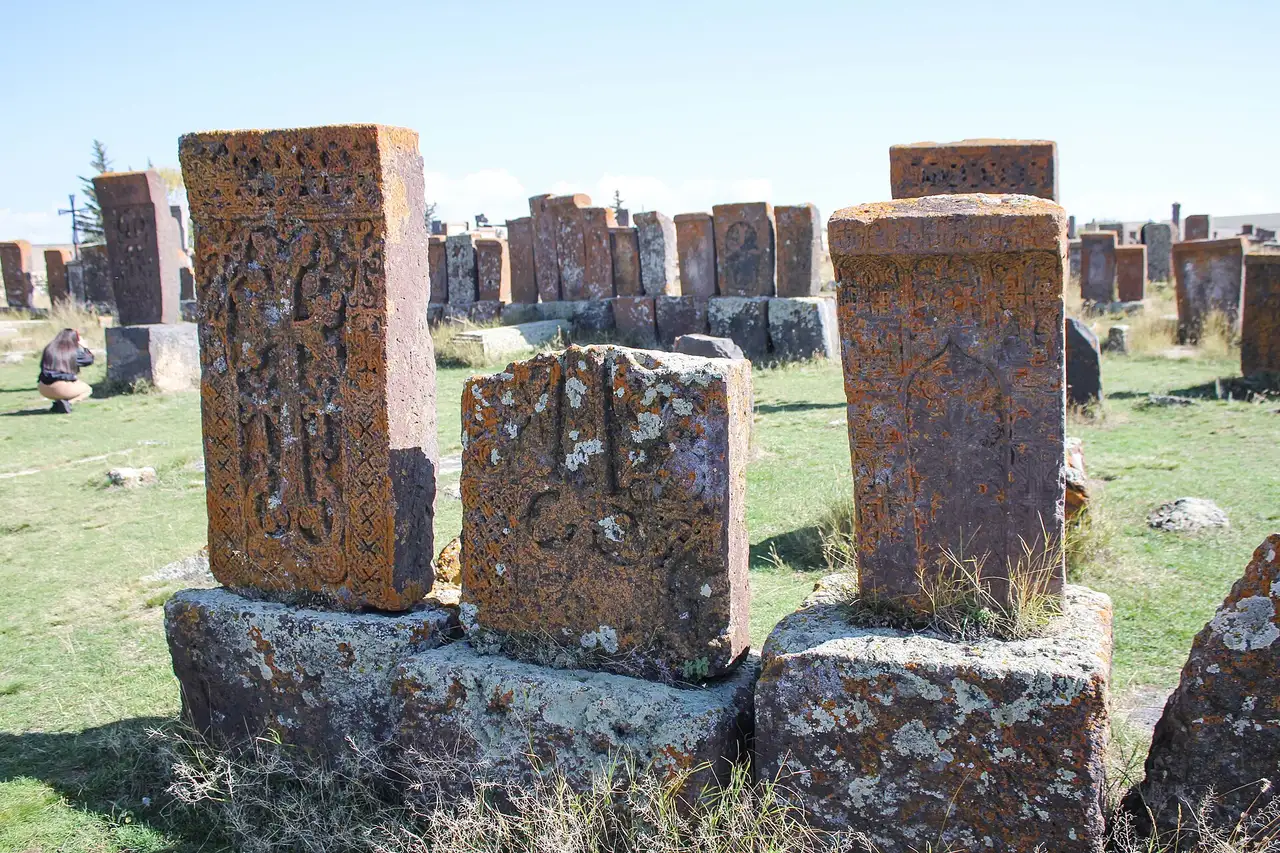
This is where the promise of telling one century from another pays off, and it comes down to the carving itself. On a peak stone of the 13th or 14th century the ornament is cut deep and fine, on two or three levels, so the cross seems to float over a shadowed web of interlace you could almost pass a thread through. The earliest stones, the 10th and 11th-century ones, are the plainest in the field: a big, clear cross with bare stone left around it and only spare, rigid pattern. The revival work is the third look, and the one that gives Noratus its character. Under Safavid rule in the 16th and 17th centuries carvers here worked with visible eastern influence in the ornament, and three masters are known by name from that generation - the best of them Kiram Kazmogh (1551-1610), alongside his contemporaries Arakel and Meliset. Their stones are flatter and more crowded, the pattern shallower and a little rustic - not failed medieval work, but a tradition being rebuilt under occupation. Once you’ve those three registers in your eye, the field stops being a jumble and starts sorting itself by date as you walk.
Then there are the flat ones. Scattered among the standing crosses are horizontal slabs carved with scenes - weddings, farm work, figures and animals under a band of inscription. These are the stones worth hunting for, because they’re the only place in the field where you meet the individual rather than the formula.
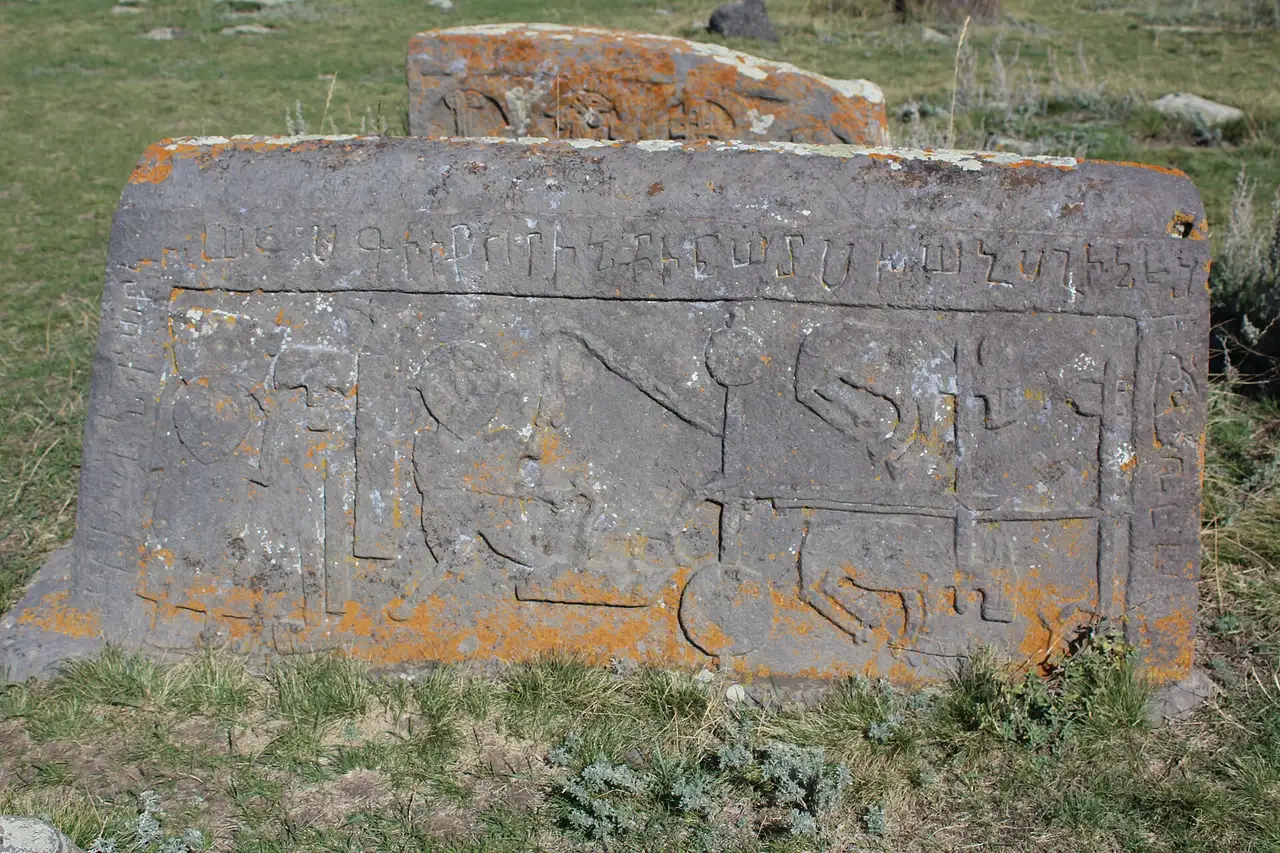
One more thing worth carrying in: those inscriptions are dated with letters, not digits. Medieval Armenian used the alphabet as its number system, so the date on a slab looks like a word until you know what you’re seeing. You’ll not decipher it on the spot, but it explains why the top band of a stone often looks like a phrase that has run out of vowels.
Why it is the largest, and what that costs
Noratus is the biggest surviving khachkar field not because it was the biggest ever, but because the bigger one was destroyed. The Armenian cemetery at Julfa (Jugha) in Nakhichevan held roughly 10,000 khachkars in 1648. By 1998 the count was down to about 2,700, and between 1998 and 2005 the government of Azerbaijan levelled what remained, in defiance of a 2000 UNESCO resolution demanding their protection. That’s the plain reason a modest village graveyard by Lake Sevan now carries the title, and it is worth knowing before you photograph it.
It also sets expectations properly. The stones usually rated the finest in Armenia are elsewhere - the 1213 stone at Geghard, probably by masters Timot and Mkhitar; the Holy Redeemer at Haghpat carved by master Vahram in 1273; and master Poghos’s 1291 khachkar at Goshavank. Noratus isn’t about the one perfect stone. It’s about scale, variation and folk carving, and that’s a different and in some ways better experience than admiring a masterpiece behind a rope. Our roundup of the best monasteries in Armenia covers where those masterpiece stones live, and the UNESCO sites in Armenia page explains how khachkar craft sits on the intangible heritage list rather than the World Heritage one.
The stories the village tells
Two pieces of folklore attach to the field, and both get told to visitors as fact.
The first is a siege story. When an invading army approached, the villagers are said to have put helmets on top of the khachkars and leaned swords against them, so that from a distance the field looked like a standing army holding a defensive line, and the invaders withdrew. In the most repeated version the army is Tamerlane’s; Armenian sources tell the same trick with King Gegham deceiving Seljuk troops. Two different enemies for one story is usually a sign of folklore rather than history, which doesn’t make it less worth hearing while you’re standing in the field it describes.
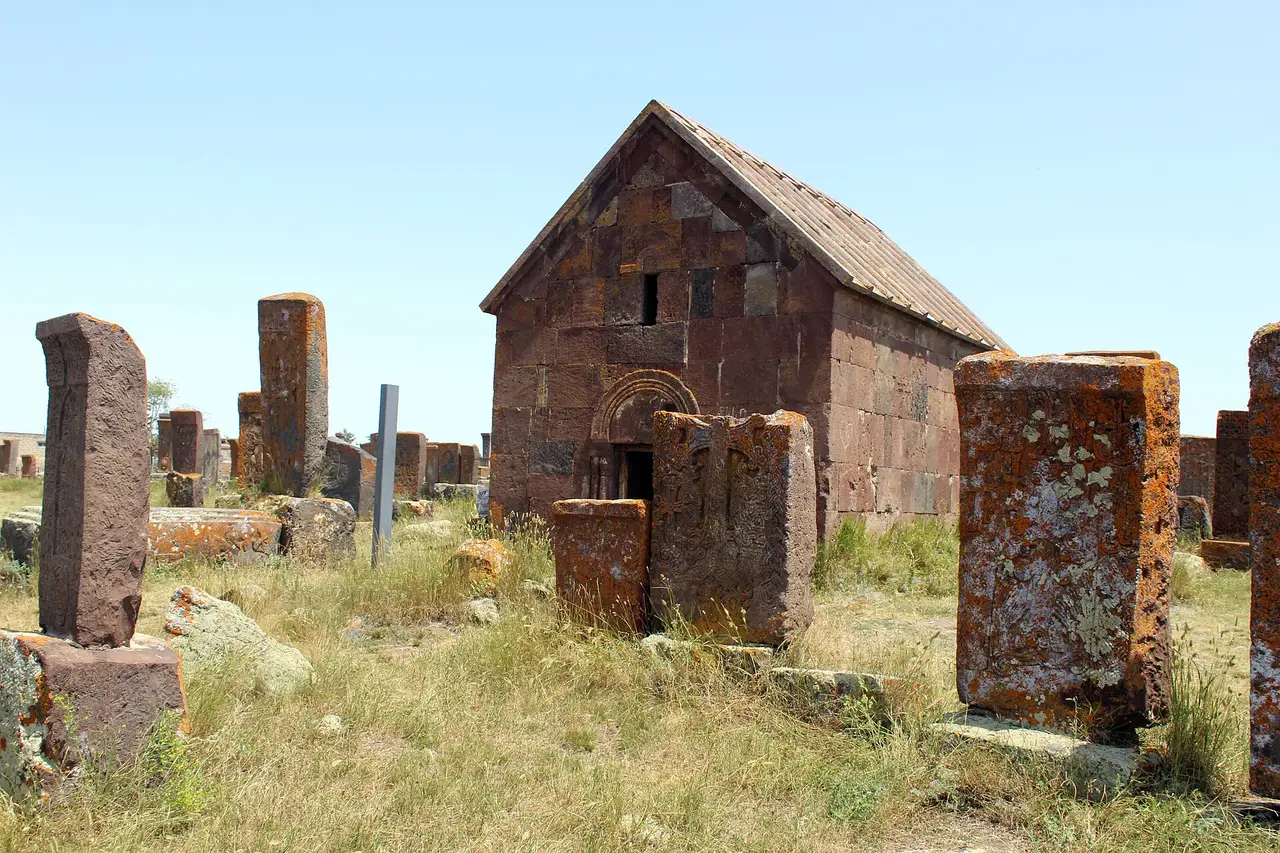
The second is stranger and, going by the evidence on the ground, still alive. A 19th-century monk named Ter Karapet Hovhanesi-Hovakimyan served the burials here from a monastery near the village. To spare himself the two-hour round trip he built a cell at the cemetery, and at 90 years old he asked his brother monks to bury him alive, telling them to fear nothing but God, and instructing anyone afraid to come to his grave, pour water on the stone, drink it, wash their face and limbs, then break the vessel. People still do. If you find a grave with broken glass scattered around it, you’ve found him.
Getting there, and doing it properly
Noratus lies about 90 km from Yerevan: the M4 to Lake Sevan and then the quieter western shore road south, past Hayravank, to the village a few kilometres short of Gavar. Reckon on an hour and a half to two hours each way by car. Our guide to Lake Sevan covers the shoreline and the beaches, and the full driving circuit that takes in Noratus, Hayravank and the Selim pass is laid out in our Lake Sevan loop.
By public transport it’s a two-stage trip and a slow one. Travellers reported in 2025 that marshrutka 326 runs from Yerevan’s northern bus station to Gavar roughly every half hour for about 1,100 AMD, with the last one out leaving around 18:40; from Gavar’s central square local minibuses cover the last few kilometres to Noratus village until about 14:30. The catch is the return: the last marshrutka back from Gavar to Yerevan goes at roughly 15:40, so the day is shorter than the outbound times suggest. Treat all of this as a starting point rather than a timetable - Armenian marshrutka schedules and fares move, so confirm at the station on the day, and pin down that last bus back before you commit. If you would rather not gamble, a taxi held for the round trip is the usual local solution; our page on taxi apps in Armenia covers how fares work here, and getting from Yerevan to Lake Sevan has the wider transport picture. A guided Lake Sevan day trip that bundles Sevanavank and Noratus solves the problem in one booking.
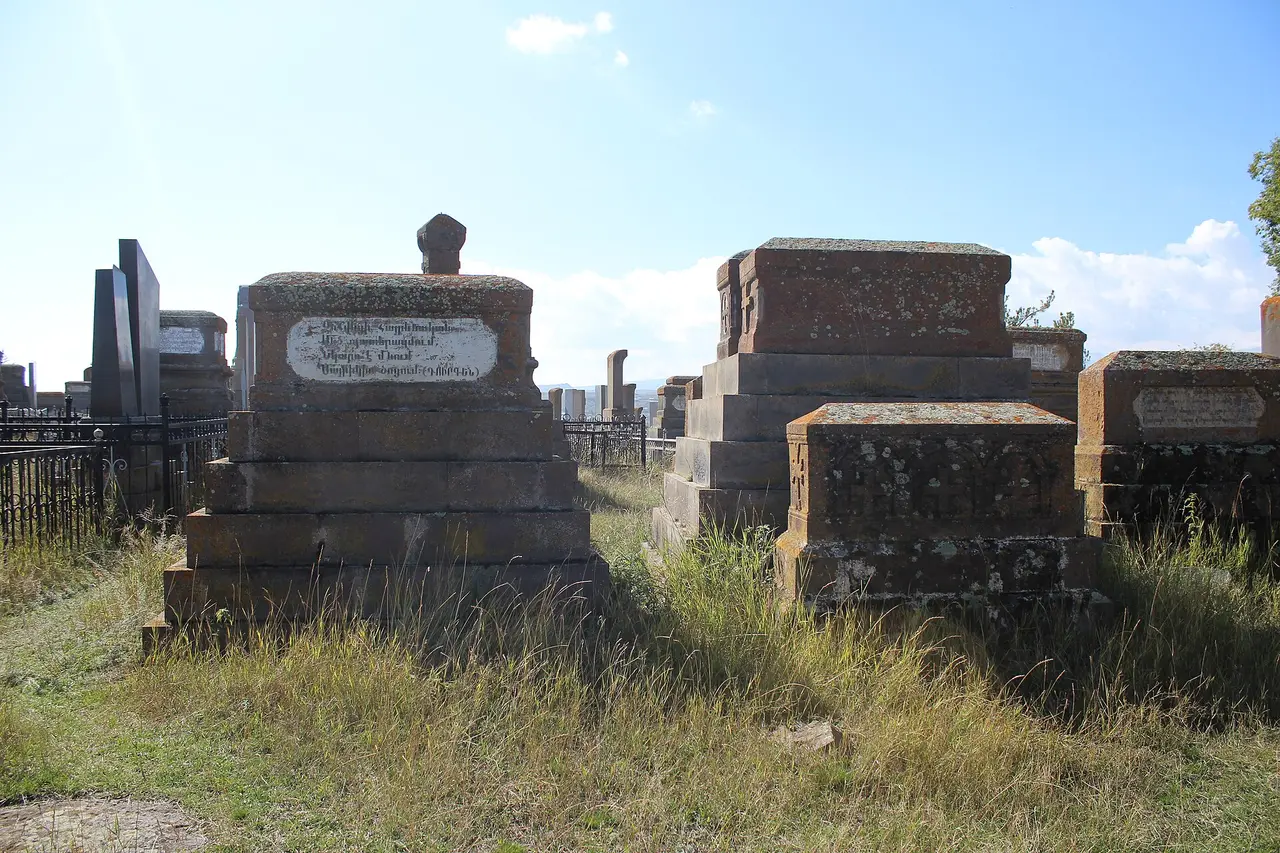
On the ground, three things matter. First, it is free and unfenced, so there is nobody to tell you where to walk - and a modern cemetery stands right beside the old field, separated by a fence, with recent family graves inside the old one too. This is an active burial ground and you should move through it like one: paths between the stones, nothing climbed on, no propping cameras against carving. Second, there’s no shade and no shelter anywhere in seven hectares, and this is open plateau at Sevan altitude, so a hat in July and a windproof layer in spring or autumn aren’t optional. Third, in season there’s often a stall or two by the entrance selling snacks and knitted souvenirs, and you may be gently pressed to buy something - but don’t count on anyone there to explain the stones.
Pair it with the lake rather than driving out for the stones alone. Sevanavank on its peninsula is the obvious partner and covered on our Sevanavank monastery page, Hayravank on the shore is quieter than either, and Gavar is the only sensible place nearby for lunch. Come in the morning if you want the carving to read - low side-light picks the interlace out of the lichen, while flat midday sun turns the whole field into grey blocks. That’s an argument for a car: the first bus only gets you to Noratus around midday, so morning light here effectively means driving yourself or staying the night nearby. Our guide to car rental in Armenia covers what to expect from these secondary shore roads.
On the map
The map loads on click - to keep the page lightweight.
The map didn’t load. Check your connection and refresh the page.
Good to know
Free, unfenced and open air, with no ticket office and no fixed hours. It is still an active village cemetery - stay on the paths between the stones and do not climb on them.
Details checked: July 24, 2026
Distance ≈90 km · 1.5-2 h by car
- Yerevan ≈90 km · 1.5-2 h by car M4 to Lake Sevan, then the western shore road south past Hayravank; the village sits a few kilometres from Gavar.
Read also

What to see · 10 min read
Soviet Modernist Yerevan: An Architecture Walk
Verified · September 5, 2026Walk Yerevan's Soviet modernism: Rossiya Cinema, Komitas Hall, Cascade, Hrazdan Stadium and Demirchyan Complex - dates, route order, and what still stands.

What to see · 9 min read
Kond: Walking Yerevan's Oldest Neighborhood
Verified · September 3, 2026Walk Kond, Yerevan's oldest living quarter: Surp Hovhannes, Tepebashi mosque walls, Leo Street alleys, and how to visit without treating it like a set.
What to see · 8 min read
Sardarapat Memorial: Armenia's 1918 Battle Site
Verified · August 31, 2026Sardarapat Memorial near Armavir: 1918 battle site, Israelyan's red-tufa complex, ethnography museum tickets, hours and how to reach it from Yerevan.
What to see · 12 min read
Goshavank Monastery & the Village of Gosh
Verified · August 29, 2026Visiting Goshavank: Mkhitar Gosh's law code that reached Poland, the 1291 embroidered khachkar, his statue and hillside tomb, and the drive from Dilijan.