Shirak Loop: Gyumri, Marmashen & Harichavank
A 1-2 day self-drive loop north from Yerevan into Shirak: Aruch basilica, black-tuff Gyumri, Marmashen over the Akhurian, and Harichavank.
Most people who “do Gyumri” from Yerevan ride the train up, walk the old streets for an afternoon, and ride back. That’s a shame, because the best of Shirak sits just outside the city, and a car turns a flying visit into one of the most rewarding short loops in Armenia. This route runs northwest from Yerevan on the M1, stops at the dome-less basilica of Aruch on the way up, gives you a proper half-day in Gyumri, then reaches the two sights that make the detour worth it: Marmashen on its shelf above the Akhurian, and Harichavank on the road back. It’s about 300 km round trip, and it works as one long day or, much better, as a relaxed two-day trip with a night in Gyumri.
A word on how to travel it: this is a self-drive loop. Gyumri itself is reachable by train and marshrutka, but Aruch, Marmashen and Harich are all short spurs off the main axis, on their own quiet roads, and stitching them together without your own car means a lot of waiting or a hired driver. Roads are paved the whole way and the M1 is fast; the only slow bits are the last kilometres up to each monastery. Shirak is a high plateau, so this is a spring-to-autumn route. In winter Gyumri sits under snow and the side roads get iffy.
Yerevan to Aruch: a basilica open to the sky
Point the car northwest out of Yerevan onto the M1 (Ashtarak highway), the main road to Gyumri. About 60 km up, a signed spur leads left into the village of Aruch, and it is worth the ten-minute diversion. The cathedral of Aruch (Aruchavank, or St Grigor) was founded by prince Grigor Mamikonyan in 662 and consecrated in 666, one of the largest early-medieval domed-hall churches ever built in Armenia. Its dome collapsed centuries ago and was never rebuilt, and the odd result is the best thing about the place: the huge hall now stands open to the sky, flooded with light, with swallows going in and out where the vault used to be.
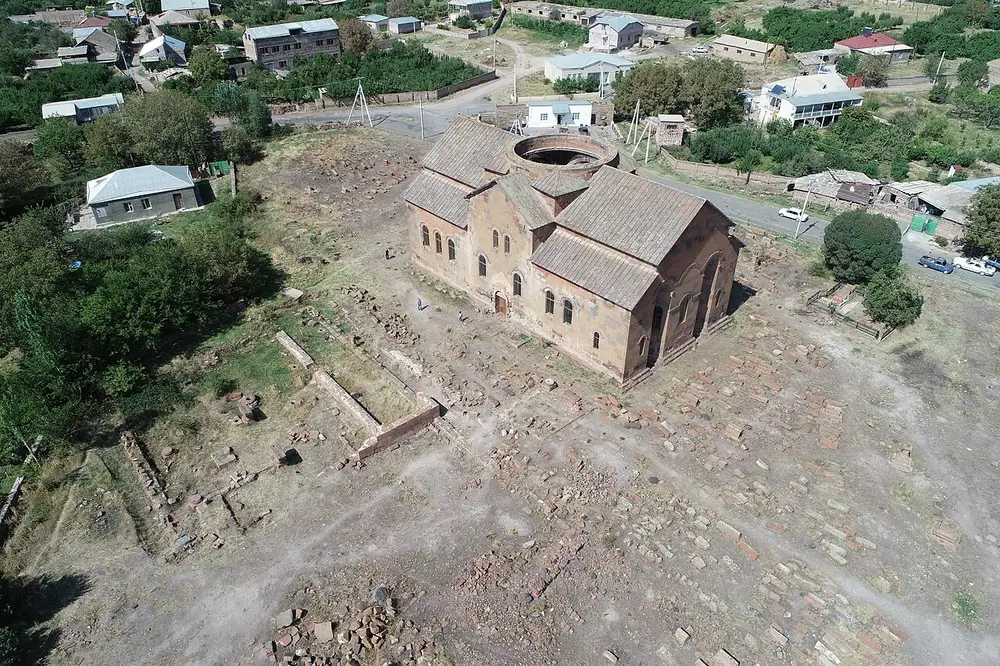
Two things reward a slower look. Inside, on the apse, are fragments of 7th-century frescoes by an artist recorded as Stephanos, among the oldest surviving murals in the country. Outside, the low walls around the church aren’t random rubble but the excavated foundations of Mamikonyan’s palace, dug up in the 1940s and 50s, and in the village stands a half-ruined caravanserai, a reminder that this was a working seat on a real road, not just a church in a field. Give it an hour, then get back on the M1.
Gyumri: the black-tuff city
Roughly 125 km from Yerevan you roll into Gyumri, Armenia’s second city and, by local reckoning, its capital of art and dry humour. Head straight for the Kumayri quarter, the old core, which is the whole reason to come. This is one of the few places in Armenia, or anywhere, with a large stretch of intact 19th-century urban Armenian architecture: more than a thousand houses on a grid of wide streets, built in the black and red volcanic tuff that gives Gyumri its unmistakable dark, two-tone look.
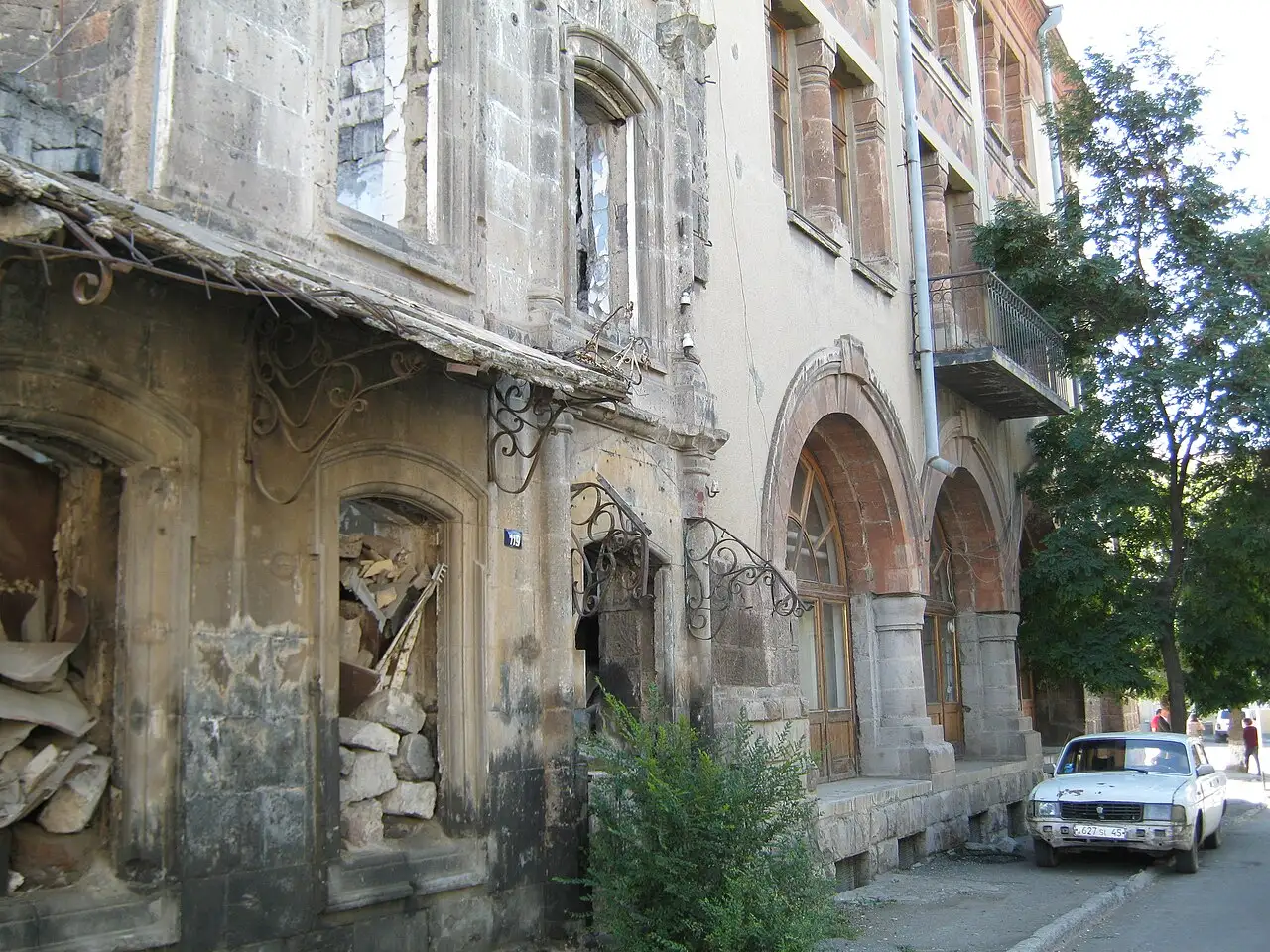
Here’s the honest bit, and it’s part of the character. Gyumri was renamed Alexandropol in 1837 and boomed as a crafts-and-trade town; the finest houses went up between the 1860s and 1880s, and from 1880 black tuff became the dominant colour, with white-jointed masonry, arched doorways and virtuoso stone carving. Then came the 1988 earthquake, which levelled much of the modern city and killed tens of thousands. Remarkably, most of the Kumayri stone houses survived both that quake and an earlier one in 1926, but some still stand half-collapsed and unrestored, propped and patient. Walking these streets you see a city both proud and unfinished, and it’s far more moving than a tidy museum quarter would be. Spend the rest of the day here: the wrought-iron balconies, the Sev Berd (Black Fortress), a coffee on Vardanants Square, and the food, which is a reason to come in itself. Our Gyumri city guide has the detail on where to walk, eat and sleep, and if you want to arrive by rail instead of driving up, our guide to getting from Yerevan to Gyumri covers the train, the marshrutka and the timings.
This is where the two-day version pays off. Sleep in a Kumayri guesthouse, eat a long Gyumri dinner, and keep the monasteries for a fresh morning rather than cramming them into a fading afternoon.
Marmashen: red stone above the Akhurian
The single sight that makes this loop more than “Gyumri plus a church” is Marmashen, about 10-15 km northwest of the city, a twenty-minute drive out onto a shelf of apple orchards above the left bank of the Akhurian river. The monastery was built between 988 and 1029 by the noble Vahram Pahlavuni, and it’s one of the loveliest settings in Shirak: warm red-and-ochre tuff churches on a green terrace, the river below, the bare hills of the Turkish frontier country beyond.
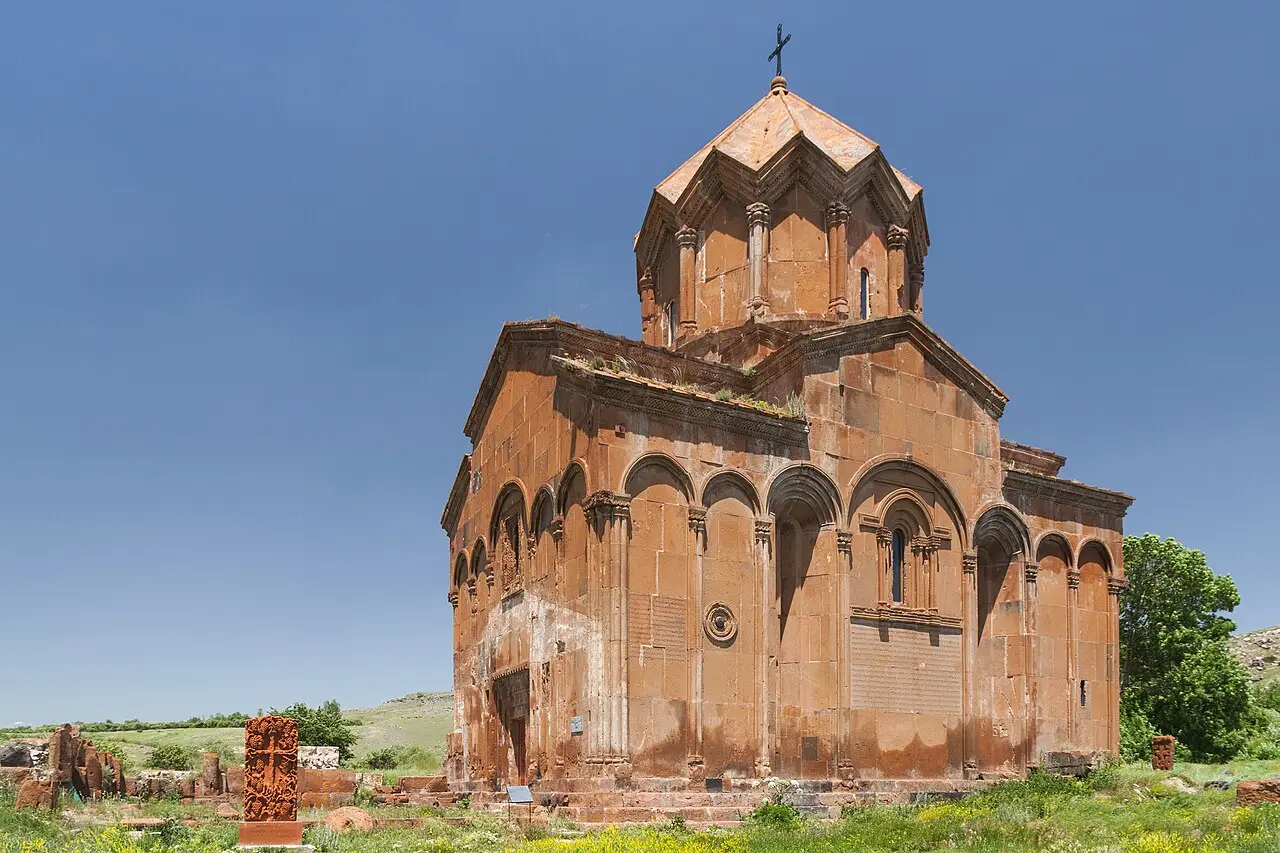
Five churches were built here; three survive in good order, grouped close together in the same style. The main one, St Katoghike, is the tall one, and it repays a slow circuit for the blind arcading, the slim arched windows and the carved cornices that Pahlavuni’s masons cut into the soft volcanic stone. It’s usually quiet, sometimes empty, and that emptiness is the point - after the crowds at Khor Virap or Tatev, Marmashen feels like your own discovery. Bring water and decent shoes; the last approach is a rough track, and the orchards are best in blossom (spring) or fruit (late summer). Monastery-hunters can line this up against the country’s headline sites in our roundup of the best monasteries in Armenia, where Marmashen holds its own for setting alone.
Harichavank on the road home
Rather than backtrack the way you came, loop south on the return and stop at Harichavank, the monastery near the village of Harich, a short spur off the Gyumri-Yerevan road. This one was a heavyweight: a 7th-century foundation that grew into one of the most important monastic schools and scriptoria in medieval Armenia, its scholars copying and teaching for centuries.
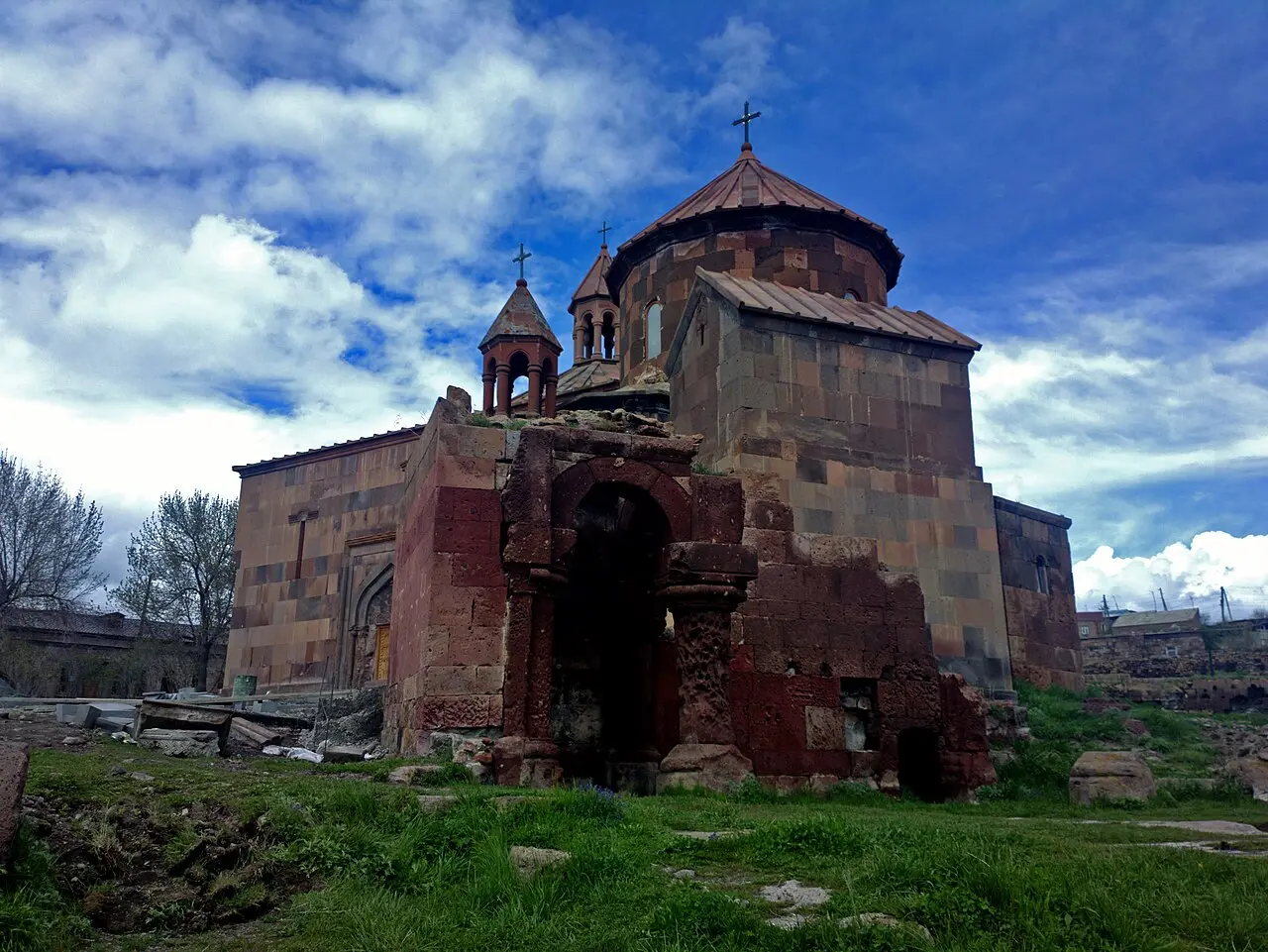
The oldest part is the small Church of St Gregory the Enlightener, a compact domed structure of the early “Mastara” type; the big draw is the pair of monumental gavits (covered narthexes) added around the turn of the 13th century, built of huge stones, some over three metres. There’s a later chapter too: from 1850 Harich became the summer residence of the Catholicos of Echmiadzin, and the 19th-century buildings around the medieval core date from that era. It sits handsomely on the edge of a gorge, and because it’s on the way back it costs you almost no extra time. From Harich it’s a straightforward drive south on the M1 to Yerevan.
Costs, timing and how to shape it
As a rough floor, a two-day self-drive version - a small rental car, one night in a Gyumri guesthouse, local food and fuel - starts around AMD 60,000 per person for two sharing, and climbs with nicer hotels and a bigger car. The monasteries are free; the real costs are the car, the room and the meals, and Gyumri’s food is generous and cheap. Treat that figure as a starting point rather than a quote, and pick up your car in Yerevan the day before if you want an early start - our guide to renting a car in Armenia covers the deposit, the paperwork and the mountain-road realities before you take the keys.
The one-day version is doable but honest about itself: it’s a long day, roughly ten hours door to door, and you’ll trade the leisurely Gyumri evening for a quicker lunch. If you only have the day, cut Aruch or Harichavank rather than rushing Gyumri and Marmashen, which are the heart of it. If you have the two days, keep everything and add an hour somewhere - a longer wander in Kumayri, a coffee by the Akhurian.
This loop also slots neatly into a bigger trip. It pairs naturally with the north: from Gyumri you’re within reach of Lori, Haghpat and Sanahin to the northeast, or of the high meadows and crater lake on Mount Aragats to the south, whose foot you already pass at Aruch. For a full week that works Shirak in alongside the wine country and the deep south, see our 10-day Armenia itinerary; for a shorter frame, the 7-day itinerary shows how to fold a Gyumri night into the classic loop. Browse the routes hub for more ways to build a trip.
Route day by day
- Days on the road
- 2
- Distance
- ≈300 km
- Budget from
- 60000 AMD
- Best season
- May, June, July, September, October
The route at a glance
-
Yerevan
Route startstop ≈0 min
Start point: pick up the rental car and head northwest onto the M1 (Ashtarak highway) toward Shirak.
-
Aruch
60 km from the startstop ≈60 min
A 7th-century domed basilica (662-666) at the foot of Aragats, its dome long gone so the hall opens to the sky, with a ruined caravanserai beside it.
Photo: Soseh Aghaian / Wikimedia Commons, CC BY-SA 4.0 ( source) -
Gyumri
125 km from the startstop ≈240 min
Armenia second city: the Kumayri quarter of black-and-red tuff, 1,000-plus 19th-century houses, carved balconies, and the arts-and-humour spirit of old Alexandropol.
Photo: Vacio / Wikimedia Commons, CC BY-SA 3.0 ( source) -
Marmashen
138 km from the startstop ≈90 min
A red-stone monastic complex of 988-1029 on a shelf above the left bank of the Akhurian, five churches built, three still standing.
Photo: Marcin Konsek / Wikimedia Commons, CC BY-SA 4.0 ( source) -
Harichavank
170 km from the startstop ≈90 min
A 7th-century monastery near Harich, once a famous school and scriptorium, later the summer seat of the Catholicos; on the way back toward Yerevan.
Photo: Soghomon Matevosyan / Wikimedia Commons, CC BY-SA 4.0 ( source)
Route map
The map with stops loads on click - to keep the page lightweight.
The map didn’t load. Check your connection and refresh the page.