Matenadaran: Yerevan's Museum of Ancient Manuscripts
Matenadaran holds about 23,000 manuscripts, including a 28kg book saved from genocide in two halves. Tickets, hours and what's actually worth seeing.
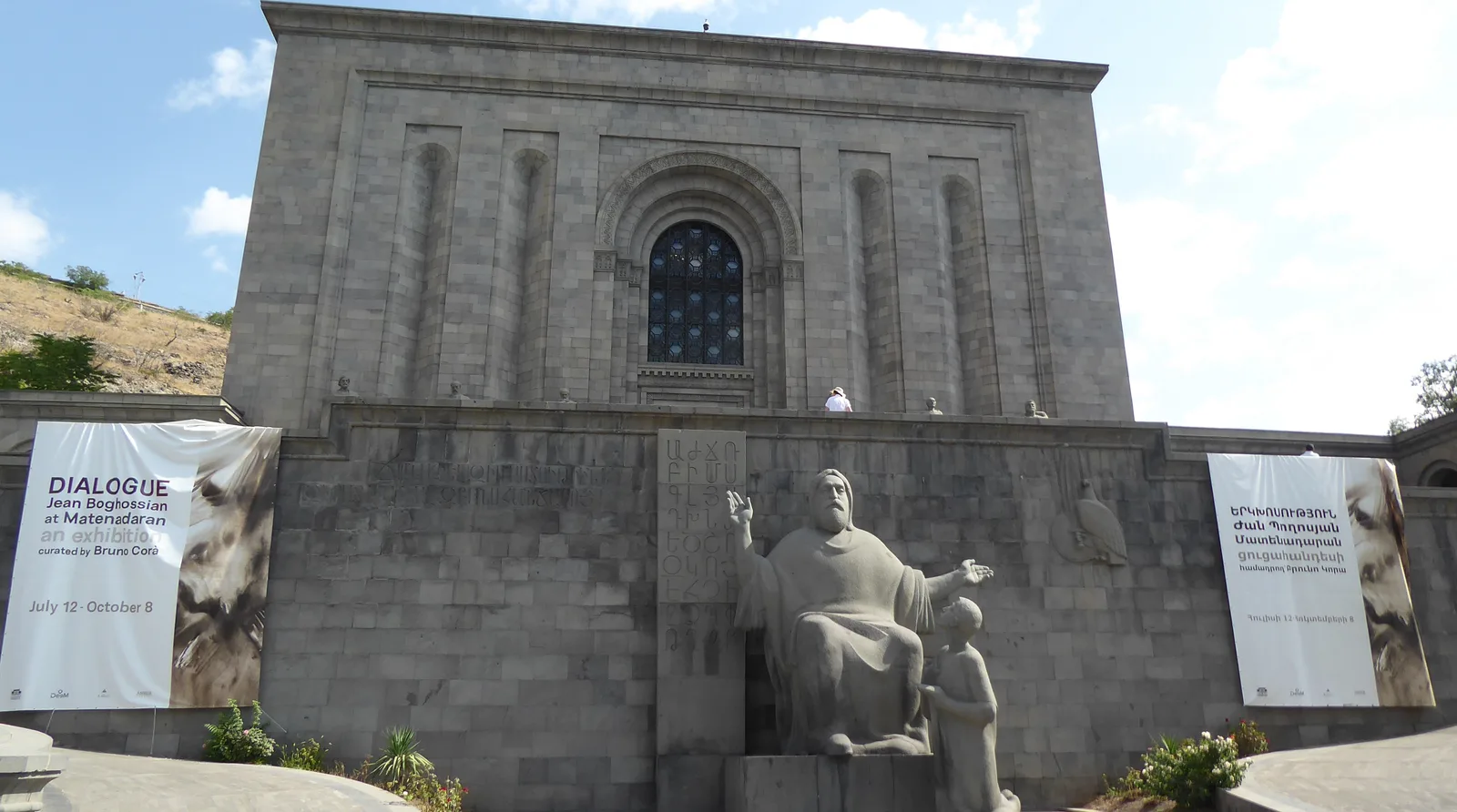
Matenadaran is Armenia’s national manuscript library and museum, a squat grey building at the top of Mashtots Avenue that holds around 23,000 manuscripts, fragments and talismans, most in Armenian, others in Greek, Latin, Arabic and half a dozen other languages. Admission is 2,000 AMD, it’s open Tuesday to Saturday, and the one object worth building your visit around is a 28-kilogram book that survived a genocide in two separate pieces.
From an alphabet to a state institute
Armenian manuscript culture starts with the alphabet itself. Mesrop Mashtots invented the Armenian script in 405, and what followed was a genuine burst of activity: monks and scholars raced to translate the Bible, then Greek and Syriac philosophy, medicine and histories, into the new alphabet within a couple of generations. Armenians call it their Golden Age of literature, and it’s the reason a country of monasteries ended up sitting on one of the world’s great manuscript hoards rather than a handful of relics. The collection lived for centuries inside the Armenian Church’s seat at Etchmiadzin, growing slowly: a count in 1828 found 312 manuscripts, by 1837 there were 2,340, and by 1913 the number had reached 4,060.
The twentieth century nearly ended the collection more than once. It was evacuated to Moscow during the First World War and only returned to Armenia in 1922; after the Genocide, roughly 1,600 manuscripts rescued from Vaspurakan, Mush and Erzurum were carried to Etchmiadzin for safekeeping. Soviet nationalisation followed in December 1920, the whole archive moved to Yerevan’s state library in 1939, and the dedicated building you see today, designed by architect Mark Grigoryan, went up between 1945 and 1959. The institute was formally established on 3 March 1959 and took Mashtots’s name in 1962. UNESCO added the collection to its Memory of the World register in 1997, when it numbered around 17,000 manuscripts; it’s grown by several thousand more since.
You meet the founder before you meet a single manuscript. Below the entrance terrace stands a monumental sculpture of Mashtots himself, seated and teaching, one hand raised, with a young pupil kneeling at his side taking it in, carved from the same grey stone as the building above it. A row of statues of other Armenian scholars and chroniclers stands watch along the terrace, and the Armenian alphabet is cut into a stone tablet right beside Mashtots, letter by letter, so the approach tells you what the place is about before you’ve climbed a single step.
The Homilies of Mush: 28 kilograms of parchment
If you only remember one object here, make it this one. The Homilies of Mush, known in Armenian as Msho Charrentir, is the largest surviving Armenian manuscript, written and illustrated between 1200 and 1202 at the Avagvank monastery near Yerznka, on 604 sheets of parchment made from roughly 600 calfskins. It weighs 28 kilograms, closer to a paving slab than a book you’d hold. Within a couple of years it was seized, and the monks of St Arakelots in Mush bought it out of captivity for 4,000 silver coins, a monastery and the villages around it raising the price of a book none of them had commissioned, before it settled at the monastery of St Arakelots, now inside Turkey, for roughly 711 years until the Genocide of 1915 forced it out. Two women fleeing the monastery split the book in half between them to carry it, and both halves eventually reached Matenadaran, where the manuscript is still kept and displayed in its two original parts, with no single cover binding them back together, which says as much about what it survived as the calligraphy does.
What makes the object land isn’t really its size, it’s what the size represents. A book that heavy was never meant to travel, and the fact that it did, split between two refugees walking away from a massacre, is the reason it’s treated less like an exhibit and more like a survivor. It sits alongside the roughly 1,600 other manuscripts carried out of Vaspurakan, Mush and Erzurum in the same period, a reminder that most of what’s on display here made it to Yerevan the hard way.
What else is behind the glass
The Homilies of Mush aside, what makes Matenadaran worth the entry fee is the range. Illuminated Gospels sit near scientific treatises, medical texts and star charts, covering subjects from history, geography and law to mathematics, cosmology, calendar science and music. The languages go well beyond Armenian too: Greek, Latin, Aramaic, Hebrew, Arabic, Persian, Georgian and Ethiopic all turn up somewhere in the stacks, evidence of how much cultural traffic passed through Armenia’s monasteries over a thousand years. Display cases group manuscripts by subject and period rather than dumping everything into one chronological run, so you come away with a real sense of how wide the country’s written record actually runs, not just how old it is.
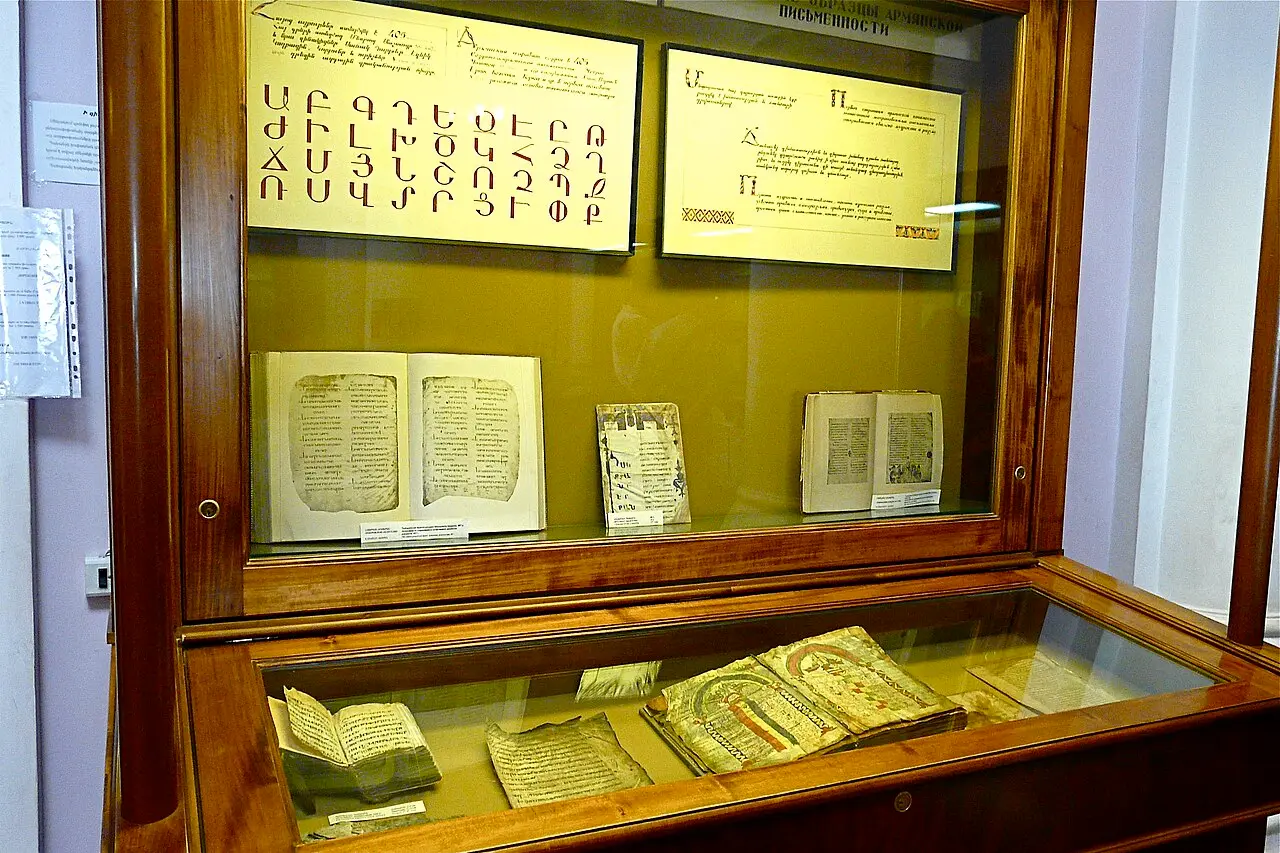
More than a museum: a working research institute
It’s easy to walk through Matenadaran as a museum and miss that most of the building isn’t open to visitors at all. Behind the exhibition halls, departments of manuscript studies, medieval art and oriental studies do the slower work: cataloguing, restoration, and a dedicated Department of Digitisation that’s been photographing pages for online access. There’s a reading room for researchers and a publishing house that puts out scholarly editions, so the institute functions closer to a working national archive than a static collection under glass.
That ongoing scholarship matters for a reason that isn’t obvious from the display cases: a good number of ancient Greek and Syriac texts survive today only because a medieval Armenian monk translated them, and the original Greek or Syriac version was later lost. The translation in the case in front of you can, in a real sense, be the only surviving copy of a much older book, which is a strange thing to sit with in a room full of quiet visitors reading labels.
Tickets, hours and getting there
Matenadaran is open Tuesday to Saturday, 10:00 to 17:50, and closed Sunday, Monday and public holidays. A standard adult ticket is 2,000 AMD, visitors aged 6 to 18 pay 1,000 AMD, and children under 6 go free. A guided tour in Armenian costs 5,000 AMD, the same starting price as a tour in English, French, German, Russian, Italian or Spanish for a group of up to 10 people, which rises to 7,000 AMD for larger groups. On the last Saturday of each month entry is free, but only for citizens of Armenia, so it won’t save visitors from abroad anything.
The building sits at the top of Mashtots Avenue, a short walk uphill from the Cascade, right in the middle of central Yerevan, so it’s an easy add-on to a day of walking rather than a special trip across town. Give yourself an hour if you’re mainly there for the Homilies of Mush and a quick pass through the exhibition halls, closer to two if you want to read every label.
Compared with Yerevan’s bigger museums, this one is compact, which works in its favour: you can see the highlights properly in under an hour without the fatigue that sets in halfway through a full history museum. That makes it an easy fit even on a day already built around something bigger, like the Cascade or a morning at the monasteries outside town. Confirm the current price list and hours on the day, since museum pricing here has shifted before and this guide reflects a specific check date rather than a permanently fixed rule.
Pairing it with the rest of the avenue
Matenadaran works best as one stop on a longer walk rather than a destination on its own. Our guide to things to do in Yerevan covers the Cascade at the bottom of the same avenue and the rest of the city centre within easy reach on foot. For a heavier, more reflective contrast, the Tsitsernakaberd genocide memorial is a short taxi ride away and adds real context to the story behind the Homilies of Mush, a manuscript that only survives today because two people ran with it rather than left it behind.
Photos
On the map
The map loads on click - to keep the page lightweight.
The map didn’t load. Check your connection and refresh the page.
Admission and opening hours
- Admission price
- 2,000 AMD adult; 1,000 AMD ages 6-18; free under 6
- Opening hours
- Tuesday-Saturday, 10:00-17:50; closed Sunday, Monday and public holidays
Foreign-language guided tour 5,000 AMD (up to 10 people) or 7,000 AMD (11+); free entry for Armenian citizens on the last Saturday of each month
Details checked: August 8, 2026
Read also

What to see · 10 min read
Soviet Modernist Yerevan: An Architecture Walk
Verified · September 5, 2026Walk Yerevan's Soviet modernism: Rossiya Cinema, Komitas Hall, Cascade, Hrazdan Stadium and Demirchyan Complex - dates, route order, and what still stands.

What to see · 9 min read
Kond: Walking Yerevan's Oldest Neighborhood
Verified · September 3, 2026Walk Kond, Yerevan's oldest living quarter: Surp Hovhannes, Tepebashi mosque walls, Leo Street alleys, and how to visit without treating it like a set.
What to see · 8 min read
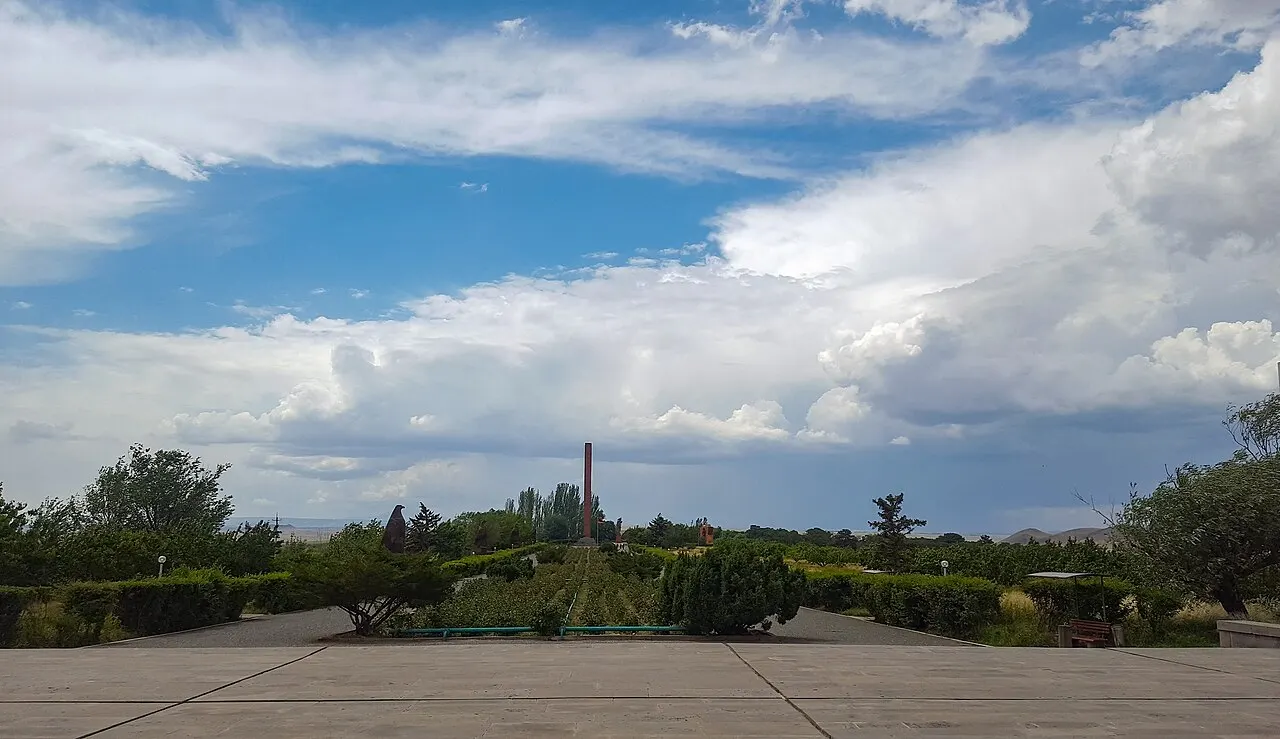
Sardarapat Memorial: Armenia's 1918 Battle Site
Verified · August 31, 2026Sardarapat Memorial near Armavir: 1918 battle site, Israelyan's red-tufa complex, ethnography museum tickets, hours and how to reach it from Yerevan.
What to see · 12 min read
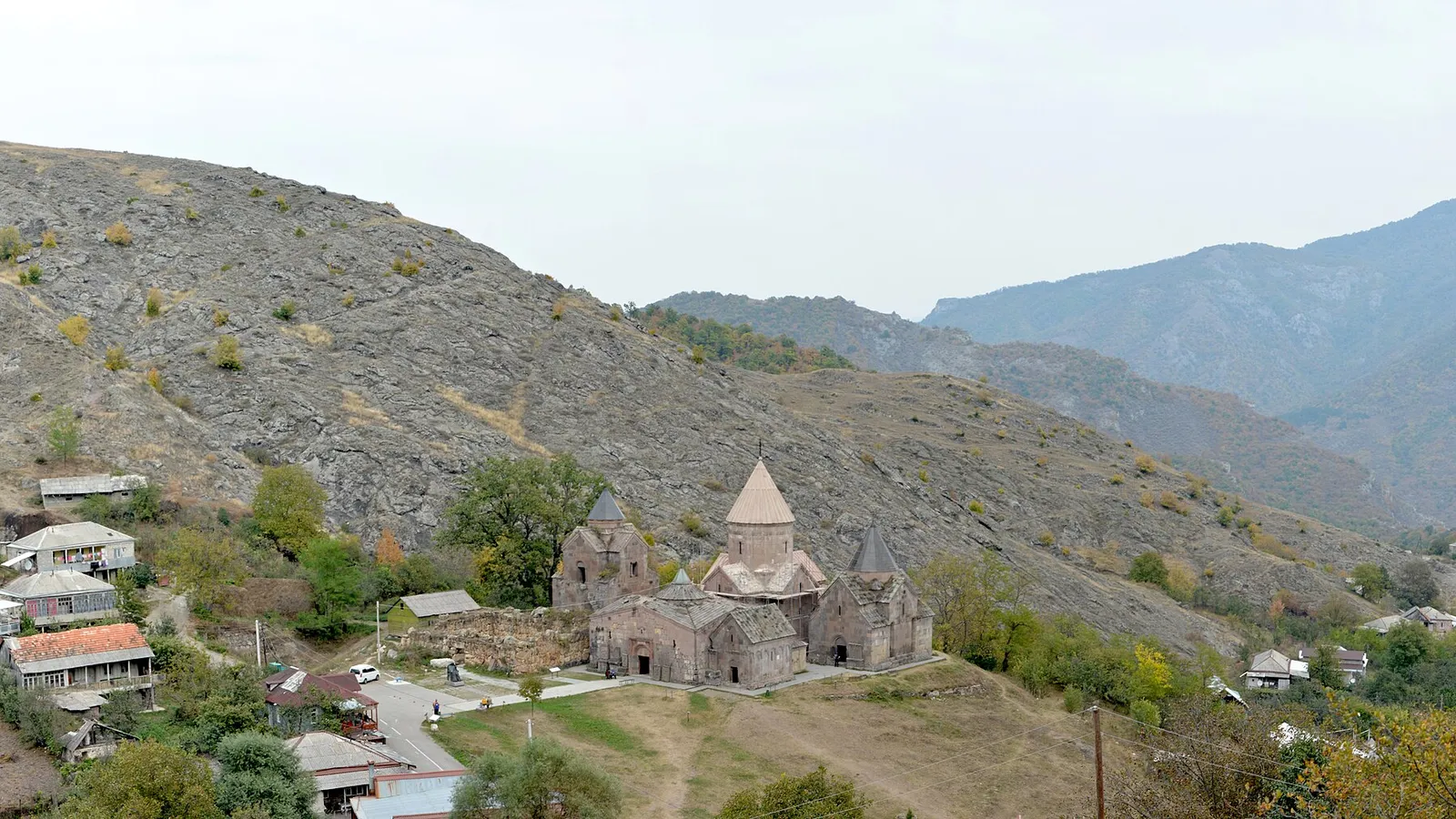
Goshavank Monastery & the Village of Gosh
Verified · August 29, 2026Visiting Goshavank: Mkhitar Gosh's law code that reached Poland, the 1291 embroidered khachkar, his statue and hillside tomb, and the drive from Dilijan.